



Part of our Wonder Series, where we follow curious questions through nature, history and the wonderfully untidy corners of language.
Picture a tower, a parliament, a murder and a flamboyance.
Are you imagining buildings, politicians, a crime and a dazzling costume?
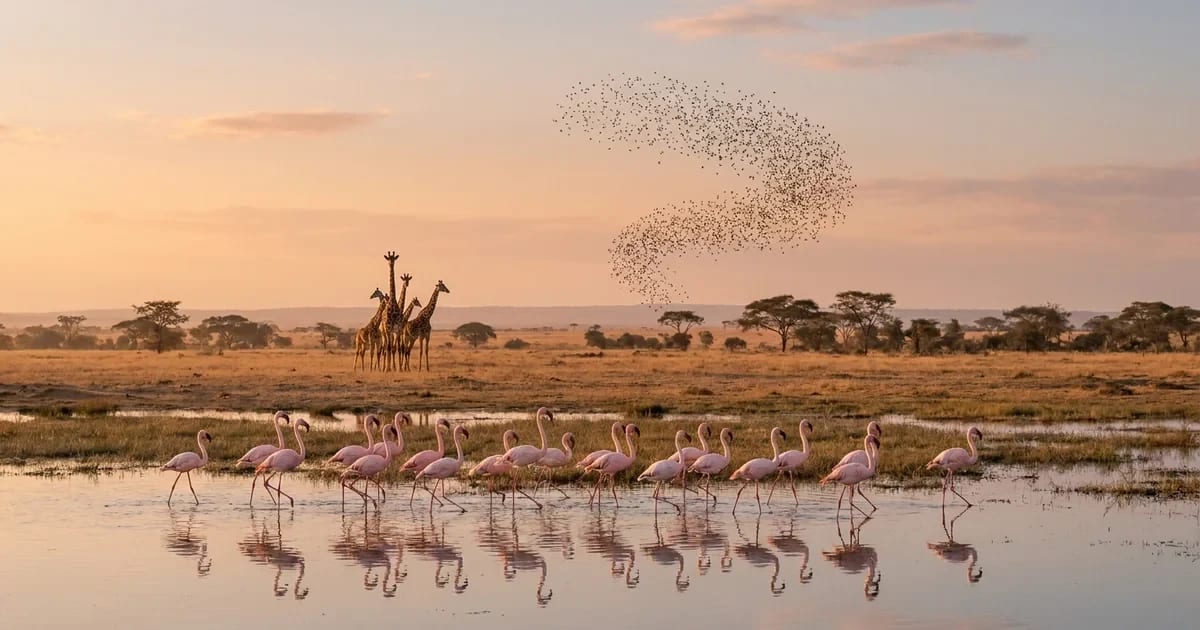
English can use every one of those words for animals: a tower of giraffes, a parliament of owls, a murder of crows and a flamboyance of flamingos.
Who decided that? And do the animals know?
They do not, of course. These names tell us at least as much about human imagination as they do about wildlife.
What Is a Collective Noun?
A collective noun names a collection as one thing. A team contains players. A choir contains singers. A forest contains trees. For animals, familiar examples include a flock, herd, school, colony and pack.
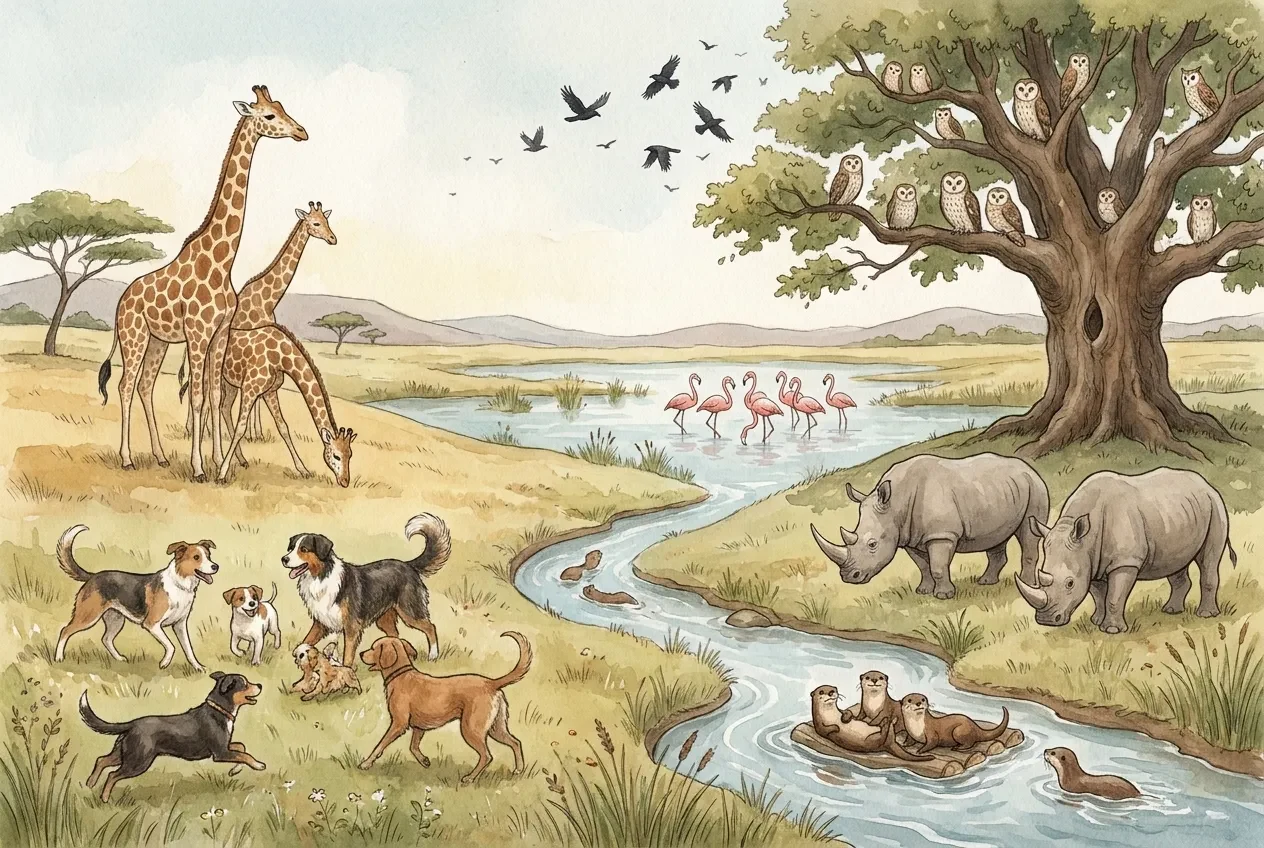
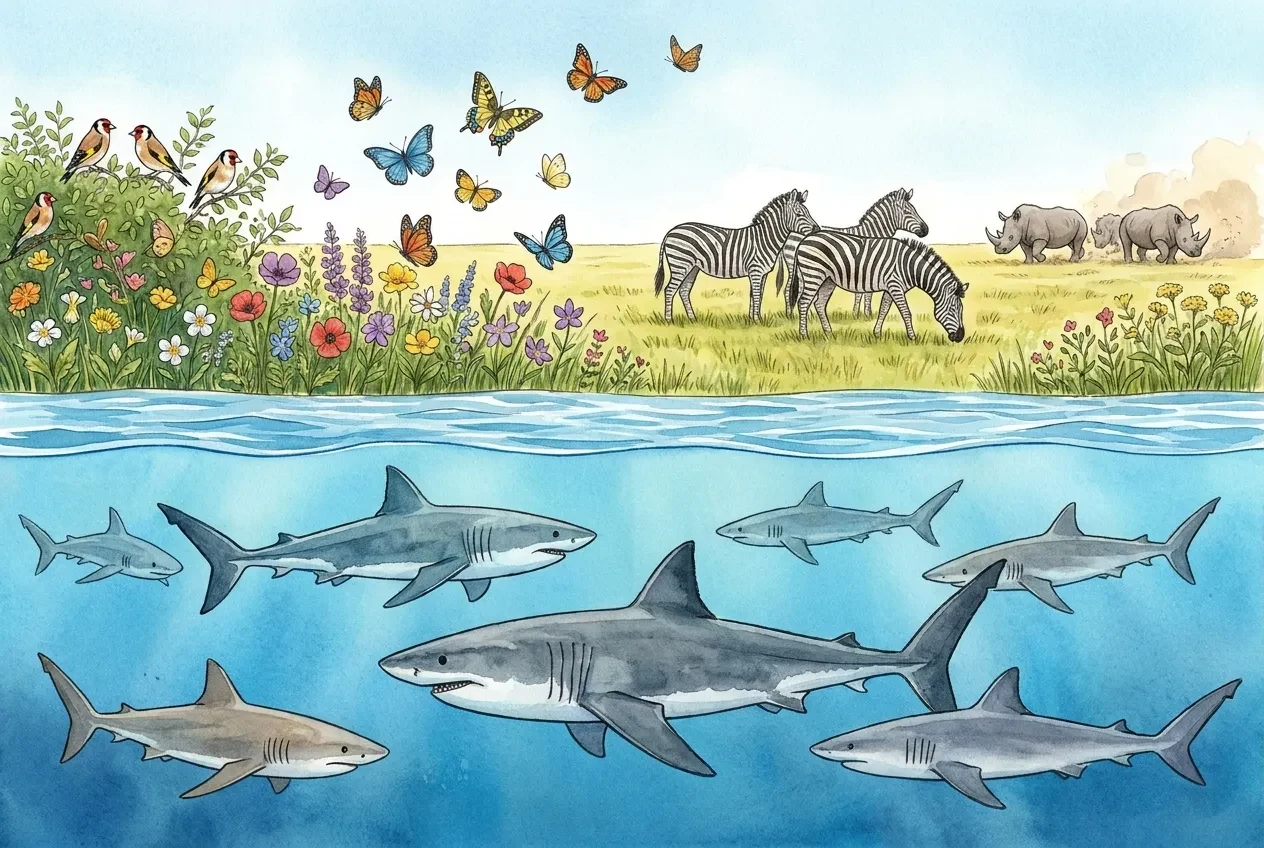
Some words describe how animals really live or move. Wolves cooperate in packs. Fish swim in schools. Ants build colonies. Other terms are more like miniature poems: a charm of goldfinches, a dazzle of zebras or a shiver of sharks.
There is no animal-language police officer waiting to arrest you for saying “a group of giraffes”. In scientific reports and ordinary conversation, simple terms are often clearer. Many of the fanciful names are rare, playful or used mainly in lists and quizzes.
That does not make them useless. Language can be both practical and delightful.
Why Does English Have So Many Animal Group Names?
Part of the answer lies in medieval hunting culture. Hunters developed specialised vocabulary for animals, their tracks and the chase. Knowing the correct terms could show that a person understood the customs of the hunt.
One famous early printed source is The Boke of Saint Albans, published in 1486. It includes material about hawking, hunting and heraldry, along with a list of “company terms”. Some names may preserve genuine usage. Others appear to be clever inventions, jokes or comments on the animals — and even on groups of people.
Linguist David Crystal notes that the list mixed traditional expressions with playful creations. Later writers added still more. That means we should be careful with the popular claim that every strange name has been used continuously since medieval times.

The habit continues because English speakers enjoy it. A good collective noun creates a picture in only two words. Tower notices a giraffe’s height. Crash imagines the unstoppable weight of rhinos. Murmuration seems to carry the soft sound of thousands of starlings turning in the sky.
A Wonderfully Weird Menagerie of Animal Group Names
Here is a generous quick-reference collection covering mammals, birds, insects, sea creatures, reptiles and amphibians. Some animals have several possible names, and different dictionaries may give different answers. The first term listed is not always the only or most scientific choice.
Mammals
- A shrewdness of apes
- A cete or colony of badgers
- A herd of antelopes
- A colony or cauldron of bats
- A sloth or sleuth of bears
- A colony or family of beavers
- A herd of bison
- A sounder of boars or wild pigs
- A caravan of camels
- A clowder of cats; a kindle of kittens
- A herd or drove of cattle
- A herd of deer
- A pack of dogs
- A pod of dolphins
- A drove of donkeys
- A herd of elephants
- A business of ferrets
- A skulk of foxes
- A tower or herd of giraffes; “journey” is also popularly used
- A herd or trip of goats
- A troop or band of gorillas
- An array of hedgehogs
- A bloat of hippopotamuses
- A herd or team of horses
- A cackle or clan of hyenas
- A mob of kangaroos
- A conspiracy of lemurs
- A leap of leopards
- A pride of lions
- A labour of moles
- A troop of monkeys
- A raft of otters in water, or a romp on land
- A prickle of porcupines
- A colony of rabbits; a warren is their network of burrows and can also refer to the rabbits living there
- A crash of rhinoceroses
- A colony or rookery of seals
- A flock of sheep
- A surfeit of skunks
- A scurry of squirrels; a dray is their nest
- An ambush or streak of tigers
- A pod of whales
- A pack of wolves
- A wisdom of wombats
- A herd or dazzle of zebras
Birds
- A sedge of bitterns
- A flock of chickens; a brood or clutch of chicks
- A murder of crows
- A flight or dule of doves
- A flock of ducks; a raft or paddling may describe ducks on water
- A convocation of eagles
- A cast of falcons
- A flock or flamboyance of flamingos
- A gaggle of geese on the ground; a skein or wedge in flight
- A charm of goldfinches
- A kettle of hawks when circling together in rising air
- A siege or sedge of herons
- A charm of hummingbirds
- An exaltation of larks
- A mischief of magpies
- A parliament of owls
- A flock, company or pandemonium of parrots
- A covey of partridges
- A muster or ostentation of peacocks
- A covey of pheasants, or a bouquet when flushed
- A flock or kit of pigeons
- A colony of penguins; a tightly packed group may be called a huddle
- A covey or bevy of quail
- An unkindness of ravens
- A building or parliament of rooks
- A host of sparrows
- A murmuration of starlings, especially a great swirling flock
- A bevy of swans; a wedge may be used in flight
- A flock or rafter of turkeys
- A wake of vultures, especially when feeding
- A descension of woodpeckers in traditional lists
Insects and Other Invertebrates
- A colony or army of ants
- A cast of crabs
- A colony, hive or swarm of bees
- A kaleidoscope or swarm of butterflies
- An army of caterpillars
- A swarm of flies
- A cloud or horde of gnats
- A cloud of grasshoppers
- A bloom or smack of jellyfish
- A loveliness of ladybirds, in popular lists
- A risk of lobsters, in popular lists
- A swarm or plague of locusts
- A bed of oysters
- A bed or nest of scorpions
- A troupe of shrimp, in popular lists
- A walk, rout or escargatoire of snails in traditional lists
- A cluster or clutter of spiders
- A shoal of squid
- A colony of termites
Reptiles, Amphibians, Fish and Other Sea Animals
- A congregation of alligators
- A quiver of cobras
- A bask of crocodiles on land, or a float in water
- A swarm of eels
- A school or shoal of fish
- An army of frogs
- A lounge of lizards
- A knot of newts
- A pod or school of porpoises
- A congress of salamanders
- A run of salmon moving upstream
- A herd of seahorses
- A shiver of sharks
- A den, nest or bed of snakes
- A fever of stingrays
- A knot of toads
- A hover of trout
- A bale of turtles
- A nest of vipers
This is still not every name ever printed. There are hundreds of regional, historical and invented alternatives. A list that claims to contain the single “official” term for every animal is promising something language cannot neatly provide.
Expanded Animal Group Names
The quick-reference list is useful when you need one word. These expanded answers explore the most searched and most wonderfully memorable names in a little more depth.
What Is a Group of Crows Called?
A group of crows is famously called a murder of crows, although “flock” is perfectly correct in ordinary wildlife writing. “Murder” appears in lists of animal group terms from the late Middle Ages, but the original writer did not explain the choice. Later stories connected it with the birds’ dark feathers, loud calls or old associations with death. Those are possible interpretations, not a proven origin.
What Is a Group of Flamingos Called?
A group of flamingos can simply be called a flock, but the best-known colourful term is a flamboyance of flamingos. The name suits a gathering of vivid birds with long curved necks, bright feathers and synchronised displays.
The companion article Why Are Flamingos Pink? explains how pigments called carotenoids travel through a flamingo’s food and into its feathers. The colour is biological; the flamboyance is linguistic.
What Is a Group of Giraffes Called?
A group of giraffes is commonly described as a herd or a tower of giraffes. “Tower” is easy to remember because several standing giraffes can resemble a moving skyline of necks.
You may also encounter journey in popular lists, especially for giraffes travelling together. These alternatives show why context matters: a wildlife researcher may naturally write “herd”, while a storyteller may be delighted by “tower”.
What Is a Group of Lions Called?
A group of lions is called a pride. Unlike many fanciful collective nouns, this word describes a genuine social unit: lions are unusual among cats because they often live together. Encyclopaedia Britannica describes a pride as several generations of lionesses, a smaller number of breeding males and their cubs, although its membership can change. “A group of lions” is still correct, but “pride” is the familiar everyday term.
What Is a Group of Owls Called?
A group of owls is famously called a parliament of owls. The name fits the old association between owls and wisdom, although confident stories about one exact origin are difficult to prove.
There is another complication: many owl species are usually solitary outside breeding situations. You are more likely to meet one owl than a whole parliament. The term is well known even though the sight it describes is uncommon.
What Is a Group of Penguins Called?
A group of penguins is usually called a colony. A tightly packed gathering may be called a huddle, especially when birds press together in harsh weather. You may also see raft used for penguins floating together on the water. The best word therefore depends on what the penguins are doing and where they are gathered.
What Is a Group of Monkeys Called?
A group of monkeys is most often called a troop of monkeys. “Troop” is a practical term used for social groups that travel, feed or rest together. Because “monkey” covers many different species, group structures vary enormously. Some monkeys form large, complex communities; others live in much smaller groups. “Tribe”, “cartload” and “barrel” occur in playful lists, but “troop” is the clearest general answer.
What Is a Group of Dolphins Called?
A group of dolphins is usually called a pod of dolphins. “School” and “herd” also appear in dictionaries, but “pod” is the term most readers will recognise. Whale and Dolphin Conservation explains that dolphins in pods swim together, hunt cooperatively and protect one another. The size and stability of a pod vary between species and places.
What Is a Group of Sharks Called?
A group of sharks is popularly called a shiver of sharks. You may also encounter “school” or “shoal”, especially when several sharks are swimming together. Many shark species spend much of their lives alone, so a shiver is not a permanent social unit in the way a lion pride can be. It is a memorable English label rather than a scientific classification.
What Is a Group of Elephants Called?
A group of elephants is called a herd. Encyclopaedia Britannica explains that females remain with their family herd while males usually leave their original herd as they mature, living alone or in smaller male groups. “Parade of elephants” appears in playful lists, but “herd” is the ordinary and biologically useful term.
What Is a Group of Dogs Called?
A group of dogs can be called a pack, especially when the animals live, hunt or move together as a social group. “Pack” is different from many fanciful list words because it can describe a real pattern of canine social life.
But pet dogs gathered at a park do not suddenly require a grand title. “A group of dogs” remains perfectly good English. A group of puppies born together is a litter, which describes shared birth rather than social behaviour.
What Is a Group of Bees Called?
A group of bees may be called a colony, hive or swarm, but these words do not mean exactly the same thing. A colony is the social community of bees. A hive is properly the structure in which managed bees live, although people also use it for the bees inside. The UK’s National Bee Unit explains that when a swarm leaves a colony, its natural urge is to find and establish a new home.
What Is a Group of Gorillas Called?
A group of gorillas is commonly called a troop or band of gorillas. The Dian Fossey Gorilla Fund explains that many gorilla groups contain one dominant adult male, several adult females and their young, although mountain gorilla groups can include several silverbacks. “Whoop” sometimes appears in entertaining lists, but troop and band are the clearest general terms.
What Is a Group of Zebras Called?
A group of zebras is ordinarily a herd, while dazzle of zebras is the colourful favourite. “Dazzle” makes us notice the shifting pattern made by many black-and-white coats together. It is tempting to claim that the stripes literally dazzle predators, but the collective noun itself is not evidence for a scientific explanation. It is a picture made from language.
What Is a Group of Jellyfish Called?
A group of jellyfish is often called a bloom of jellyfish or, more playfully, a smack. “Bloom” is especially useful when jellyfish numbers increase greatly in one place. Jellyfish are not fish and do not form coordinated schools in the way many fish do. The Natural History Museum notes that jellyfish often drift and are not strong swimmers, which helps explain why currents and storms can gather them in large numbers.
What Is a Group of Hedgehogs Called?
A group of hedgehogs is popularly called an array of hedgehogs. In real life, however, hedgehogs are mostly solitary animals, so an array is not a common natural social group. The British Hedgehog Preservation Society explains that hedgehogs generally avoid one another outside mating season and that the young are called hoglets. This is another lovely term that is more common in word lists than in wildlife reports.
Wonderfully Weird Favourites
If you only remember ten, make them these:
- A flamboyance of flamingos
- A tower of giraffes
- A parliament of owls
- A murder of crows
- A charm of goldfinches
- A crash of rhinos
- A shiver of sharks
- A prickle of porcupines
- A kaleidoscope of butterflies
- A murmuration of starlings
Notice how the strongest ones make you see, hear or feel something. That is why they stick.
Down the Rabbit Hole: Can You Invent One?
People have been playing with group names for centuries, so perhaps the next delightful phrase has not been made yet.
Imagine a group of slow snails crossing a path. Would you call it a patience of snails? What about a whisper of moths around a lamp, a pocketful of ladybirds or a question of curious children?
An invented term is not automatically a dictionary fact. Label it as your own creation. Language play is most fun when we are honest about the playing.
Try It Yourself: Build an Animal-Name Menagerie
- Choose six animals.
- Find one recorded collective noun for each in a dictionary or trusted wildlife source.
- Draw every group on separate cards.
- On the back, write whether the term seems practical, descriptive, historical or playful.
- Mix the cards and challenge someone to match the animals and names.
- Invent one new collective noun and explain the picture behind it.
The Big Takeaway
Animal collective nouns are tiny containers of history and imagination. Some grew from real observation. Some belonged to hunting traditions. Some were jokes, and others were added much later because people could not resist making language sparkle.
You can call giraffes a herd or a tower. You can call flamingos a flock or a flamboyance. The ordinary word tells us what is there; the colourful word changes how we picture it.
Perhaps that is why these names have so much life. They remind us that words do more than label the world. Sometimes they help us look again.
Sources and Further Reading
- Encyclopaedia Britannica — Animal Group Names
- Macquarie Dictionary — Collective Nouns for Animals
- Project Gutenberg — The Boke of Saint Albans
- David Crystal — A Naming of Nouns
- Princeton Writes — A Murder of Crows and Other Terms of Venery
- Merriam-Webster — Collective Nouns and Terms of Venery
- Whale and Dolphin Conservation — What Is a Group of Dolphins Called?
Take the whole list outdoors with Anna Comstock & Nature Journaling, or follow flamingos into the sky with Do Flamingos Fly?. A future owl article can return here through its parliament — one more path through the Wonder Series.