Discover how light, objects, eyes and the brain work together to create the colours we see.
£6.99
Digital download · a printable Parent Guide and Wonder Companion Journal for your child
 Digital download
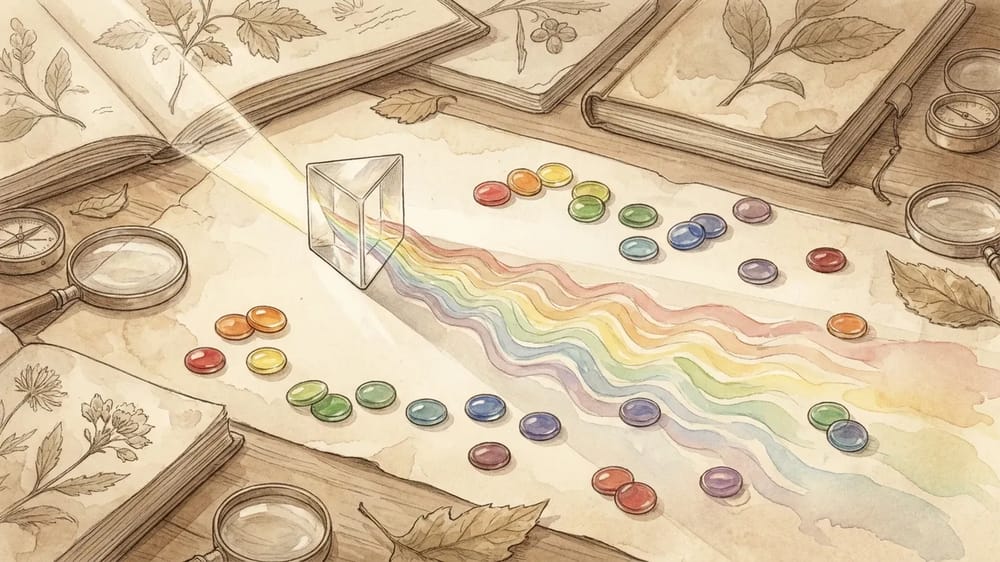
A rainbow, an apple or a bright flower can open a question about something we see every day. Light travels in waves, objects absorb and reflect it, and our eyes and brain help turn those signals into an experience of colour.
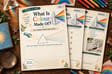
This printable Wonder Lesson invites children to explore the visible spectrum, compare mixing paint with mixing light and try a disappearing-rainbow investigation. The Parent Guide and Wonder Companion Journal connect clear explanations with predictions, drawing, sequencing and new questions about vision.
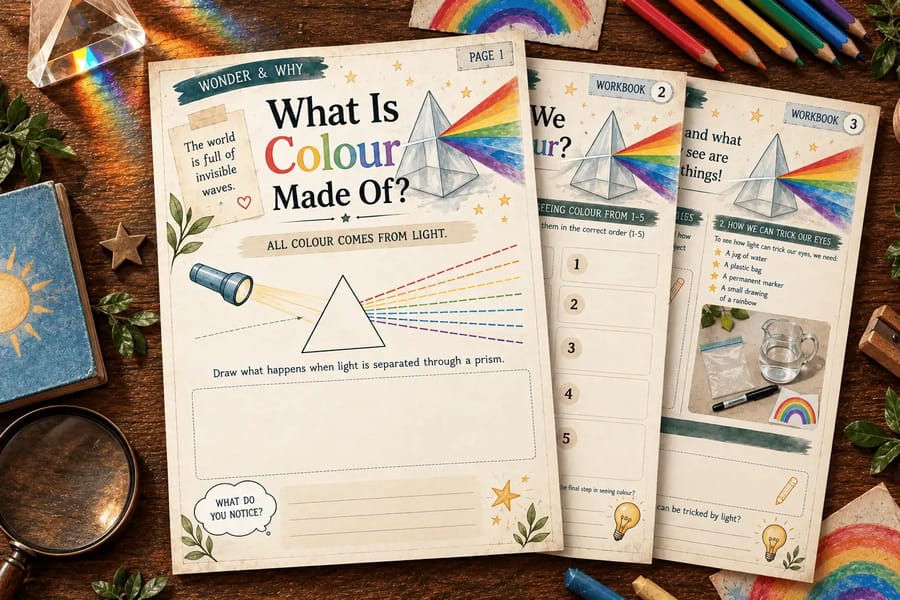
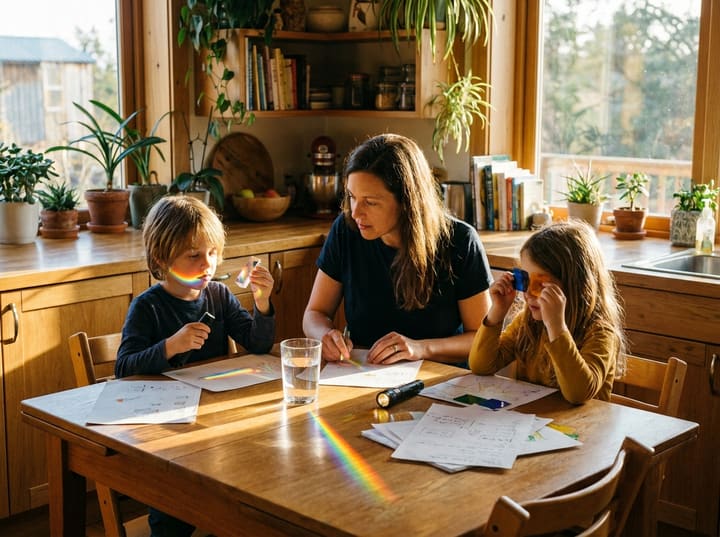
Make predictions, change your viewpoint and compare what each person notices. The Parent Guide helps explain the light-to-brain journey while the journal provides places to draw, order ideas and record an observation.
You do not need to memorise every science term before beginning. Start with one colour or the water investigation and follow the questions it raises, with adult help for glass, water, scissors and permanent markers.
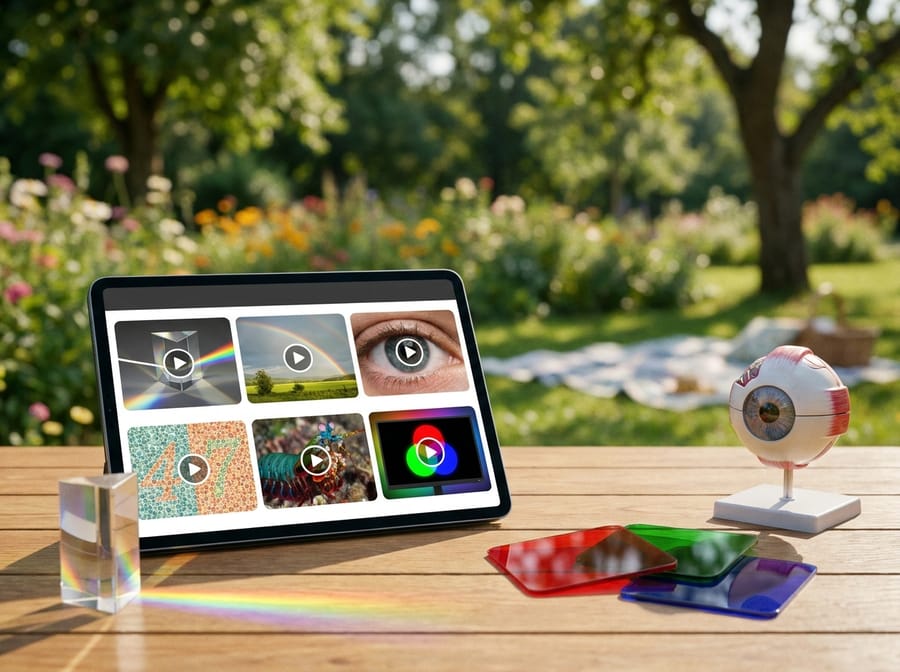
The free companion resources include three videos showing how light combines and how we see colour, a Colours Colours Everywhere read-aloud and information about The Stories and Secrets of Colours. Explore eye science, the retina and a blind-spot activity, then revisit light and waves with the quiz.
Follow the rabbit holes into bees, mirrors, screens, colour-vision differences and the mantis shrimp. The retina activity and quiz are best explored with older children or an adult; choose the resources that suit your family’s curiosity.
Can’t find what you’re looking for? We’re always happy to help.
There is no fixed age recommendation. Choose the drawing, observation and science questions that suit your child, helping with reading, writing and abstract vocabulary where useful. Some companion resources are better for older children or shared exploration.
Two printable PDFs: a four-page Parent Guide and a four-page Wonder Companion Journal, eight pages in total. This is a digital download, not a physical book or science kit.
Printing provides the journal’s drawing, sequencing and reflection spaces. You can read the guide on a screen and use your own paper or notebook for responses if you prefer.
There is no fixed completion time. Explore one demonstration, drawing or question at a time, or return over several days. You do not need to complete every extension.
For the water investigation, use a glass jug, water, paper, coloured pencils, a plastic food bag, scissors and a permanent marker, with adult supervision. A prism can support further exploration but is not essential to begin with the explanations, drawings and videos. Never look directly at the sun or shine bright lights into eyes.
Yes. The videos, articles, quiz and further prompts are free to access with or without purchasing the printable lesson. Some linked books are separate purchases; the Parent Guide and Wonder Companion Journal are the paid download.
No. Colour vision varies between people and between species. Compare observations without treating one person’s experience as wrong; the lesson invites questions about how eyes and brains respond to light, not a diagnosis of anyone’s vision.
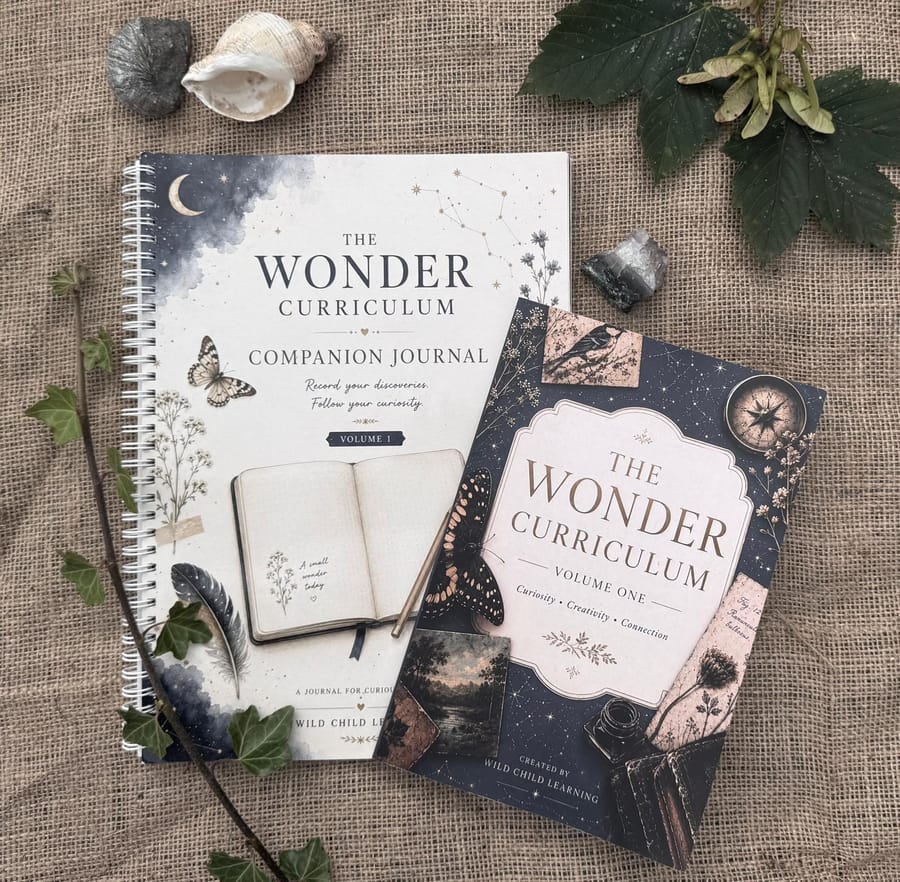
What Is Colour Made Of? is one of the wonder-led adventures in The Wonder Curriculum Volume One. The complete family set travels through science, nature, history, art and the wider world, with every adventure designed to be used in any order.
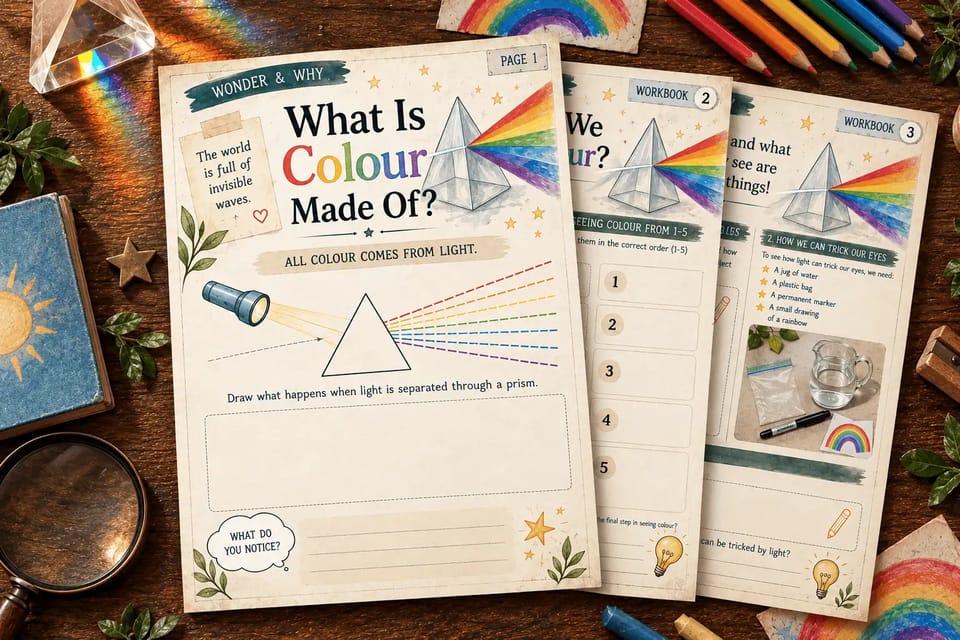
Download the Parent Guide and Wonder Companion Journal and explore light, colour and the questions our eyes can open together.
£6.99
Digital download · a printable Parent Guide and Wonder Companion Journal for your child