



If you home educate, you've almost certainly heard at least one of these already — from a well-meaning relative at a gathering, a stranger in a supermarket queue, or a friend who means no harm but asks "so what about socialisation?" within about ninety seconds of finding out. I've had the supermarket version more times than I can count, usually somewhere between the tinned tomatoes and the till.
This isn't a dig at the people who ask. Most of them genuinely don't know, and school is simply the only model most of us grew up with — of course it's the default mental picture. But myths, repeated often enough, start to feel like facts, and they can quietly talk hesitant families out of a choice that might have suited their child beautifully. So let's take the biggest ones apart properly, one at a time, with sources — and then let's talk honestly about the parts that genuinely are hard, because pretending home education is flawless helps nobody either.
Myth 1: "Homeschooled kids don't get socialised"
This is the big one — the question every home-educating parent hears first, and hears most.
The reality is almost the opposite of the myth. Home-educated children typically spend their days around a much wider age range than a same-year classroom allows: siblings, home-ed groups, co-ops, sports clubs, library sessions, volunteering, part-time work as they get older. A peer-reviewed rebuttal published in The Clearing House journal (Romanowski, 2006) examined the "homeschooling produces social misfits" claim directly and found no solid evidence to support it, noting instead that home-educated children's social experiences are simply different from a school setting, not deficient.
What socialisation actually looks like day to day tends to be less about a fixed timetable and more about variety: a Tuesday nature group, a Thursday swimming lesson alongside children two years older and two years younger, a Saturday co-op where a parent who's good at art runs a session for six families' worth of kids at once. It rarely resembles "sitting alone at home" — if anything, most home-educating parents will tell you the logistics of fitting everything in is the actual challenge, not finding anyone to see.

Myth 2: "You need to be a qualified teacher"
You don't — and this one has a very short, very clear legal answer. Section 7 of the Education Act 1996 requires that a child receives an education that is efficient, full-time and suitable to their age, ability and aptitude, "either by regular attendance at school or otherwise." That "or otherwise" is doing all the work — nowhere does UK law require a teaching qualification, a degree, or any formal training from the parent providing that education.
In practice, most home-educating parents aren't teaching every subject as an expert from day one — they're learning alongside their child, finding resources, outsourcing the subjects that stretch beyond them (tutors, online courses, co-ops), and trusting that curiosity and attention matter more than a PGCE. You already taught this child to walk, talk and ask questions long before any of this began.
Myth 3: "It's illegal, or you need special permission"
Home education is completely legal throughout the UK, and has been for a very long time — it predates compulsory schooling itself. In England, Wales and Northern Ireland, if your child has never been enrolled at school, you don't need anyone's permission to begin; if they're currently enrolled, one written notification to the head teacher is generally all that's needed. Scotland is the one exception worth knowing: if your child already attends a state school there, you typically need the local council's consent to withdraw them, under Section 35 of the Education (Scotland) Act 1980.
Gov.uk confirms directly that parents can teach their child at home, and that the council's role is limited to informal enquiries about the education being provided, not approval of the decision to home educate in the first place.
Myth 4: "It's only for rich families — you need lots of space and money"
Home education can cost almost nothing, or several thousand pounds a year — the myth assumes only the expensive end exists. Libraries are free. Many excellent curricula (the UK-developed Mathematics Enhancement Programme, for instance) are free to download. Museums, nature walks, and second-hand books from charity shops cost little to nothing, and much of what a young child needs to learn well doesn't require a dedicated "school room" at all — a kitchen table and a garden or local park do a great deal of the work. In truth, for me to stay home with our children it meant we only had one income and I relied heavily on the library, free apps and charity shop bargains! It can be done and done well without a lot of money.
It's honest to say cost can scale up significantly — online schools, tutors and complete boxed curricula can run into thousands of pounds a year, and if one parent steps back from paid work to home educate, that's a real financial impact worth planning for (more on this in the disadvantages section below). But "only for the wealthy" simply isn't accurate; families across a very wide range of budgets home educate successfully every year.

Myth 5: "Home-educated children can't get into university"
They can, and do. [Oxford University's own admissions guidance states plainly](https://uni-of-oxford.custhelp.com/app/answers/detail/a_id/546/~/does-oxford-accept-home-schooled-applicants?) that it "welcomes applications from students from any background, including those who have been home educated," and Cambridge colleges publish similar guidance for home-educated applicants. The UCAS application process itself is the same one every student uses — home-educated applicants simply need a referee who isn't a family member (a tutor, employer, or another suitable adult) to provide the academic reference a school would normally supply.
Most home-educated students sit GCSEs, iGCSEs and A-levels as private candidates at approved exam centres, exactly as any independent-study student would, and those qualifications are treated identically by universities regardless of where the studying happened. The application can take a little more planning — registering for exams, finding a referee — but "can't get in" simply doesn't reflect how UK admissions actually work.
Myth 6: "You get paid, or the government funds it"
No — this one is a straightforward no, and it's worth being clear about because it comes up often enough to cause real confusion. Gov.uk is explicit that home education is entirely self-funded; there is no government payment, grant or allowance for choosing to educate your own child at home in the UK. Some local authorities offer light, non-financial support — library access, occasionally resource lists — but nothing resembling a salary or subsidy exists. Families cover the whole cost themselves, whatever level they choose to spend at.
Myth 7: "Homeschooled kids are weird, or overly sheltered"
This myth tends to travel alongside the socialisation one, and it deserves a gentler answer than "that's not true," because it usually comes from genuine unfamiliarity rather than malice.
Home-educated children often are different from their schooled peers in one specific way: they spend more of their week talking to adults and children of varied ages, rather than almost exclusively with thirty children born in the same twelve months. That difference sometimes shows up as more confidence with adults, more comfort with unstructured time, or simply less exposure to certain school-specific social trends — and it can read as "different" to someone meeting a home-educated child for the first time. Different is not the same as sheltered or deficient, and Romanowski's research (cited above) found the "social misfit" framing doesn't hold up to scrutiny.
Just think back to your school days, were there shy children, odd children? Is every adult who went through public school bubbly and vivacious? Of course not! So, in truth, some home educated children will be shy or even ‘odd’ by some standards. But that isn’t due to home education. We are all unique and that’s the joy of being human. We celebrate our differences in home education!
Myth 8: "You need the patience of a saint"
You need patience, certainly — parenting does too, whether or not school is involved. But this myth imagines an eight-hour school day recreated at home, hour after hour of formal instruction, and that's rarely how it actually works. Because learning at home is one-to-one, it tends to be far more efficient than classroom teaching: what takes a class of thirty children a full morning to cover, one child with focused attention can often get through in twenty minutes.
Most home-educating families report two to four hours of genuinely focused activity as plenty for a school-age child, woven around reading, conversation, outdoor time and ordinary life. The patience required is real, but it's closer to the patience any parent needs across a normal day than some superhuman, saintly reserve.
Myth 9: "It's just school at the kitchen table, from 9 to 3"
Some families do choose a structured, timetabled approach — and that's a completely valid choice. But "homeschooling" doesn't legally or practically require recreating a school day in miniature, and for most families it looks nothing like it. Mornings might start with a story rather than a bell. A walk might replace a maths lesson because a genuinely good question came up outside. Learning happens through the whole day, not in six fixed 50-minute blocks.
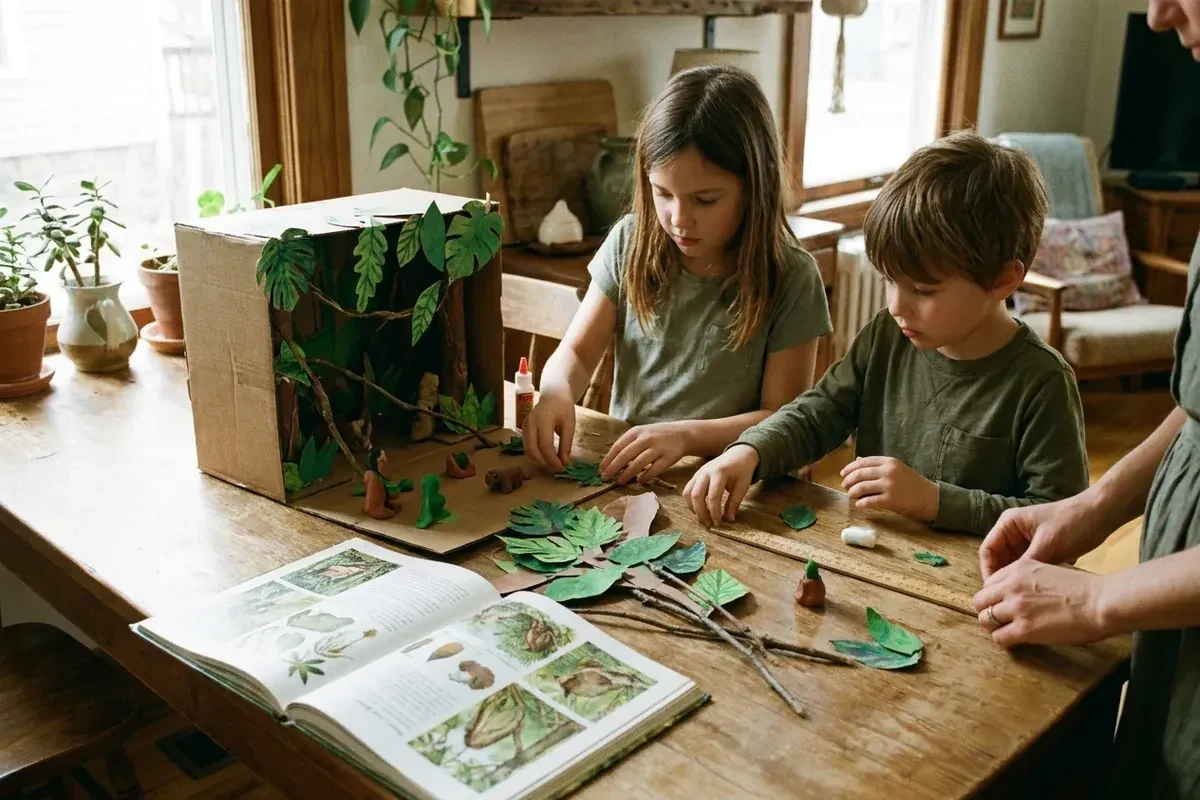
One of ours once spent an entire "school morning" building an elaborate cardboard rainforest diorama after reading a book— no workbook was opened, but there was measuring, planning, reading about different layers of the canopy, and more sustained focus than a formal lesson would likely have produced that day. That's not an unusual home-ed morning; it's a fairly typical one.
Myth 10: "Home-educated children fall behind"
This is the myth that deserves the most care, because it touches a real and reasonable parental worry, and the honest answer sits in the middle rather than at either extreme.
Good UK-specific comparative data genuinely is limited — home education here is diverse, not centrally tracked in a way that allows clean national comparisons, and families choose wildly different approaches. International research, including studies referenced by Romanowski (2006), has generally found home-educated students performing at or above average on standardised measures — but these findings are correlational. They tell us that home education, done attentively, tends to go reasonably well; they don't prove that home education itself causes better outcomes, since families able to home educate in the first place aren't a random sample of the population.
The most honest version of this answer: there's no strong evidence that home-educated children systematically fall behind, but "falling behind" is also the wrong frame entirely — without a class average to measure against, most children progress along a genuinely individual pace, sometimes faster, sometimes slower, and that's not a flaw in the system, it's the whole point of it.
How to answer these myths gently, in the moment
You don't need a rehearsed speech for the supermarket queue, but a few habits help:
- Assume good faith first. Almost everyone asking has simply never seen an alternative to school — a gentle, non-defensive answer usually lands better than a corrective one.
- Answer the real worry, not just the words. "What about socialisation?" is often really asking "will my child be okay?" — answering that underneath question tends to satisfy people faster than reciting statistics.
- Keep one or two facts ready, not ten. A single clear point (Oxford's own admissions page welcomes home-educated applicants, say) lands better than an overwhelming list.
- It's fine to simply not engage sometimes. Not every comment needs a full answer. "It's working well for us and we love it." is a complete, perfectly good response.
- Save the deeper conversations for people who genuinely want one. Most casual questions aren't invitations to a debate — save the detail for a friend or relative who's actually curious, not just making conversation.
The real disadvantages (because pretending there aren't any helps nobody)
A myth-busting article that claims home education has no downsides isn't trustworthy — it's just a different kind of exaggeration. So here, honestly, are the challenges that aren't myths at all.
There's no external check on progress. Without termly reports or a class average, you're the only person tracking whether your child is genuinely moving forward — and some weeks that judgement feels shaky, especially early on.
It can have a real financial impact. If one parent steps back from paid work, or a family invests in tutors, online courses or a complete curriculum, the cost is genuine and worth planning for honestly rather than glossing over.
Socialising takes deliberate effort — it doesn't happen automatically just because you decided to home educate. Groups, clubs and co-ops need to be found and joined; friendships don't arrive on a school register the way they might in a classroom. Families who don't put in that effort can genuinely end up more isolated, which is exactly what the socialisation myth gets partly right, even while overstating how common it is.
Comparison is relentless, and hard to switch off. Every "my child is reading chapter books at five" post online chips away at confidence, even when you know, rationally, that comparison is meaningless.
A later return to school can be genuinely bumpier. If a child does return to mainstream education after several home-educated years, they may be behind their new classmates in the specific things schools measure — not because they've learned less, but because they've learned differently. Worth weighing honestly if a return feels likely.
None of these are reasons not to home educate. They're simply the parts of the honest picture that "just myths" articles tend to leave out.
Frequently asked questions
What is the hardest age to homeschool?
There's no single answer — many parents find early adolescence (roughly 11–14) trickiest, as children want more independence just as subjects get more complex. Others find the years juggling a toddler alongside a school-age child harder. It varies enormously.
Do home-educated children do better or worse than schooled children?
UK-specific comparative data is limited. International research generally finds home-educated students performing well on standardised measures, but these studies are correlational, not proof that home education itself causes the result.
What are common homeschool stereotypes?
That home-educated children are unsocialised, "weird" or sheltered, that families must be wealthy or religious, and that parents need teaching qualifications. None of these are legal requirements, and evidence pushes back against most of them.
Is home education monitored in the UK?
Not routinely. Local authorities have no statutory duty to monitor home education as a matter of course, though they may make informal enquiries if they have reason for concern.
Do you need to be a qualified teacher to home educate in the UK?
No. Section 7 of the Education Act 1996 allows education "at school or otherwise" with no teaching qualification required.
Where The Wonder Curriculum fits
We should say this plainly, as always: we make home education resources, so of course we'd love families reading this to consider ours. But this article isn't really about that — it's about making sure the decision to home educate (or not) gets made on accurate information, not on myths that happened to travel further than the facts.
If you're weighing this decision and want to see what learning without the myths actually looks like day to day, our guide to choosing a home education curriculum and our complete guide to getting started walk through the real, practical detail — the law, the costs, the first weeks — without any of the noise above.
Come and wonder with us.
Sources and further reading
- Education Act 1996, section 7 — legislation.gov.uk
- Educating your child at home — gov.uk
- Romanowski, M. H. (2006). "Revisiting the Common Myths about Homeschooling." The Clearing House: A Journal of Educational Strategies, Issues and Ideas, 79(3), 125–129.
- [Does Oxford accept home-educated applicants? — University of Oxford](https://uni-of-oxford.custhelp.com/app/answers/detail/a_id/546/~/does-oxford-accept-home-schooled-applicants?)
- Home education in England — House of Commons Library briefing
Teresa is a home-educating UK mama and part of the family behind The Wonder Curriculum. Legal details checked 28 August 2026 — this is general information, not legal advice, so always confirm the current position for your nation on gov.uk.