Before you look closely at the photographs, make a prediction. When a horse gallops, must one hoof always touch the ground?
Perhaps you picture the horse stretched out like a leap across a puddle. Perhaps you think its legs take turns supporting it. Draw your guess if you like; you can keep it beside you while we investigate.
The question sounds small. Answering it meant finding a way to hold still something that would not stop moving.
Who was Eadweard Muybridge?
Muybridge was a photographer born in Kingston upon Thames, England, in 1830. He worked in the United States, where his photographs included landscapes as well as the movement studies for which he became famous.
In 1872, Leland Stanford, a wealthy railway businessman and horse owner, asked him to investigate a horse's movement through photography. Stanford wanted to know whether all four feet could leave the ground together.
By 1878, Muybridge had made a successful sequence using twelve cameras, as the Smithsonian explains. This was not simply a matter of waiting for a horse to pass and pressing a button. He needed a system that could separate a very quick action into clear, inspectable moments.
That is the part of his work we are following here: a question, a difficult observation and an inventive way of gathering evidence.
How did several cameras catch one moving horse?
Imagine a row of cameras looking across a track. As the horse passes along it, the cameras take their pictures one after another. Each records a slightly later position.
The resulting photographs form a sequence: pictures arranged in an order. Instead of asking your eyes to follow every hoof at once, you can look at one picture, pause, and move to the next.
Muybridge's apparatus used shutters linked to electrical circuits, activated by wires the passing horse tripped. Cornell University Library's exhibition describes this arrangement. It also explains the importance of bright light and a white background in making a clear outline.
A shutter controls the camera's exposure to light. A very short exposure records only a tiny portion of the action, helping avoid a blurred picture of the moving animal. The challenge was letting in enough light while keeping that exposure brief.
Keep two ideas separate: how long each picture takes to record and when the next camera takes its picture. Both matter, but they are not the same thing.
Muybridge changed his equipment over the years. Twelve cameras belong to the Smithsonian's account of the 1878 work; they are not a rule for every later study he made.
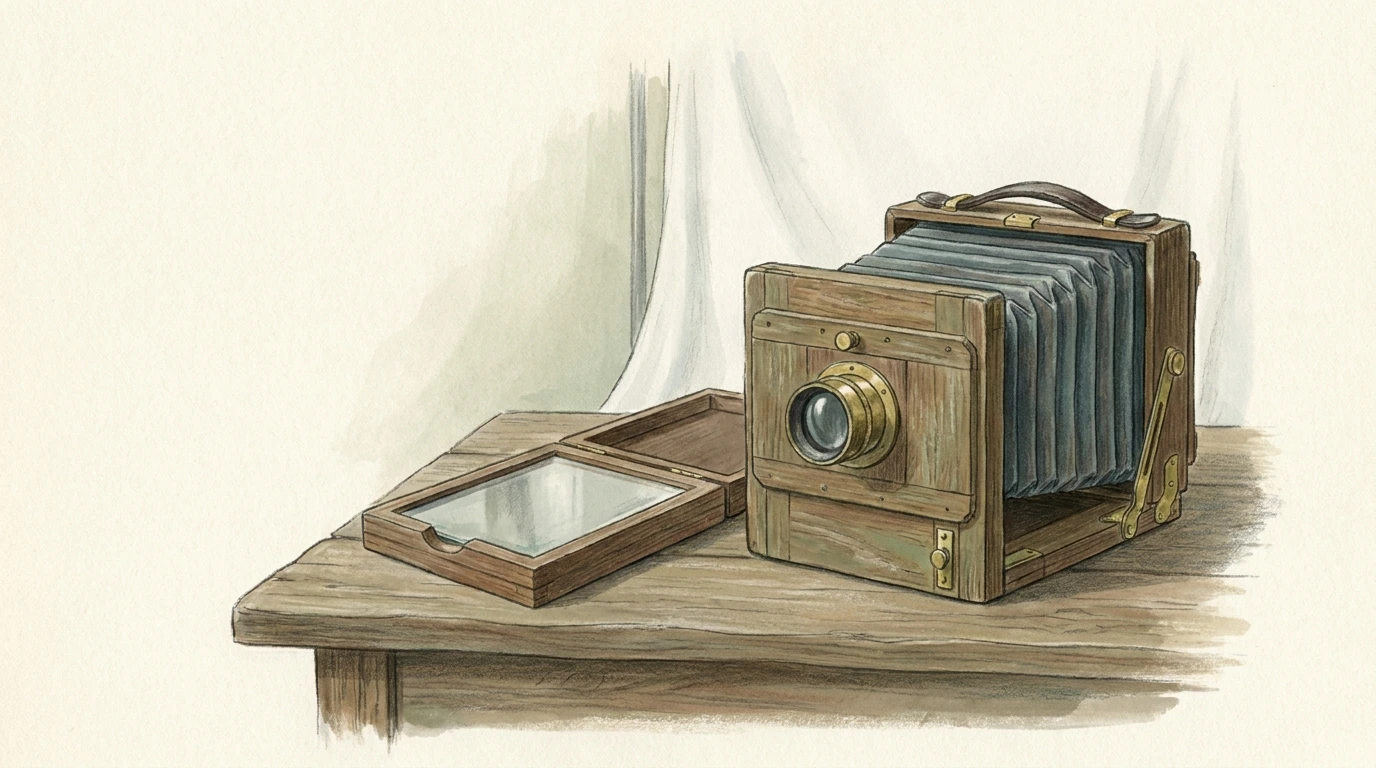
What did the horse photographs show?
They showed that a galloping horse could have all four hooves off the ground together. The surprising part was the position: its legs could be gathered beneath its body, rather than stretched far out in front and behind.
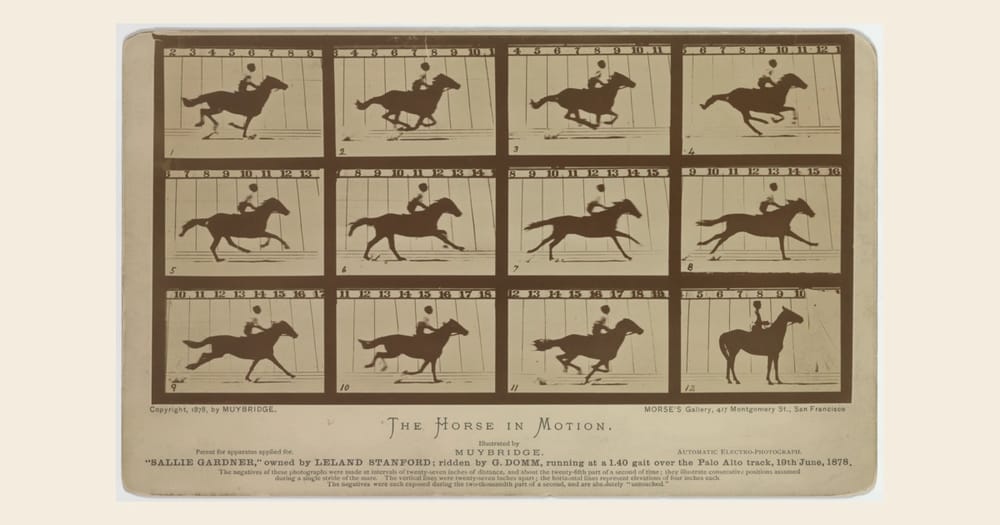
Now examine a real example. The Library of Congress holds this card, titled The Horse in Motion, identifying the horse as Sallie Gardner and the run as taking place at Palo Alto on 19 June 1878.
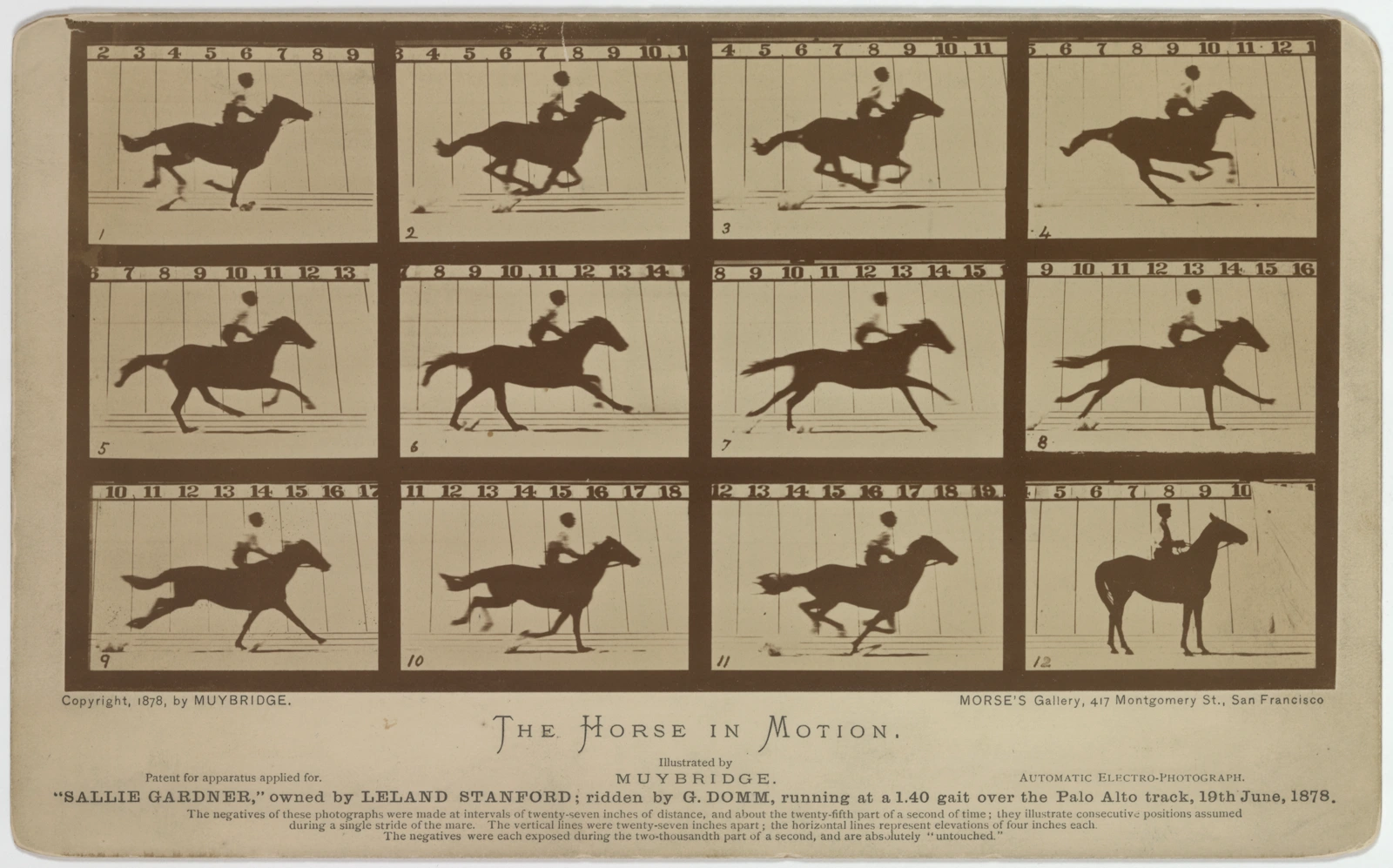
Start at the top left and follow the numbered pictures across each row. Look particularly at the third picture. Can you find the hooves gathered beneath the body and the space between them and the ground?
Compare it with a view where a leg reaches down. You are looking for a changing relationship between hooves and ground, not merely a horse whose body looks high in the frame.
Notice something else: the last panel shows the horse standing. Although the card has twelve panels, you should not treat every panel as the next instant of the same gallop. Looking carefully includes noticing what does not fit your first explanation.
Now return to your drawing. What would you change? Your first guess was not wasted. It gave you something specific to compare with the evidence.
Were these photographs already a movie?
A printed card does not move. It lets you inspect separate views. Showing pictures rapidly so that an audience sees movement is another task.
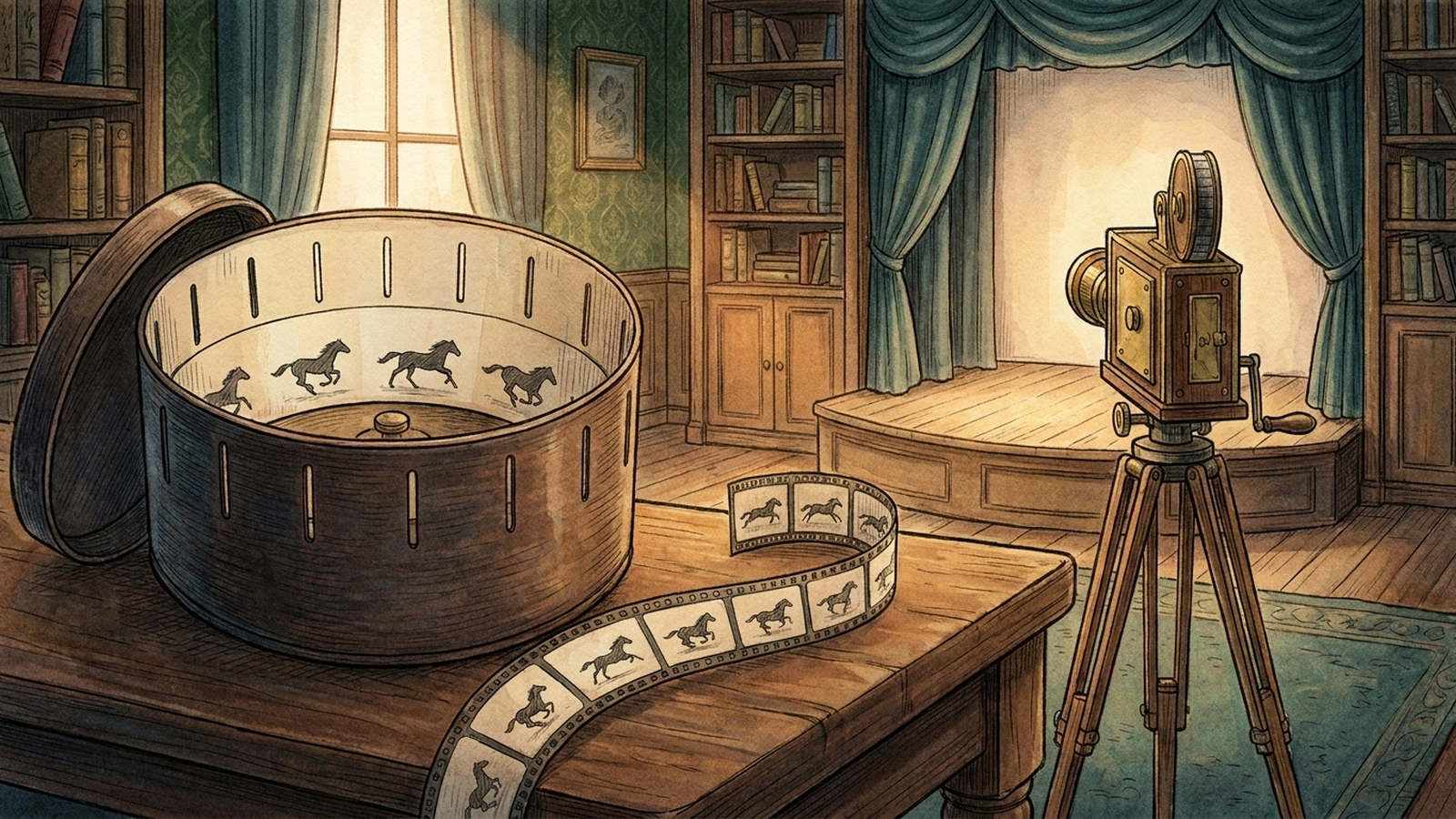
Muybridge explored that task too. In 1879, he devised the zoopraxiscope, an early moving-image projector. Kingston Museum's collection guide explains that images were arranged around a glass disc, which turned inside the projector.
Here is an important detail: those images were adapted from the photographs. Muybridge elongated and traced images to compensate for the way the projector displayed them; early discs used painted black silhouettes. He was not simply threading the original horse photographs through a modern film projector.
There are two linked achievements to notice: recording movement as separate photographs, then creating a moving display from a sequence of images. Neither requires us to call one card the world's first film.
If that makes you wonder how a spinning drum can also make separate pictures seem to move, follow the question into What Is a Zoetrope, and How Does It Make Pictures Move? The devices differ, but both invite you to think about pictures, order and viewing.
Wonderfully Surprising Facts
- A background could become a measuring tool. During later work at the University of Pennsylvania, white strings formed a grid behind the moving subject. The university archive explains that the grid helped measure movement. It was more than decoration.
- The horse question opened into a much larger investigation. Muybridge's later Animal Locomotion work, published in 1887, included many human actions and different animal species from Philadelphia Zoo. The horse study was not the end of his questions.
- The evidence includes things he collected, not only pictures he took. Kingston Museum holds Muybridge's scrapbook, containing newspaper cuttings, announcements and other material about his work. Such records help historians investigate how the photographs were shared and received.
Down the Rabbit Hole: Why do some drawn horses look different?
Try drawing a running horse without looking at one. How would you tell somebody, in a single still picture, that it was moving quickly?
One choice is to stretch the front legs forwards and the back legs backwards. It gives a strong impression of speed. But an impression is not the same as a record of exactly what happened at one instant.
Cornell's exhibition places a nineteenth-century illustration of this conventional stretched-out gallop beside material from Muybridge's motion studies. The comparison invites you to notice the difference between a familiar visual shorthand and a photographed position.
That does not mean every earlier artist drew horses in the same way, or that every later artist immediately changed. Nor does it make imagination a mistake. A picture can aim to express excitement rather than measure a stride.
The useful question is: what is this picture trying to show? If you want to investigate where the hooves actually go, a checked photographic sequence gives you different evidence from a drawing made from memory.
Look back at your sketch. Could you make two new drawings: one showing how fast the horse feels, and another carefully following one photographed pose? Both can be interesting, while doing different jobs.
Try It Yourself: Catch a toy's journey in moments
You do not need a horse or a row of old cameras to explore the idea. With a grown-up, use a toy car and a phone or tablet to compare what you notice live with what you can inspect afterwards.
This is a modern comparison, not a recreation of Muybridge's apparatus. Your device records video; his horse experiment used separate cameras.
- Choose a clear route. Use a broad, stable tabletop or a clear floor. Pick a large toy that rolls easily, and keep its path well away from edges.
- Add a reference. Put removable paper markers beside the path to indicate a start and finish. Check that the tape is suitable for the surface.
- Make a prediction. Choose something visible: when the front wheels reach the finish, where will the back wheels be? Draw your guess.
- Keep the camera still. A grown-up should secure it with a clear side view. Record while you gently roll the toy between the markers. Leave space for it to stop.
- Pause and compare. Watch normally, then pause at several points. If the player allows it, move through individual frames. Can you identify what crosses the marker first?
- Improve the observation. If the toy is blurred or hidden, try brighter daylight or a slower roll. Keep the route and viewpoint the same while you change one thing.
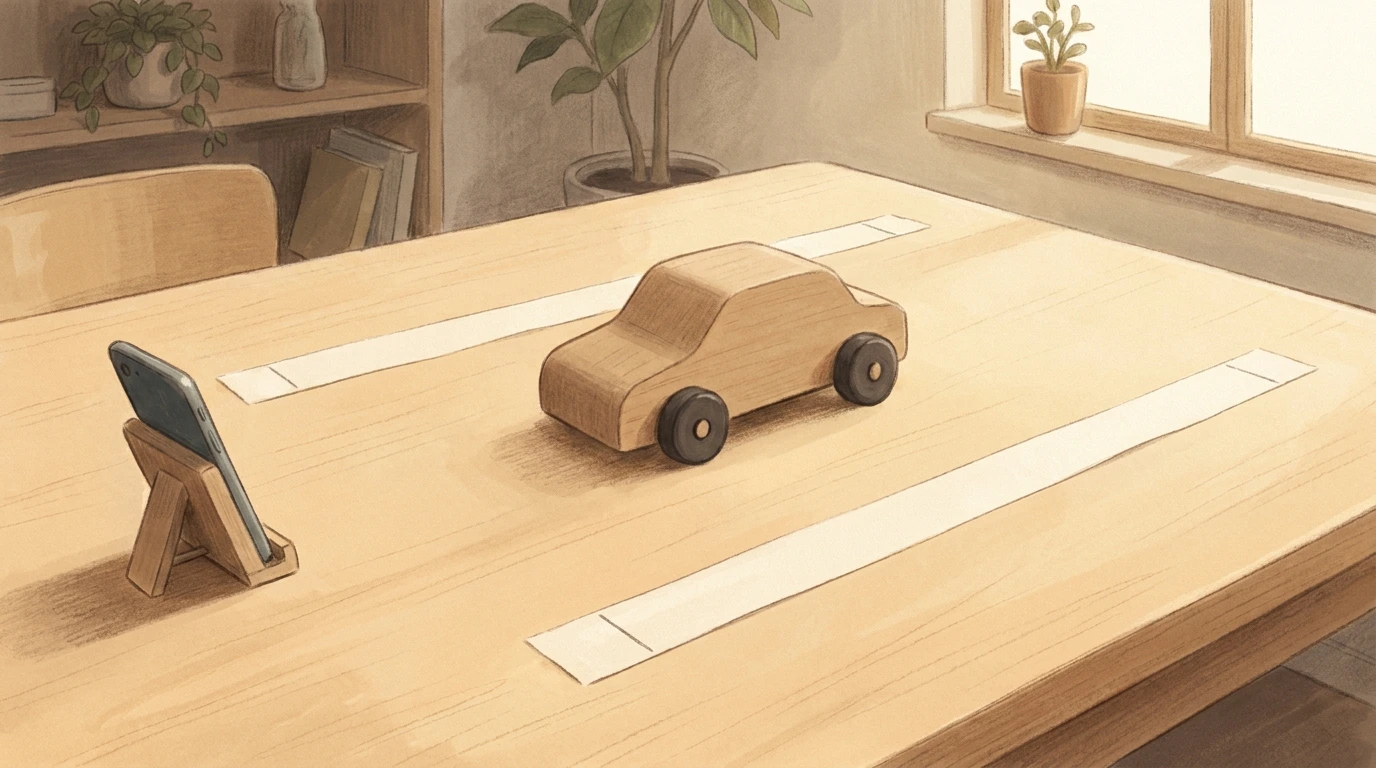
A paused video shows recorded moments, not every possible instant between them. If you cannot find the exact position you hoped to see, that does not prove it never happened. Describe what your pictures actually let you observe.
No recording device? Move the toy by hand, stop it in several positions and sketch each one. You are choosing the stops yourself, so this explores a sequence rather than capturing freely rolling movement.
The Big Takeaway
Muybridge's horse photographs turned a fleeting movement into something people could stop and examine. They made an everyday-looking question answerable in a new way.
Your drawing and your toy experiment begin with the same useful habit: make a guess, find a way to look closely, then let the evidence change your mind.
The wonder is not only that the horse leaves the ground. It is that a moment too quick to inspect as it passes can become a picture you return to, notice more in and question again.
Sources and Further Reading
- Smithsonian — The Photographer Who Captured Humans and Animals in Motion: the horse question, 1878 cameras and gathered-hoof result.
- Library of Congress — The Horse in Motion: Sallie Gardner: the original card, its identifying title and image-rights record.
- Cornell University Library — Moving Pictures: photographic challenges, apparatus and the comparison with drawn gallops.
- Kingston Museum — Highlights of the Collection: the zoopraxiscope, adapted glass-disc images and scrapbook.
- University of Pennsylvania Archives — Eadweard Muybridge Collection: later equipment, measuring grid and Animal Locomotion. Explore with a grown-up; the collection includes nude studies.
Explore how pictures can tell a story with Who Was Alice Guy-Blaché, the First Female Film Director?, or follow these questions together in The First Movies, our parent lesson with a Parent Guide and companion workbook.