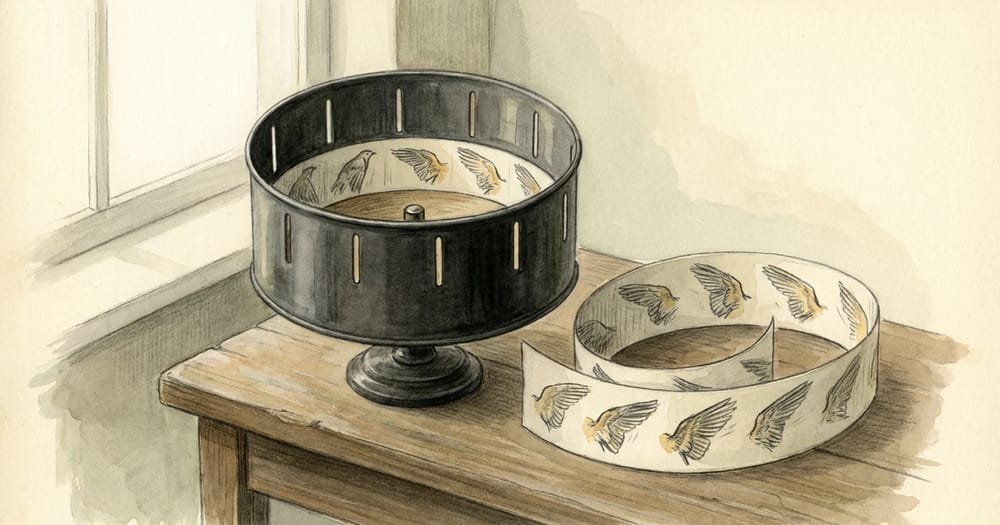
Imagine a paper bird that flaps its wings but never leaves its drawing. Stop the drum and there it is: ink on paper, perfectly still. Start it again, look through a slit, and the wings seem to beat.
Where has the movement come from?
To find out, you need to look at two things together: what the artist has drawn, and how the spinning drum lets you see it.
What is inside a zoetrope?
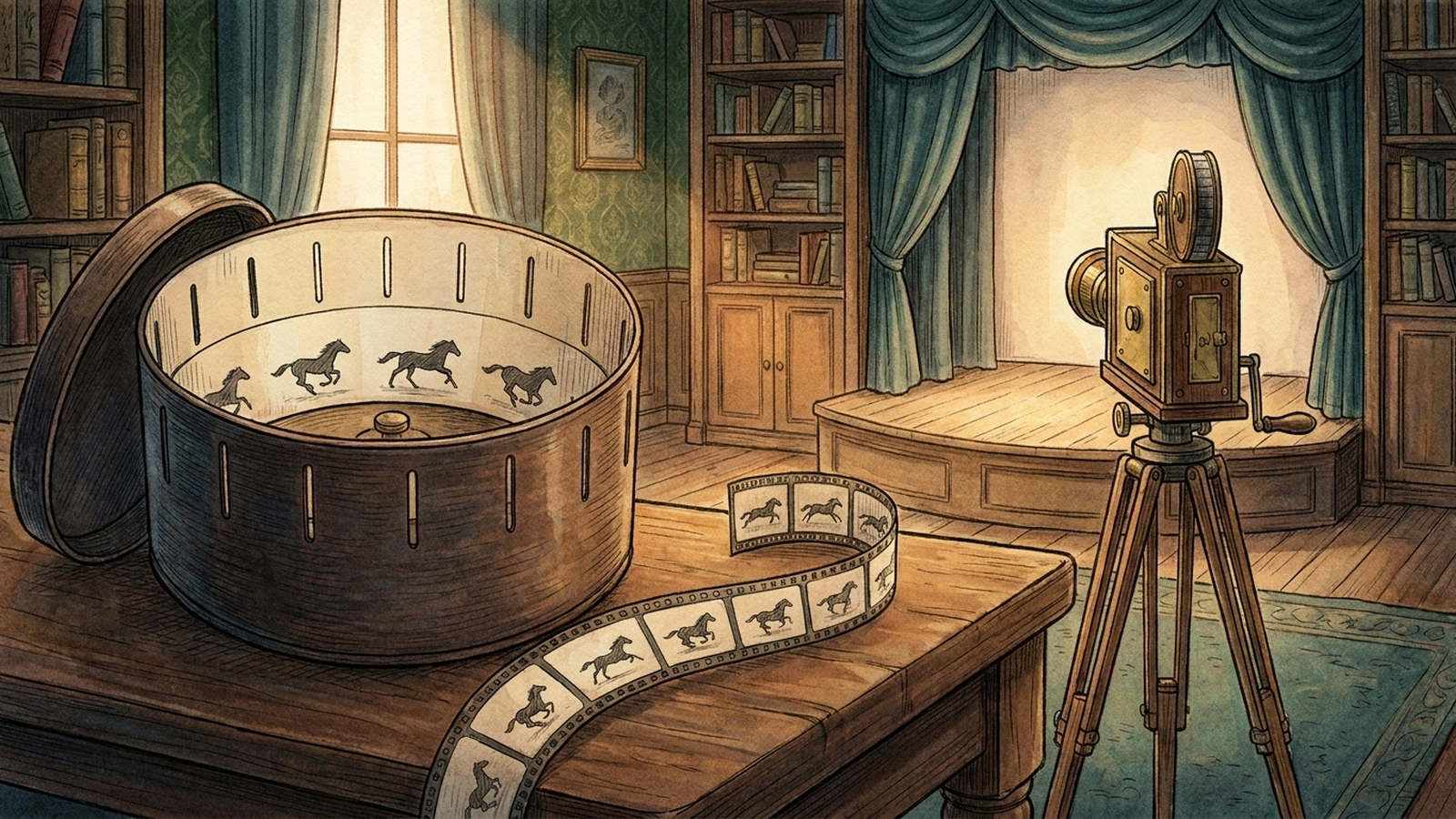
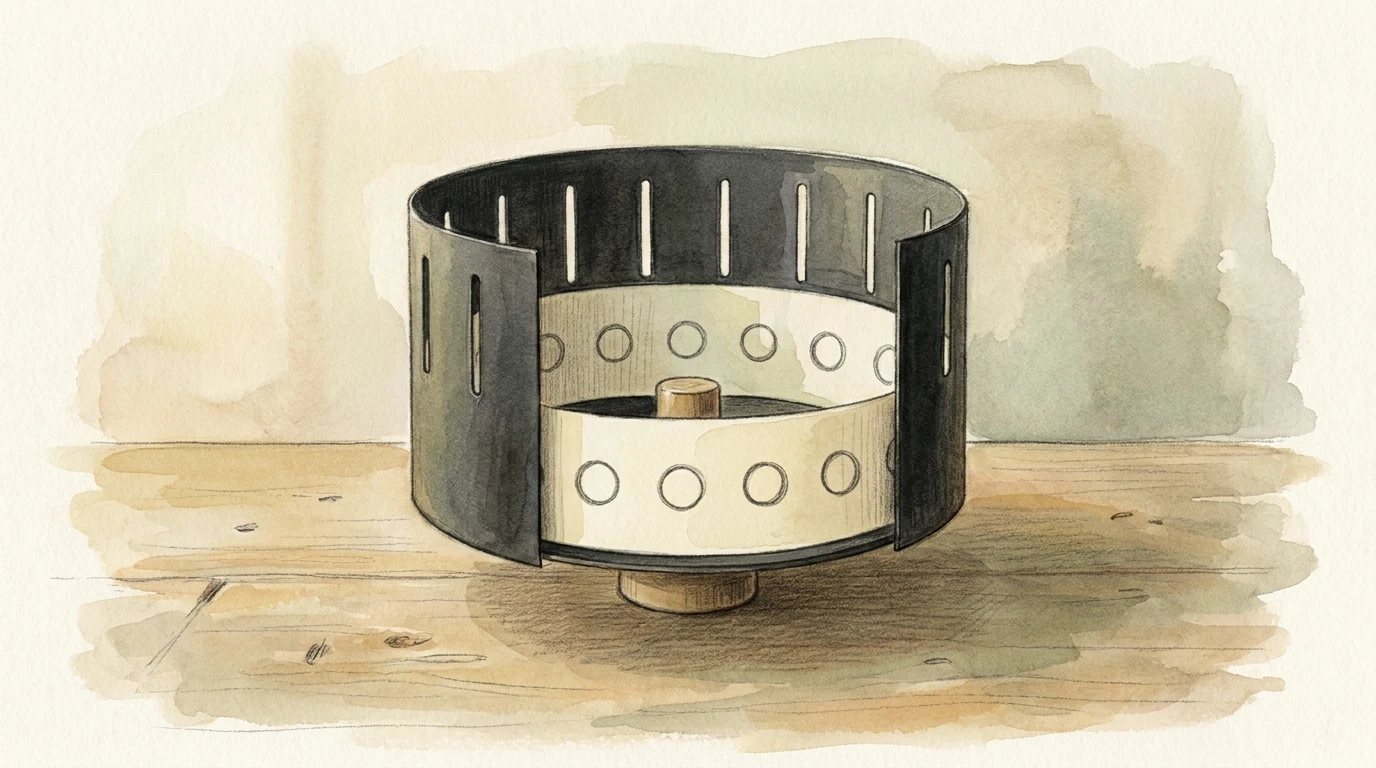
A traditional zoetrope is rather like a round, open-topped box that can turn. Its wall has a row of narrow vertical gaps called viewing slits. Inside, a paper strip carries pictures showing the stages of an action.
In the familiar design described by Kenyon College's historical apparatus collection, the slits are near the top of the drum and the pictures sit below them. You stand outside and look through the passing slits towards the pictures on the opposite inner wall.
That last part matters. You are not meant to lean over the open top and watch the paper whirling around. The openings in the wall are part of the invention, not just decoration.
Think of the drum as a little viewing machine. It carries the drawings round, while its slits control the glimpses you receive.
Why are the pictures slightly different?
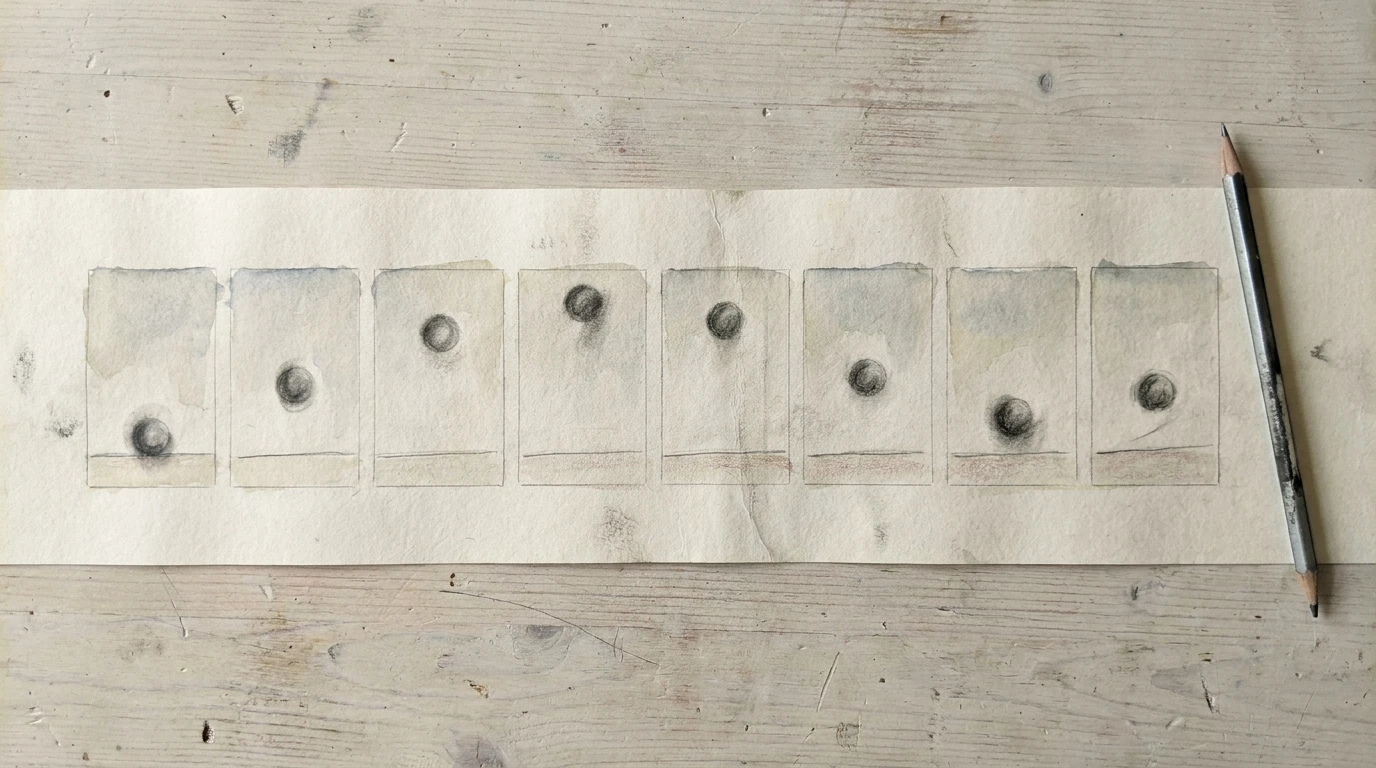
Suppose you want to draw a bouncing ball. One picture shows it near the ground. The next shows it a little higher. Another shows it near the top of its bounce. Later pictures bring it down again.
Each picture is a frame: one stage in the sequence. Lay the drawings side by side and you can follow the action with your finger. Nothing on the paper moves, but the changes are already there, waiting to be shown in order.
A zoetrope presents those stages in quick succession. Instead of seeing only a row of separate balls, you can perceive a ball bouncing.
You do not need a complicated character to begin. The National Museum of Australia demonstrates its paper zoetrope with a simple sequence of dots. A small changing shape is enough to explore the idea.
Here is a useful question for an animator: what changes, and what stays the same? In your ball drawings, you might keep the ball's size and the ground line steady while changing its height. That gives you one clear action to investigate.
How does a zoetrope work, and why does it need slits?
Imagine trying to read a drawing while somebody sweeps it past your face. You might catch a blur rather than a clear view.
The zoetrope's slits interrupt your view of the moving paper. A slit passes in front of your eye and briefly reveals a picture. Then the solid wall blocks the view, before another slit gives you another glimpse. These interrupted views help prevent the pictures from simply blurring together, as Adobe's explanation of the device describes.
The sequence of different poses can then appear as a moving action. This is an illusion of movement: you perceive something happening that no individual drawing actually does.
There are two different kinds of movement to notice. The paper really travels round inside the drum. The bird's wings, however, do not flap on the paper. Their apparent movement comes from the sequence of wing positions you see.
If you have a zoetrope to try, compare looking over the rim with looking through the slits. What changes? Use a comfortable, gentle spin and give yourself time to find the viewing position. You are investigating the view, not competing to spin the drum fastest.
Why does the animation keep repeating?
A zoetrope's picture strip bends into a circle. After the final drawing comes the first drawing again. That is why its little scene can repeat as a loop.
For your imaginary bouncing ball, the join deserves as much thought as the middle. Does the final pose lead comfortably back to the starting pose, or does it make an unexpected jump?
Try laying out your planned pictures, then putting the last beside the first. You have found a place where the end of a story becomes its beginning.
The order matters, too. With a suitable sequence, reversing the spin reverses the apparent action; Adobe even suggests changing direction if your animation is playing backwards. A ball rising and falling may make sense either way. A more one-way action could become rather surprising.
What would you draw if you wanted the beginning and ending to meet without anybody noticing the join?
Who made early zoetropes?
The zoetrope belongs to the nineteenth-century world of optical toys: devices that invited people to explore what pictures, light and movement could do.
English mathematician William George Horner developed an early version in the 1830s. It was called the daedaleum, rather than the zoetrope. Museums Victoria's history of optical toys describes his device alongside other inventions that used sequences of still pictures.
These toys were part of a wider exploration, not a whole history of cinema invented by one person. A zoetrope displays prepared pictures; it does not record an event with a camera. That distinction helps you ask two separate questions: how can we capture movement, and how can we make still pictures seem to move?
One is a question about recording moments. The other is the puzzle you have been exploring inside the drum.
Wonderfully Weird Facts
- You can share the view. Museums Victoria explains that a zoetrope allows group viewing. Unlike the earlier phenakistoscope, which a person viewed through a spinning disc towards a mirror, the drum offers places for several viewers around it. Imagine comparing what you noticed with somebody on the other side.
- A new strip can bring a new scene. The National Museum of Australia's making activity has you place an animation strip inside the wall and test different designs. The drum is the viewing device; the drawings supply the action. What would you change first: the subject, or the movement?
- Not every zoetrope is made from flat drawings. Pixar created a three-dimensional Toy Story zoetrope. The Academy Museum's exhibition account describes its 3D-printed version alongside a nineteenth-century “Wheel of Life”. The old question still invites new inventions: how do you turn separate poses into apparent movement?
Down the Rabbit Hole: Could you animate pictures without slits?
If the slits are so important, could an inventor find another way to present the pictures?
Yes — and one answer involves mirrors.
A praxinoscope also has a turning cylinder and a sequence of pictures inside. Instead of looking through narrow slits, you look at reflections in a set of flat mirrors arranged around the centre. As the cylinder turns, the pictures appear in the mirrors in succession.
Museums Victoria describes this arrangement and credits Charles-Émile Reynaud with inventing the praxinoscope in 1877. Kenyon College also compares its central mirrors with the zoetrope's viewing slits.
You have followed a lovely chain of questions: how can drawings appear to move? What do slits contribute? Could something else do that job?
That is one way an invention can lead to another. Keep the question, then change the way you answer it.
Try It Yourself: Make a tiny moving-picture book
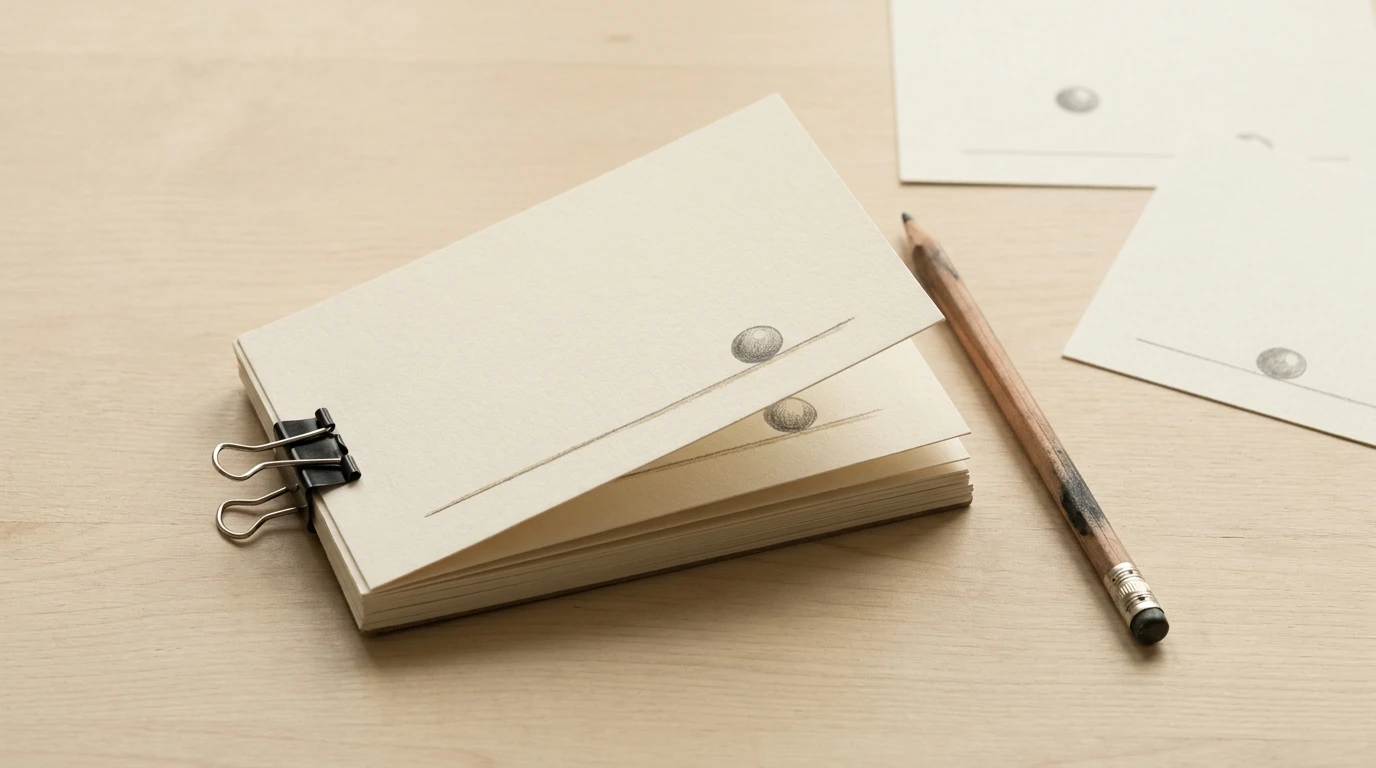
You can explore a sequence without building a spinning drum. This small flip book is a comparison, not a zoetrope: you turn pages rather than look through slits.
Gather a pencil and eight small pieces of paper of the same size. You can hold them together or ask a grown-up to secure one edge with a clip. Eight pages are simply a manageable starting point for this experiment, not a rule for animation.
- Decide the viewing order. Flick through the blank stack first. Notice which page you see first, and put it at the start of your drawing sequence.
- Choose one small action. Try a ball rising and falling. Draw a ground line in the same place on every page.
- Change the ball's position a little at a time. Keep its size similar. Check the pages in order as you work.
- Look slowly first. Turn one page at a time. Can you explain the changes you drew?
- Try a quicker flick. Hold the secured edge and release the free edges with your thumb. Does the ball begin to look as though it moves?
- Change one thing. Move one drawing higher, or swap two pages. Compare the result. Which version tells the action more clearly?
If the movement looks jumpy, you have something to investigate. Check the page order, your grip and the changes between drawings. Keep your first attempt so you can compare it with the next one.
Ready to explore the actual drum? The National Museum of Australia's zoetrope-making guide includes instructions and links to its templates. Read its materials list with a grown-up first; those external templates are separate from this article.
The Big Takeaway
Your paper bird has not escaped its drawing. The artist has given it a sequence of wing positions, and the zoetrope has given you a way to see them as movement.
A strip of paper, a turning drum and carefully timed glimpses: ordinary things, arranged to reveal something unexpected.
Next time you draw a bird, a bouncing ball or a waving hand, pause over a new question. Not just “What does it look like?” but “What would the very next picture show?”
Sources and Further Reading
- Kenyon College — Zoetropes: the drum, picture placement, viewing position and mirror comparison.
- Museums Victoria — Philosophical (Optical) Toys: The Details: Horner, group viewing, related optical toys and the praxinoscope.
- Oxford History of Science Museum — Zoetrope: the rotating cylinder and narrow-slit viewing mechanism.
- National Museum of Australia — Zoetrope: the paper make, picture strips, dot demonstration and adult-help guidance.
- Adobe — Zoetrope Animation Explained: interrupted viewing, looping images and reversing direction.
- Academy Museum — The Pixar Toy Story 3D Zoetrope: a modern three-dimensional interpretation.
Keep exploring with our Wonder lesson, The First Movies, with a children’s Journal and an accompanying Parent Guide to help you guide the lesson.