


If you're asking this question, you are probably somewhere in the middle of the night, phone glowing, wondering whether you're "allowed" to do this your own way. Perhaps you've pictured a slower morning — a nature walk instead of a spelling test, a book abandoned halfway through for a better one — and then a small, nagging voice has asked: but is that actually legal?
Take a breath. It is. I remember asking myself almost the exact same question, half-convinced there was a rulebook somewhere I hadn't been given. There isn't — and once you understand what the law actually asks of you, the rest of this decision gets a great deal lighter.

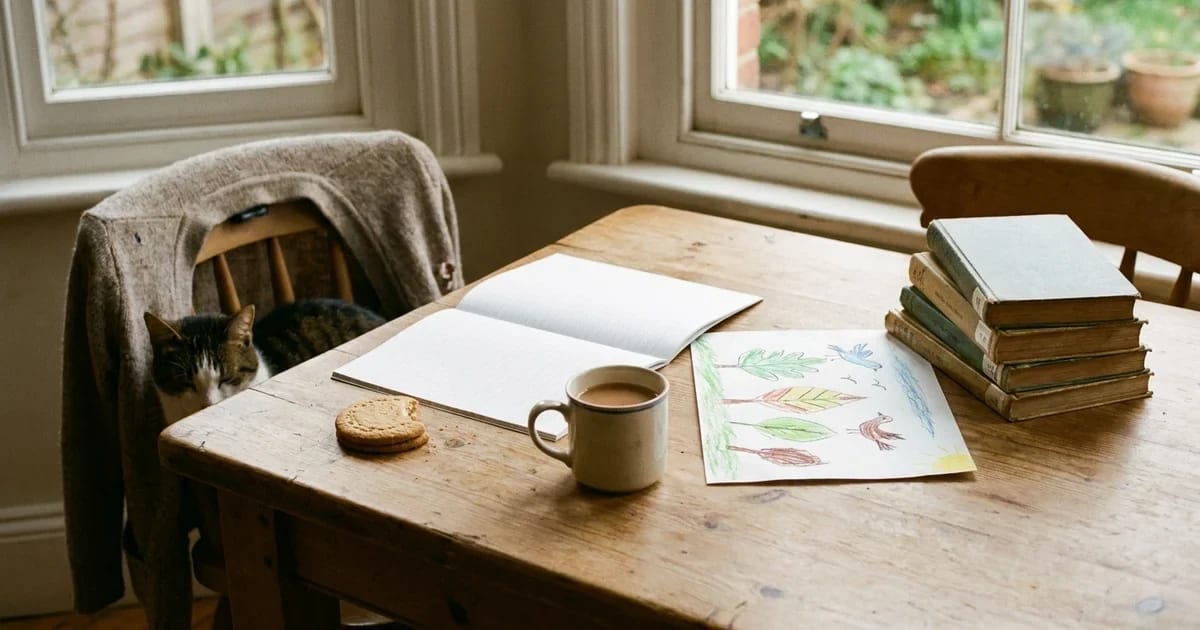
Alt: Parent and child drawing together at a kitchen table during a gentle home education morning
What the law actually requires (it isn't the National Curriculum)
In England and Wales, the legal foundation for home education is one sentence: section 7 of the Education Act 1996, which places the duty on parents, not schools:
"...efficient, full-time education suitable to his age, ability and aptitude... either by regular attendance at school or otherwise." — Education Act 1996, s.7
Notice everything that sentence doesn't say. No subjects are named. No hours are set. No tests are required. The Department for Education's elective home education guidance confirms plainly that home-educating parents are not required to follow the National Curriculum, provide a "broad and balanced" curriculum, or replicate school hours and terms.
Scotland and Northern Ireland have their own legislation with the same practical effect: parents must provide a suitable education, and no national syllabus is prescribed for children learning at home.
What the National Curriculum actually is — and who it's for
It helps to untangle a common mix-up. The National Curriculum is a statutory programme of study, written for state-maintained schools in England, setting out what must be taught in each subject and year group. It was never written with home-educating families in mind, and it has no legal reach into your home.
| Nation | Is the National Curriculum required for home education? |
|---|---|
| England | No. Confirmed directly by gov.uk. Applies only to state-maintained schools. |
| Wales | No. Same legal foundation (Education Act 1996), with Welsh Government guidance for home educators. |
| Scotland | No. Parents must educate "by other means" to a suitable standard — Scotland's Curriculum for Excellence applies to schools, not home education. |
| Northern Ireland | No. Wording mirrors England and Wales: education suitable to age, ability and aptitude, "at school or otherwise." |
(This is general information, not legal advice — always check current guidance for your nation on gov.uk or your devolved government's website.)
A morning that never went near a syllabus
A few winters ago, one of ours came in from the garden holding a snail, utterly certain it was dead, and utterly determined to bury it "properly." What followed was not on any plan: we talked about what "dead" actually means, found a picture of a snail's insides in an old encyclopaedia, and somehow ended up reading about hibernation because — as it turned out — the snail wasn't dead at all, just cold and sealed up for winter. It went back under a log, alive and unbothered, and we spent the rest of the morning talking about which other creatures do the same thing.
No textbook mentioned the National Curriculum that morning. Nothing about it would tick a Year 1 science objective in the order a school might teach it. And yet biology, vocabulary, a little grief and a lot of relief all happened in about ninety minutes, because nothing was steering the morning except a genuinely interested child and a genuinely interested adult. That's the freedom this whole legal question is actually about — not a loophole, just permission to let a real question be worth more than a lesson plan.

Alt: Nature notebook, pencil, autumn leaves, berries and snail shell on a wooden bench for outdoor home learning
So why do some families follow it anyway?
Plenty do — and it's worth saying clearly that this is just as valid a choice as not following it. Families sometimes lean on the National Curriculum because:
- it offers a reassuring map when everything else about home educating feels new and unmapped;
- a child might return to school at some point, and staying roughly in step eases that transition;
- older children heading towards GCSEs or iGCSEs may find it useful to work backwards from an exam syllabus for certain subjects, from around age 14.
None of this makes it the "proper" or "safer" option — it simply makes it one option among many equally lawful ones. Structured programmes, literature-rich approaches, project-based learning, unschooling and wonder-led, interest-driven learning are all just as legitimate in the eyes of the law. (We've written a full, gentle guide to choosing a home education curriculum if you'd like to explore what might fit your family.)
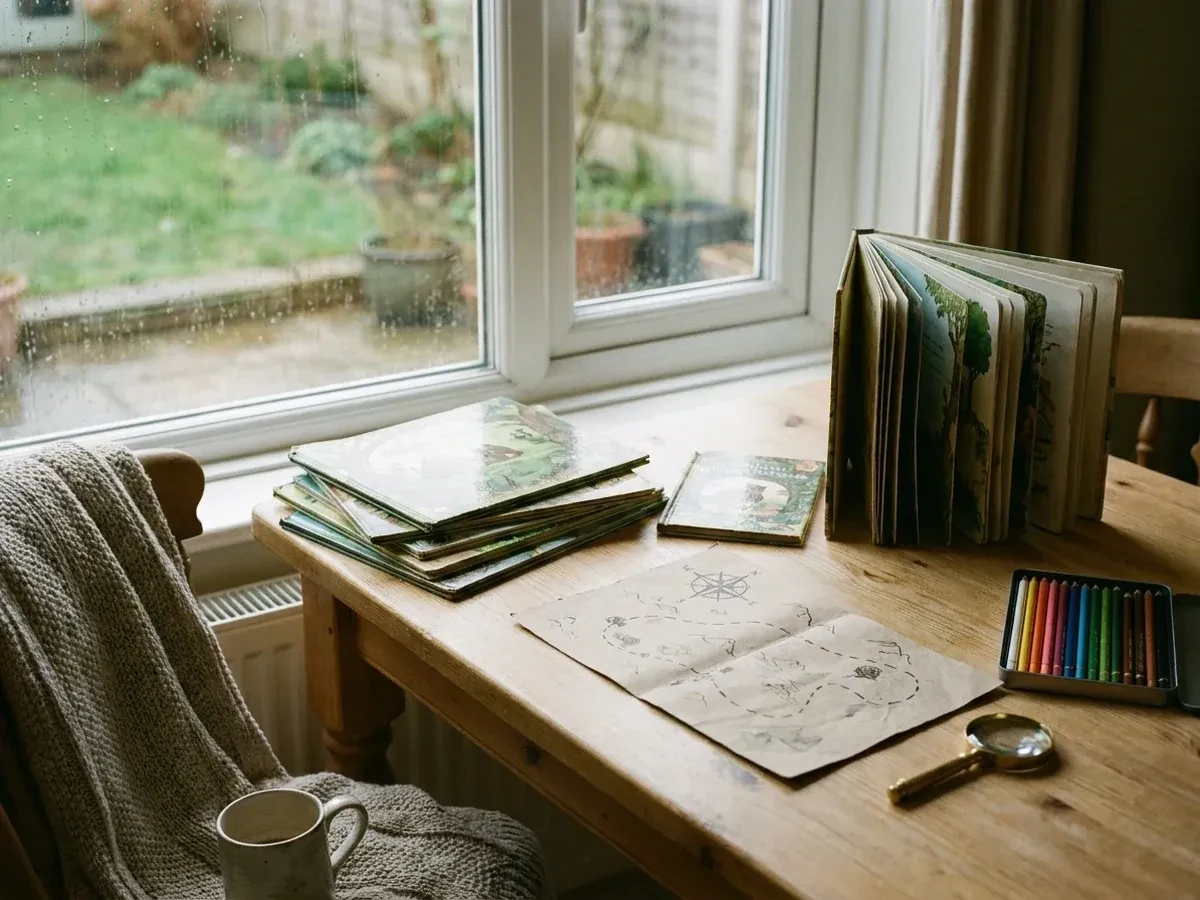
Alt: Children’s books, coloured pencils, a hand-drawn map and magnifying glass on a cosy table by the window
What does the evidence actually say about outcomes?
It's a fair question, and a common worry hiding underneath this one: if we skip the National Curriculum, will my child do worse?
The honest answer is that good UK-specific evidence is thin — home education here is diverse and largely unmonitored, which makes clean research difficult. The most recent House of Commons Library briefing notes that at least 126,000 children were in elective home education in England in autumn 2025, around 1.5% of the school-age population, but attainment data at that scale simply isn't collected in a way that allows a fair national comparison.
International research offers a more cautious but still useful picture. Studies gathered by the US National Home Education Research Institute have repeatedly found home-educated students scoring well above average on standardised tests — but these findings are correlational, drawn largely from motivated families able to home educate in the first place, and don't isolate curriculum choice as the cause. In other words: the research doesn't tell us that following (or not following) the National Curriculum specifically drives outcomes — it tells us that home education itself, done attentively, tends to go well. Curriculum choice within that is genuinely secondary to the attention and care behind it.
What "suitable, efficient and full-time" actually means
This is the phrase that carries all the legal weight, so it's worth sitting with it for a moment.
- No hours are prescribed. There is no legal minimum number of hours per day or week. One-to-one learning is naturally efficient — what takes a class of thirty a whole morning can take one child twenty minutes — so most families find two to four focused hours plenty, woven around reading, conversation and everyday life.
- No subjects are listed. "Suitable" means suitable to your child — their age, ability, aptitude and any special educational needs — not suitable to a national average.
- No routine inspection exists. Local authorities have no statutory duty to monitor home education as a matter of course. They may make an informal enquiry if they have reason to believe a child isn't receiving a suitable education, but — as Child Law Advice sets out clearly — they cannot insist on entering your home or speaking to your child, and cannot demand evidence in a particular format. Most families find that a brief, friendly written update once a year is all that's ever asked of them.
If a local authority does have concerns, the formal route is a written notice giving you at least 15 days to demonstrate a suitable education, and only as a last resort — after every reasonable step has been exhausted — a school attendance order. For the vast majority of home-educating families, none of this is ever triggered.
When we borrowed the map ourselves
We haven't always ignored the National Curriculum entirely, and it's worth being honest about that too. When our eldest turned twelve, a real possibility of returning to school for GCSEs came up — nothing decided, just a door we wanted to keep open. So for two subjects, maths and English, we deliberately looked at what a Year 7 classroom would be covering and quietly nudged our own approach to sit somewhere near it, mostly so that door wouldn't quietly close without us noticing. Everything else — history, science, the wonder-led rabbit holes — stayed exactly as free as before. It wasn't a wholesale conversion to school-at-home. It was one practical decision, made for one clear reason, and it's a good example of how loosely borrowing from the National Curriculum can be a tool you pick up and put down, not an all-or-nothing commitment.
If your local authority makes an informal enquiry
Most home-educating families never hear from their local authority at all, but if you do, it helps to know the shape of what usually happens:
- A letter or email arrives, usually asking how you're providing a suitable education — this is an informal enquiry, not a demand.
- You're not obliged to invite them into your home or agree to a meeting; a written response is a perfectly acceptable way to reply. Although, we personally loved our visits and it’s been an opportunity for our children to show their work, skills and for me as a mama, to get some external validation that we were doing ok, was amazing in the early years.
- Write a short, honest summary — a paragraph or two on your general approach, a few examples of what your child has been learning, and roughly how your days are shaped. There is no required format.
- Keep it proportionate. You do not need to justify your curriculum choice, defend not following the National Curriculum, or provide formal assessments — only show that the education is suitable to your child.
- If they ask for more, you can ask why. You're entitled to understand what specifically has prompted further enquiry, and to respond to that directly rather than guessing.
- If things escalate to a formal notice, you'll be given at least 15 days to respond with evidence of a suitable education — and organisations like Education Otherwise offer free, experienced support if you reach this stage.
For the overwhelming majority of families, step 3 is where it ends.
Where this gets genuinely hard
It would be dishonest to end this on pure reassurance, so here's the part most guides skip.
Not following the National Curriculum can make a later return to school genuinely bumpier. If your child does go back into mainstream education after several curriculum-free years, they may be behind their new classmates in the specific things schools test for — not because they've learned less, but because they've learned differently. This is real, and worth weighing honestly if a return feels likely, rather than assuming it will sort itself out.
There's no external check to tell you if it's working. Without termly reports or National Curriculum levels, you are the only person tracking whether your child is genuinely progressing. Most families manage this by staying closely involved and keeping light records — but it does mean the reassurance a school report gives you simply isn't there, and some parents find that absence harder than they expected.
Wobbly days will make you doubt it. There will be afternoons where nothing has gone to plan, your child is frustrated, and a school timetable suddenly looks appealingly simple. That doubt is normal, not a sign you've chosen wrongly — but nobody should pretend it doesn't happen.
Common worries, gently answered
"If we don't follow the National Curriculum, will my child fall behind?"
Behind whom, and by what measure? Without a classroom of thirty children to keep pace with, "behind" mostly stops being a meaningful idea. What matters legally — and, we'd argue, practically — is whether your child is progressing in a way that's suitable for them. Plenty of home-educated children move through material considerably faster than a class average simply because learning is one-to-one; others take longer over the things that matter to them and race through the rest.
"What if we want to go back to school one day?"
You can apply for a school place at any point — home education is not a one-way door. If you think a return is genuinely likely, some families (us included, at times) do choose to loosely track National Curriculum year-group expectations for that reason alone, particularly in English and maths — see above. That's a sensible, practical choice, not a legal requirement.
"Will the local authority ask what curriculum I use?"
They may ask how you're providing a suitable education, but there is no tick-box for "which curriculum." A short written summary is normally all that's needed — see the step-by-step above.
"What if I choose wrong and only realise years later?"
This is the worry underneath most of the others, and it deserves a straight answer: curriculum choices in home education are almost never irreversible. You can add structure, drop it, borrow from the National Curriculum for a term and abandon it the next. Very few families follow a straight line from decision to decision — most of us adjust constantly, and that's not failure, it's parenting attentively. The key is to teach your children how to learn, if you’ve equipped them with those tools then they will catch up if they do return to mainstream school. We really believe that education is not filling our children with knowledge but igniting a fire in them to want to learn!
Frequently asked questions
Do homeschooled children have to follow a curriculum at all?
No. There is no legal requirement to follow any formal curriculum, National or otherwise. The requirement is that the education provided is suitable, efficient and full-time — the how is entirely up to the family.
Do you have to take GCSEs if you're homeschooled?
No, GCSEs aren't compulsory for anyone, home-educated or not. Many home-educated teenagers do choose to sit GCSEs or iGCSEs as private candidates at approved exam centres, entirely independently of which curriculum or approach they followed beforehand.
Is homeschooling monitored in the UK?
Not routinely. Local authorities have no statutory duty to inspect home education as a matter of course, though they can make informal enquiries if there's reason for concern. They cannot insist on a home visit.
What are the new rules for homeschooling in the UK?
The Children's Wellbeing and Schools Act 2026 (Royal Assent 29 April 2026) will introduce local authority registers for children not in school, once the relevant sections are commenced — expected from late 2026. It does not introduce any requirement to follow the National Curriculum.
Is home education legal in the UK?
Yes, throughout all four nations. In England, Wales and Northern Ireland you deregister a school-age child by writing to the head teacher; in Scotland, you generally need the council's consent if your child already attends a state school.
Where The Wonder Curriculum fits
We should say this plainly: we make home education resources, so this question naturally touches our own corner of the world. Here's our honest place in it.
Because you don't have to follow the National Curriculum, you're genuinely free to choose learning that follows your child's own questions instead — which is exactly the space The Wonder Curriculum was built for. Our books and lesson PDFs take one wonderful question (what is infinity? why is the sky blue?) and follow it deeply, with stories and things to notice along the way, rather than working through a syllabus.
It won't suit you if you specifically want a National Curriculum-aligned programme with levels and formal tracking — and that's a completely legitimate thing to want. In that case, our guide to choosing a curriculum will point you towards approaches better suited to that path.
If wonder-led learning is what you've been quietly longing for instead, we'd love to welcome you in — you're welcome to explore Volume One of The Wonder Curriculum and see sample pages before deciding anything at all.
Come and wonder with us.
Sources and further reading
- Education Act 1996, section 7 — legislation.gov.uk
- Educating your child at home — gov.uk
- DfE: Elective home education, guidance for parents — gov.uk
- The National Curriculum — gov.uk
- Home education — Child Law Advice (Coram Children's Legal Centre)
- Home education in England — House of Commons Library briefing
Teresa is a home-educating UK mama and part of the family behind The Wonder Curriculum. Legal details checked 28 August 2026 — this is general information, not legal advice, and registration requirements are changing under the Children's Wellbeing and Schools Act 2026, so always confirm the current position for your nation on gov.uk.