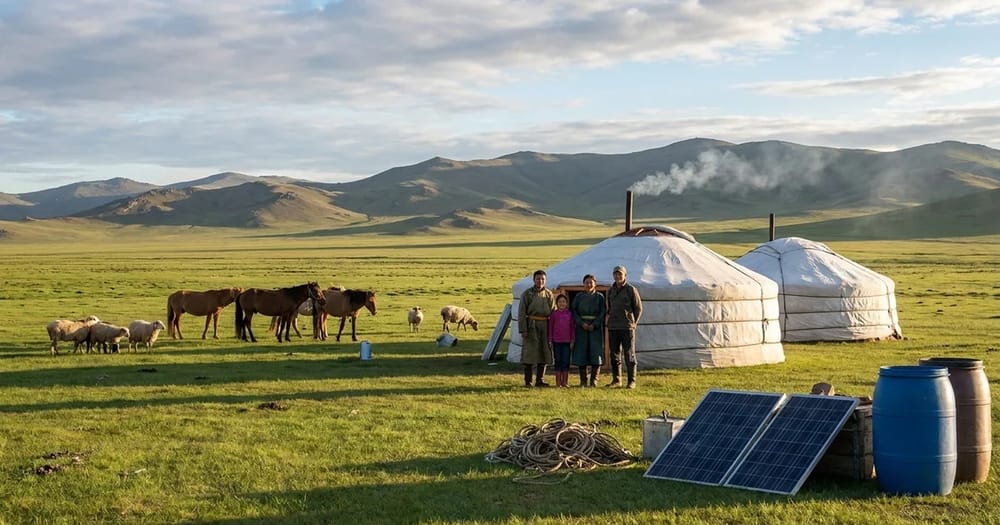
Imagine that the best grass for your animals changes with the season. Your home can be taken apart and rebuilt. The route ahead is not random: it is remembered, discussed and chosen with care. Welcome to a world where moving can be part of home.
What is a nomad?
The simplest answer is: a nomad is someone whose way of life includes moving from one place to another.
That definition needs one important extra piece. Nomadic life is often organised. Families may return to familiar summer and winter places. They may know where water can be found, which pasture recovers at a certain time, where weather is safer, and how long a journey usually takes.
So “nomad” does not simply mean “a person who wanders with no plan”. Movement can follow a cycle as carefully as a school timetable — only the timetable is shaped by seasons, animals, work and the land.
Some people are fully nomadic. Others are semi-nomadic, moving for part of the year and spending long periods at regular homes or camps. Ways of life also change over time. A family may combine herding with town work, school, vehicles, phones or solar power. Tradition and modern technology can exist in the same place.
Why do nomads move?
There is no single answer for every community. Historically, researchers have described several broad kinds of nomadic life:
- Pastoral nomads move with domesticated animals so the herds can reach pasture and water.
- Nomadic hunter-gatherers move as they find wild plants, animals and other seasonal food sources. Not every hunter-gatherer community is nomadic.
- Travelling craft or trade groups move to offer skills, services or goods in different places.
Today, people also use the phrase digital nomad for someone who works online while travelling. That is a modern use of the word. It is very different from a pastoral culture built around livestock, shared routes and generations of environmental knowledge.
For many pastoral families, movement helps animals reach what they need. Grass does not grow equally everywhere or in every season. Water can change. Snow, drought or heat can alter a plan. Good decisions depend on close observation and experience.
A route is therefore more than a line on a map. It can hold knowledge about wells, rivers, shelter, grazing, weather, neighbours and the strength of different animals.
Do nomads have homes?
Yes. Being mobile is not the same as being homeless.
A home can be a portable structure, a vehicle, a boat, a group of familiar seasonal camps or several places a family returns to. It can also include things that cannot be packed: relationships, stories, routes, responsibilities and knowledge of a landscape.
Different nomadic peoples use different kinds of shelter. It would be wrong to imagine that everyone lives in the same tent. Homes are designed for local materials, weather, transport and family needs.
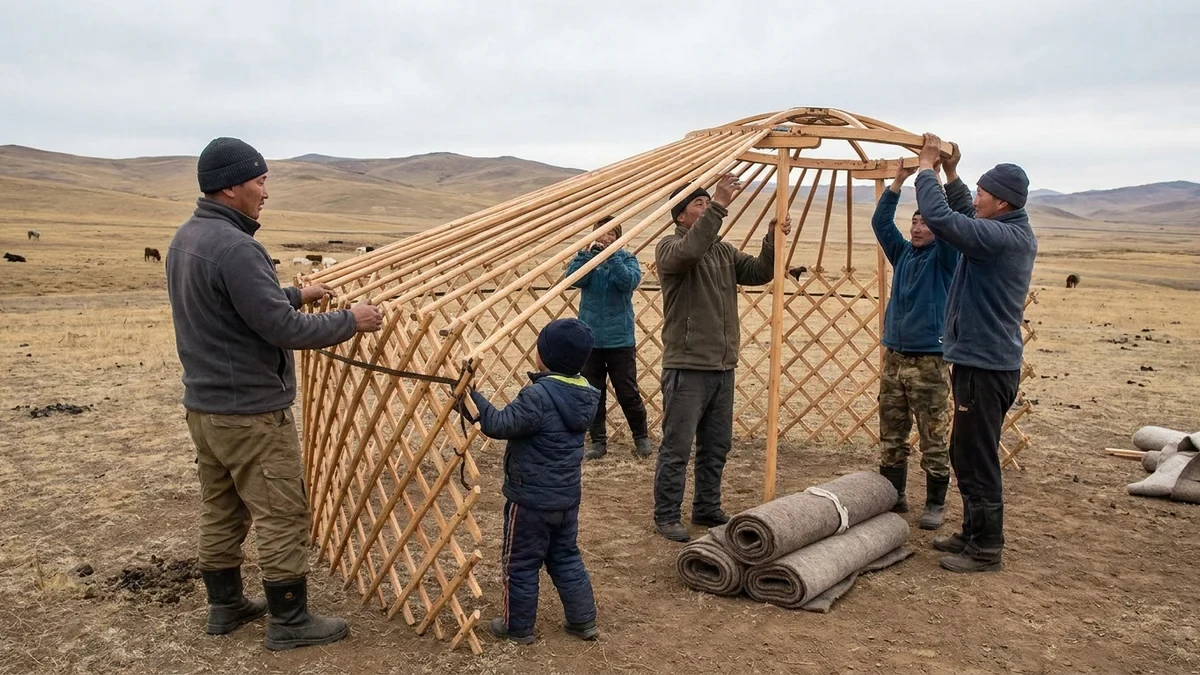
In Mongolia, a traditional round portable home is called a ger. You may also know the Russian-derived word yurt, but ger is the Mongolian word. A ger has a wooden lattice wall, roof poles, a central roof ring and coverings that can include felt and fabric. Its parts can be taken down, transported and assembled again.
That does not make it a flimsy camping tent. A ger is a carefully organised home suited to a mobile pastoral life and Mongolia's climate.
How do Mongolian nomads live?
Mongolia is a country of cities, towns and enormous rural landscapes. Its capital, Ulaanbaatar, is a major city. Not every Mongolian family is nomadic.
Among families who practise Mongolian pastoral nomadism, livestock, pasture and seasonal movement are closely connected. UNESCO describes families choosing pastures according to grass, geography, climate and season. Moving allows animals to graze in different places and can give used land time to recover.
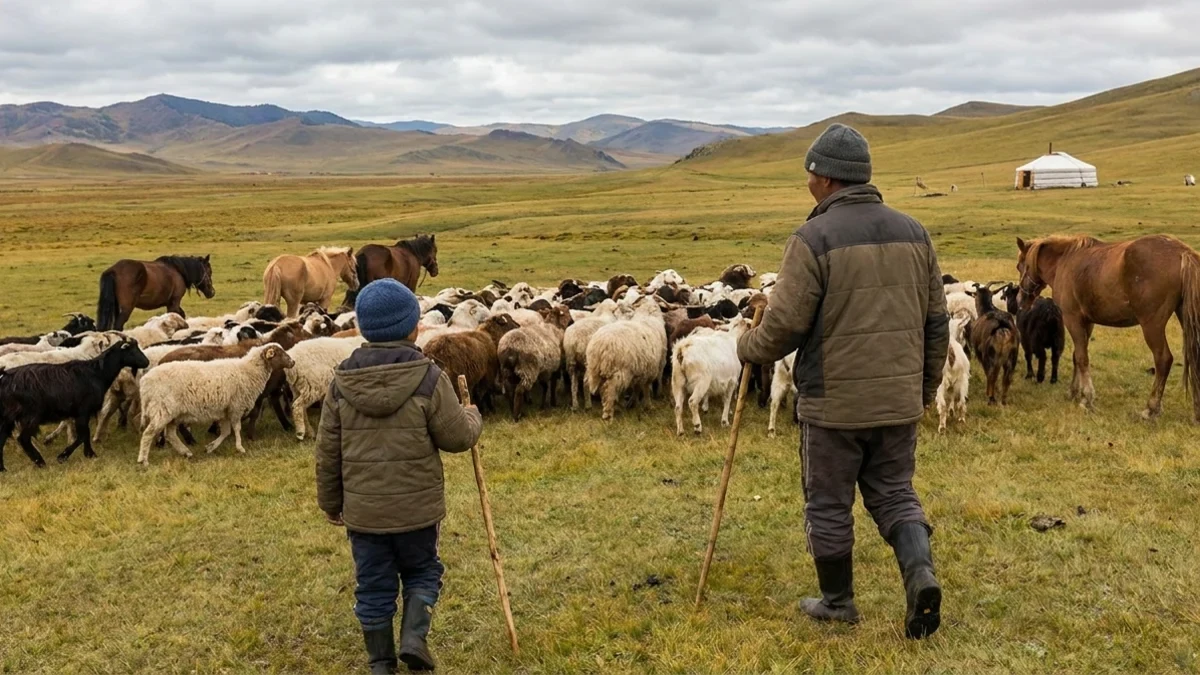
Herds may include sheep, goats, cattle, horses, camels or yaks, depending on the region and the family. Animals provide different foods, fibres, transport and income, so caring for them requires a wide range of skills.
A move involves much more than folding a home. Families prepare animals and equipment, take down the ger, organise loads, clean the area and decide when conditions are right. Every journey must consider people, young animals, weather and the distance to the next place.
UNESCO's description of Mongol nomad migration says children begin learning important knowledge from a young age, including livestock care, migration routes, and assembling and disassembling gers. Learning happens through participation with other family and community members.
This is not a pretend adventure assembled for visitors. It is skilled work and a living cultural practice. In 2024, Mongol nomad migration and its associated practices were inscribed on UNESCO's Representative List of the Intangible Cultural Heritage of Humanity.
Do nomads travel all the time?
Usually not.
Pastoral nomads may spend considerable time at particular seasonal places. A family might move several times in a year, but the exact pattern varies enormously. Another community may travel more often, less often or over a very different distance.
Movement can also change from year to year. If pasture is poor or water is scarce, a family may adjust. If conditions are good, a camp may be used for longer. This flexibility is one reason detailed local knowledge matters.
The word nomadic describes a relationship with movement, not a stopwatch that is always ticking.
Are all nomads the same?
No. “Nomad” is a broad description, not the name of one people.
Pastoral nomads have lived in parts of Central Asia, the Arabian Peninsula, northern Africa and many other regions. Britannica Kids gives Kazakh and Bedouin peoples as examples of communities with pastoral traditions. Within any named community, however, people's lives are varied. Some may continue mobile herding, some may live in settlements, and some may combine different ways of living.
That is why respectful language matters. It is better to name a people accurately when a reliable source allows it, rather than treating “nomadic tribes” as one giant culture. Clothing, food, homes, animals, languages and routes belong to particular places and histories.
Curiosity should make the world more detailed, not flatten it.
Four myths about nomadic life
Myth 1: Nomads wander randomly
Many movements are seasonal, cyclical or carefully adjusted to current conditions. Knowing when and where to move is part of the expertise.
Myth 2: Nomads have no home
A home does not need to stay on one foundation. Portable homes and familiar seasonal places can be deeply organised and meaningful.
Myth 3: Nomadic life belongs only to the past
Pastoral nomadism is a living practice. Families may use motorbikes, mobile phones or solar panels while continuing knowledge passed between generations.
Myth 4: All nomads live alike
There is no universal nomad house, animal, outfit or route. Communities adapt to different environments and have their own identities.
Wonderfully Weird Facts
- The English word nomad comes through Greek from a word linked with grazing or pasture.
- Pastoral movement may return to known seasonal places rather than travelling endlessly forwards.
- A Mongolian ger's circular wall begins as an expandable wooden lattice.
- A ger's roof poles meet a central ring, creating a strong framework that can be dismantled.
- Mongolian migration decisions can consider grass, geography, climate and season all at once.
- UNESCO says children in Mongolian pastoral communities learn routes, livestock care and ger-building skills through family life.
- A solar panel beside a ger is not a contradiction. Portable modern technology can support a mobile home.
Down the Rabbit Hole: can movement protect pasture?
Picture one patch of grass with animals eating from it every day. New shoots may be eaten before they recover. Now imagine moving the herd to another suitable pasture and allowing the first area time without grazing.
The real science is more complicated than a simple two-patch game. Rainfall, soil, plant type, herd size, distance, wildlife and weather all matter. Moving at the wrong time or placing too many animals in one area can still cause problems.
Yet the central question is powerful: how can people meet the needs of animals without exhausting the land?
Mongolian pastoral knowledge considers pasture conditions and seasons when planning movement. It is a reminder that a journey can be part of land care — not merely travel from A to B.
Try it yourself: design a four-season route
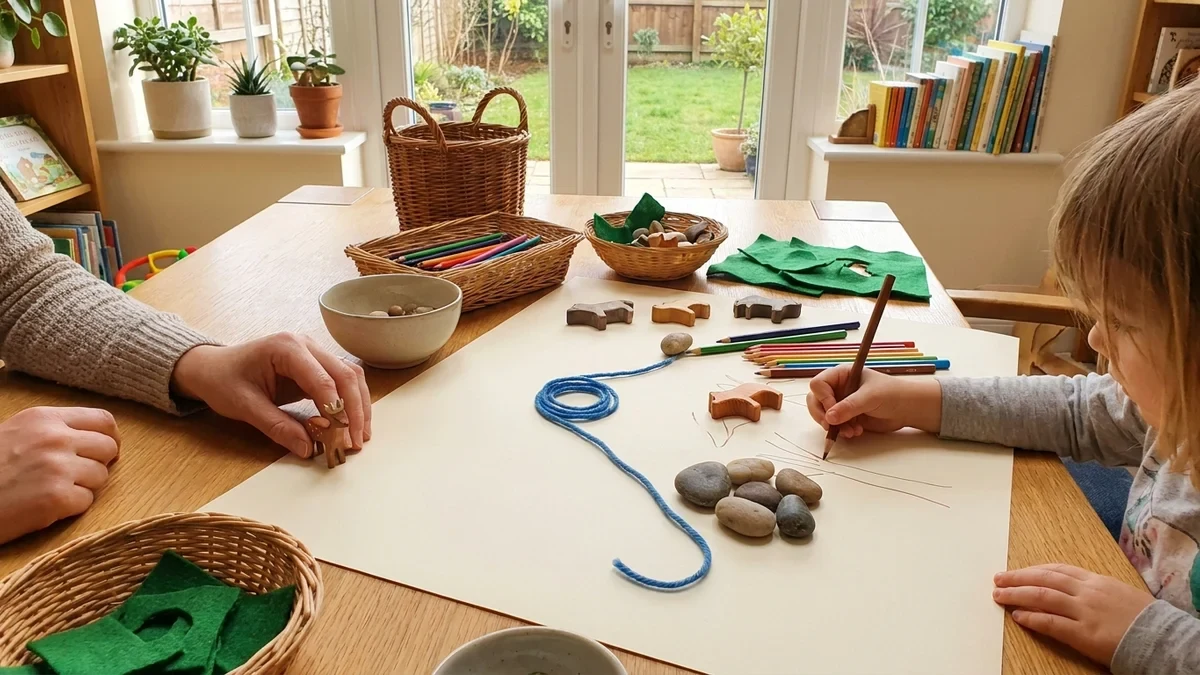
You will need:
- a large sheet of paper
- coloured pencils
- blue string or wool for water
- small stones or blocks for hills and shelter
- toy or paper animals
1. Build a landscape
Make a pretend region with two water sources, high ground, low ground, summer grass and a sheltered winter area. Do not copy a real community's sacred places or clothing; this is a geography puzzle, not cultural role-play.
2. Add four seasons
Mark spring, summer, autumn and winter around the edge. Imagine how water, temperature and grass might change.
3. Plan the route
Move your animals between possible camps. At each stop, explain:
- Is there enough water?
- Is there suitable pasture?
- Is the weather safe?
- How far must young animals travel?
- Which area needs time to recover?
4. Add a surprise
Ask someone to choose one event: little rain, early snow, a blocked path or a dried water source. Change your route without abandoning the animals or damaging another pasture.
5. Record what you learned
Draw the final route and write one sentence beginning: “Our plan changed because…”
The big takeaway
A nomad is someone whose life includes moving between places. But the most important word may not be moving. It may be knowing.
Nomadic life can require knowledge of animals, weather, water, pasture, routes, homes and community. Journeys are often planned around seasons and needs rather than random wandering.
Mongolian pastoral families offer one well-documented example, not a pattern for every nomadic people. Their practices show how a portable home can still be a real home, how children can learn through participation, and how movement can connect people closely with a landscape.
So when you hear “nomad”, do not picture one costume or an endless road. Ask better questions: Which people? Which place? What is moving? Why? What knowledge makes the journey possible?
Continue exploring with our Where Is Mongolia? family resource.