




There's a particular kind of worry that arrives with a 4, 5 or 6 year old: am I doing enough? Too much? Is this too formal, or not formal enough? I remember standing in a stationery aisle holding a workbook meant for a five-year-old, feeling both ridiculous and anxious in equal measure. Some days it felt like everyone else had a plan and I was making mine up as I went along.
Here's what I wish someone had told me sooner: at this age, you are almost certainly doing more than enough already. The threading, the puddle-jumping, the endless "why" questions answered at the kitchen sink — that is the curriculum, more than any workbook could be.
What the law actually requires at this age
This is worth understanding properly, because it quietly removes most of the pressure.
A child becomes of compulsory school age at the start of the term following their 5th birthday — not on their birthday itself, and never at 4:
| Child's 5th birthday falls between | Compulsory school age begins |
|---|---|
| 1 September – 31 December | Start of the spring term (January) |
| 1 January – 31 March | Start of the summer term (April) |
| 1 April – 31 August | Start of the autumn term (September) |
Before that point, there is no legal education requirement of any kind — home-based or otherwise. Many children start school-based reception the September after they turn 4, which is where the common assumption that "school starts at 4" comes from, but nothing in law requires a home-educating family to begin anything formal at that age.
From compulsory school age onward, section 7 of the Education Act 1996 applies exactly as it would to a child of any age: your child must receive an education that is efficient, full-time and suitable to their age, ability and aptitude. No subjects are named, no hours are set, and — crucially for this age group — "suitable" for a 5, 6 or 7 year old very reasonably includes a great deal of play. Gov.uk confirms directly that you do not have to follow the National Curriculum, and nothing in the law asks a 5 year old's education to resemble a school reception classroom.
What "gentle" actually looks like, stage by stage
Around 4 — no lessons required. This is a pre-formal year for most children, home-educated or not. Rich talk, being read to daily, plenty of unstructured play, and time outdoors do more for later learning than any early workbook. If your child is curious about letters or numbers, follow that curiosity lightly — there's no need to introduce it.
5–6 — short, playful beginnings. Once a child shows signs of readiness (not before), 15–30 minutes of gentle phonics and number sense a few times a week is genuinely plenty. The rest of "school" at this age is still story, play, and noticing the world — a walk where you count magpies is doing real mathematical work.
7 — a little more shape, still short by school standards. Sessions might stretch to 30–45 minutes, and a light rhythm can start to feel good rather than restrictive. Even so, most home-educating families of 7 year olds report an hour or two of focused time as ample, because one-to-one learning covers far more ground per minute than a classroom of thirty.
What the research actually says about starting slowly
It's worth pausing on the "are we behind" worry with real evidence, because this is one of the better-studied questions in early education — and the findings are reassuring in a specific, checkable way.
A landmark study by Suggate, Schaughency and Reese, published in Early Childhood Research Quarterly (2013), followed children who began formal reading instruction at either age 5 or age 7. Early on, the age-5 group did read better — unsurprisingly, since they'd had two more years of instruction. But by age 11, that advantage had completely disappeared, and the later-starting children had caught up entirely on decoding, fluency and comprehension. Separately, large international comparisons (Elley, 1992; Suggate, 2009) found no meaningful difference in reading achievement by age 15 between children who began formal instruction at 5 versus those who began at 7, using data drawn from dozens of countries.
None of this means formal instruction at 4 or 5 is wrong for a child who's genuinely keen — some children are, and following that is exactly what wonder-led learning is about. It means the anxious version of "starting late" — worrying that a 6 year old not yet reading fluently is somehow falling permanently behind — isn't well supported by the evidence. The advantage of an early start is real, and temporary. The advantage of a happy, unhurried start to reading appears to last.
The real building blocks of a 4–7 curriculum
Rather than a timetable, think in terms of ingredients you can mix as your family and child need:
- Early reading (phonics). Jolly Phonics and the free UK site Teaching Children to Read & Write are widely used and pair well together — the latter is especially helpful for children who find particular sounds tricky to blend.
- Number sense. BBC Bitesize’s Early Years Maths offers free games and simple guides covering counting, number recognition, patterns and shapes, with helpful ideas for supporting maths at home.
- Read-aloud and story time. The single highest-value habit of these years. A daily chapter or picture book does more for vocabulary, attention and a love of learning than almost anything else on this list.
- Outdoor and nature time. A regular walk, a garden, a local park with the same trees visited across seasons — nature study at this age is mostly noticing, with words and drawing added gradually.
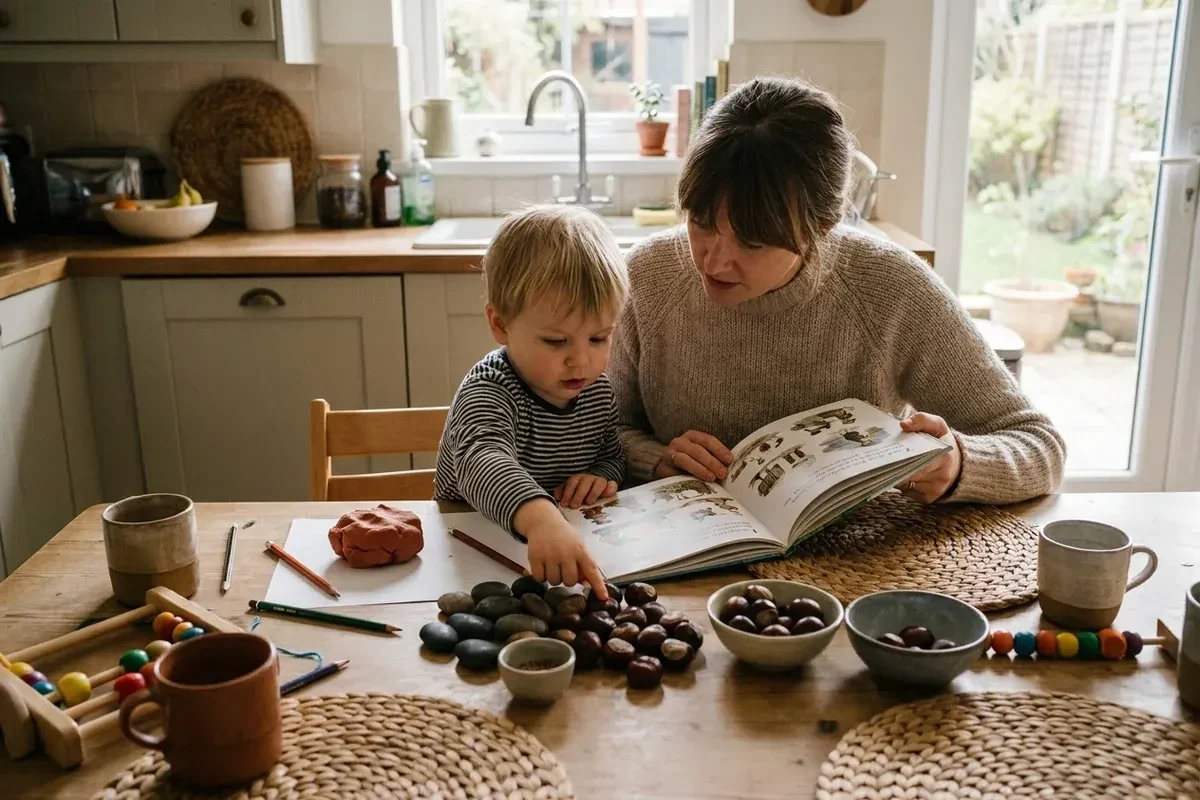
- Fine motor and creative play. Threading, cutting, playdough, drawing — the unglamorous groundwork for later handwriting and concentration.
| Approach | What it asks of you | Often suits |
|---|---|---|
| Charlotte Mason early years | Living books, nature study, short lessons, formal work delayed until around 6 | Book-loving families happy to wait on formal lessons |
| Play-based / EYFS-inspired | Structured play, continuous provision at home, gentle themes | Families who liked the idea of nursery/reception but wanted it at home |
| Wonder-led / interest-led | Following your child's questions, resourcing rather than instructing | Curious children who ask "why" constantly; parents happy without a fixed plan |
| Structured-lite (workbook spine) | A short daily phonics/maths workbook, otherwise unstructured | Families who want a light framework to feel steady |
Most families, honestly, borrow a little from each — a workbook for early number sense, living books for everything else, and long stretches of plain, unstructured play holding it all together. (If you'd like to think this through more broadly across all ages, our full guide to choosing a home education curriculum covers every approach in more depth.)
A gentle sample week (not a timetable to copy)
Monday might open with a story on the sofa — we went through a phase of the same battered library copy of The Snail and the Whale for what felt like eleven straight weeks — followed by 15–20 minutes of phonics or number sense while a younger sibling threads pasta shapes onto string nearby. Then out: some weeks a proper walk, other weeks just the garden with a magnifying glass, because at this age the outdoors is doing as much teaching as anything indoors.
Tuesday might have no formal time at all, because Monday's walk turned up a dead wasp nest and the whole morning became an accidental science lesson about paper and chewing and architecture, and nobody had the heart to interrupt it for a workbook. Wednesday, the phonics happens twice because Tuesday skipped it, and that's fine — nothing here is a debt that must be repaid on schedule.
Afternoons often dissolve into play, drawing, baking, or simply the ordinary business of a house with small children in it. No two days look quite the same, and that's not a sign anything is going wrong — it's closer to the whole point.

What our own early years actually looked like
My first child, Jude, wanted to learn. That was never the problem. But reading was hard for him.
We flexi-schooled from the age of four to six, and I watched him struggle with something he desperately wanted to be able to do. I still remember him coming home from school in tears one day and telling me he was an idiot. The other children had moved onto the blue reading books, he told me, and he was still on yellow.
He was six years old, and already measuring his ability against everybody else’s.
That moment cemented my decision to home educate full-time.
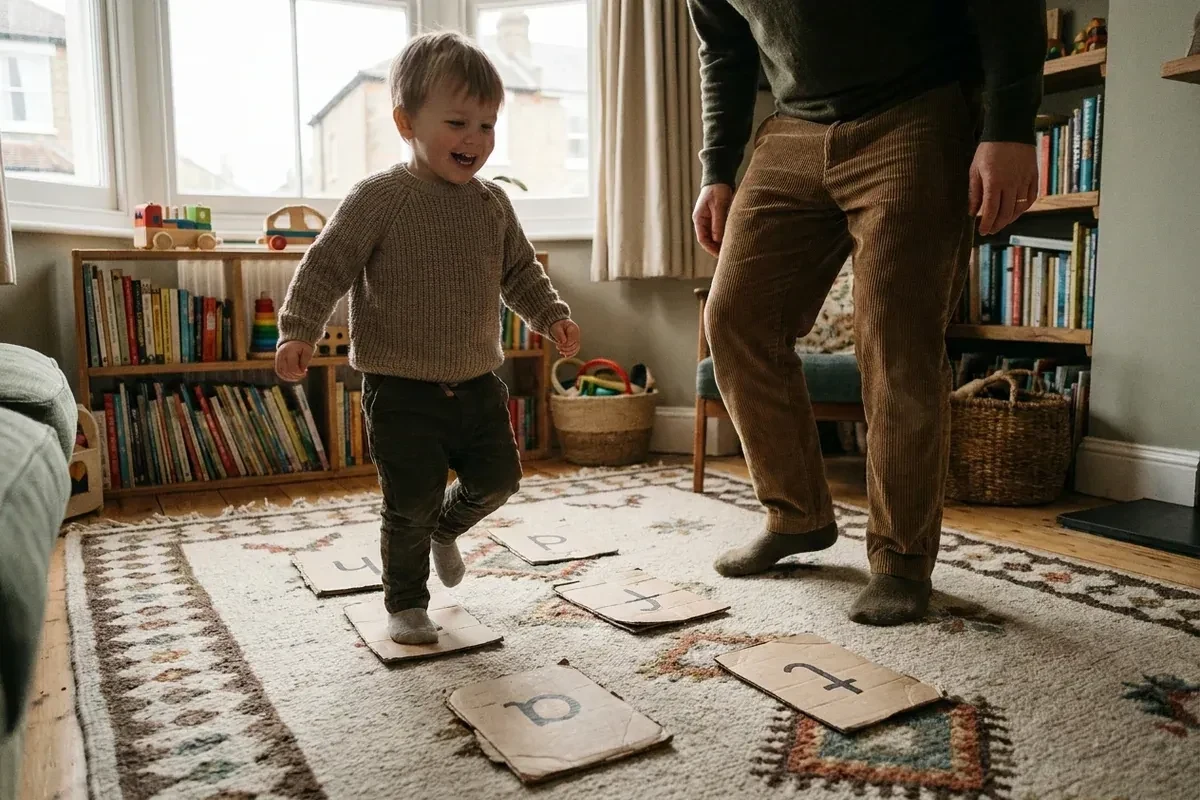
At home, I stopped trying to make phonics look like school. We made it physical. We moved, jumped and played with sounds. We practised blending through games, mess and noise. If something wasn’t working, I changed the way I taught it rather than assuming the problem was the child.
And slowly, Jude began to read.
By seven, he was devouring chapter books. There were no coloured reading levels to tell him where he should be, and no other child against whom to measure his progress. The only comparison was Jude six months earlier.
That experience shaped the way I would go on to teach all of my children — and, eventually, other people’s children too.
A child who struggles is not a child who cannot learn. Sometimes, we simply need to change our approach.
That is something I learned from my very first child, and I have never forgotten it.
Where this gets genuinely hard
It would be dishonest to leave this section entirely reassuring, so here's the part that's less often said out loud.
Comparison is relentless at this age, and it's hard to switch off. Every parent WhatsApp group, every "my four year old is reading chapter books" post, chips away at your confidence a little, even when you know, rationally, that the comparison is meaningless. This doesn't fully go away — most home-educating parents just get better at noticing it happening and choosing not to follow it down.
Siblings at different stages make "a gentle week" genuinely hard to execute. The sample week above reads calmly on a page. In a house with a four year old and a seven year old who want opposite things at the same moment, it rarely feels calm in the room. There's no clever fix for this — just the slow accumulation of small routines (independent play stations, audiobooks, patience) that make it survivable.
You may genuinely worry you're getting it wrong, with no one to check your work. Without a teacher, a report card or a class average, the only feedback loop is your own judgement — and some weeks that judgement feels shaky. Keeping a simple diary or photo record, even briefly, helps more than it sounds like it would: looking back after a term usually shows far more progress than any single hard day suggested.
How to build a gentle 4–7 routine, step by step
If you'd like somewhere concrete to start rather than assembling this from scratch:
- Watch for a fortnight before planning anything. Notice what your child is already drawn to — books, numbers, bugs, building — before choosing a single resource. This fortnight is not wasted time; it's the actual planning.
- Pick one reading resource and one number resource, and stop there. Resist the urge to buy five things at once. For reading, choose Jolly Phonics or Reading Eggs; for early maths, try BBC Bitesize’s Numberblocks games. That is genuinely plenty to start.
- Set a short, protected slot — 15 minutes is enough. Same time each day if you can manage it, so it becomes a small, expected rhythm rather than a negotiation every morning.
- Build in outdoor time as a fixed part of the day, not a reward for finishing. At this age, the walk is doing real teaching, not filling time around the "real" learning.
- Read aloud daily, even for five minutes. This single habit outperforms almost everything else on this list for long-term vocabulary and comprehension.
- Review after a term, not after a hard Tuesday. Look back at what's actually been learned and enjoyed, and adjust gently from there — most of what needs changing only becomes clear with a little distance.
Common worries, gently answered
"Are we behind because we haven't started 'proper' lessons yet?"
No. There is no legal or developmental requirement to begin formal lessons before compulsory school age, and the reading research above suggests the opposite worry — that starting formal instruction too early carries a cost — has more evidence behind it than the fear of starting late.
"Do I need to follow the EYFS framework?"
No. The Early Years Foundation Stage is a statutory framework for schools and registered early years settings — it has no legal application to home education. Some families find its seven areas of learning a useful loose checklist for inspiration; nobody is required to use it, and there's no inspection against it at home.
"What if my child isn't reading yet at 6?"
This worries a great many home-educating parents, and it's worth saying plainly: reading readiness varies hugely, including among children in school, and the Suggate research above found no lasting disadvantage to a later start. There's no legal deadline for reading fluency at home. If you're genuinely concerned — not just comparing, but noticing something that feels different — a chat with your GP or a specialist is always a reasonable step; a slower start on its own is not something to be alarmed by.
Frequently asked questions
What should I be teaching my 4 year old for home education?
Legally, nothing formal — a 4 year old isn't yet of compulsory school age. Play, conversation, story time and the outdoors are doing the real work; gentle letter and number exposure can follow your child's own curiosity.
What is a good curriculum for home educating a 4–7 year old?
There's no single right answer, but gentle, play-rich approaches (Charlotte Mason early years, EYFS-inspired play, or wonder-led learning) tend to suit this age best, paired with short phonics and number sense sessions once your child shows readiness.
At what age does a child in the UK have to start receiving an education?
At compulsory school age — the start of the term following their 5th birthday, not at 4.
How many hours a day should I home educate a young child?
There's no legal minimum. Most families of 4–7 year olds find 15–45 minutes of focused activity plenty, alongside much more time spent on play and everyday learning.
Do you get money for home educating a young child in the UK?
No, there's no government funding for home education at any age, though some local authorities offer light support such as library access or resource lists.
Where The Wonder Curriculum fits
We should say this plainly, as we always try to: we make home education resources, and this age band is one we've thought about a great deal. Here's our honest place in it.
Wonder-led learning suits this stage especially well, because a 4–7 year old's own questions are usually wonderful ones — why is the moon sometimes in the daytime? where do worms go in winter? Our materials take exactly that kind of question and wrap a short, beautiful activity around it, without asking a young child to sit still for longer than they reasonably can. But in the name of transparency, we don’t recommend doing too much formal learning before 5 years old. I always tell parents with young children that less is more with home education. Read, read, read and play, play, play. That is the strongest foundation you can build on.
If you'd like a light structure without a formal, syllabus-driven feel, our guide to choosing a curriculum can help you see how wonder-led learning compares to other approaches for this age. And if it sounds like the kind of gentle start you've been picturing, you're welcome to explore Volume One of The Wonder Curriculum and see sample pages before deciding anything at all.
Come and wonder with us.
Sources and further reading
- Education Act 1996, section 7 — legislation.gov.uk
- Educating your child at home — gov.uk
- School admissions: compulsory school age — gov.uk
- Statutory framework for the Early Years Foundation Stage — gov.uk
Teresa is a home-educating UK mama and part of the family behind The Wonder Curriculum. Legal details checked 28 August 2026 — this is general information, not legal or developmental advice, so always confirm current guidance on gov.uk and speak with a health professional if you have specific concerns about your child's development.