



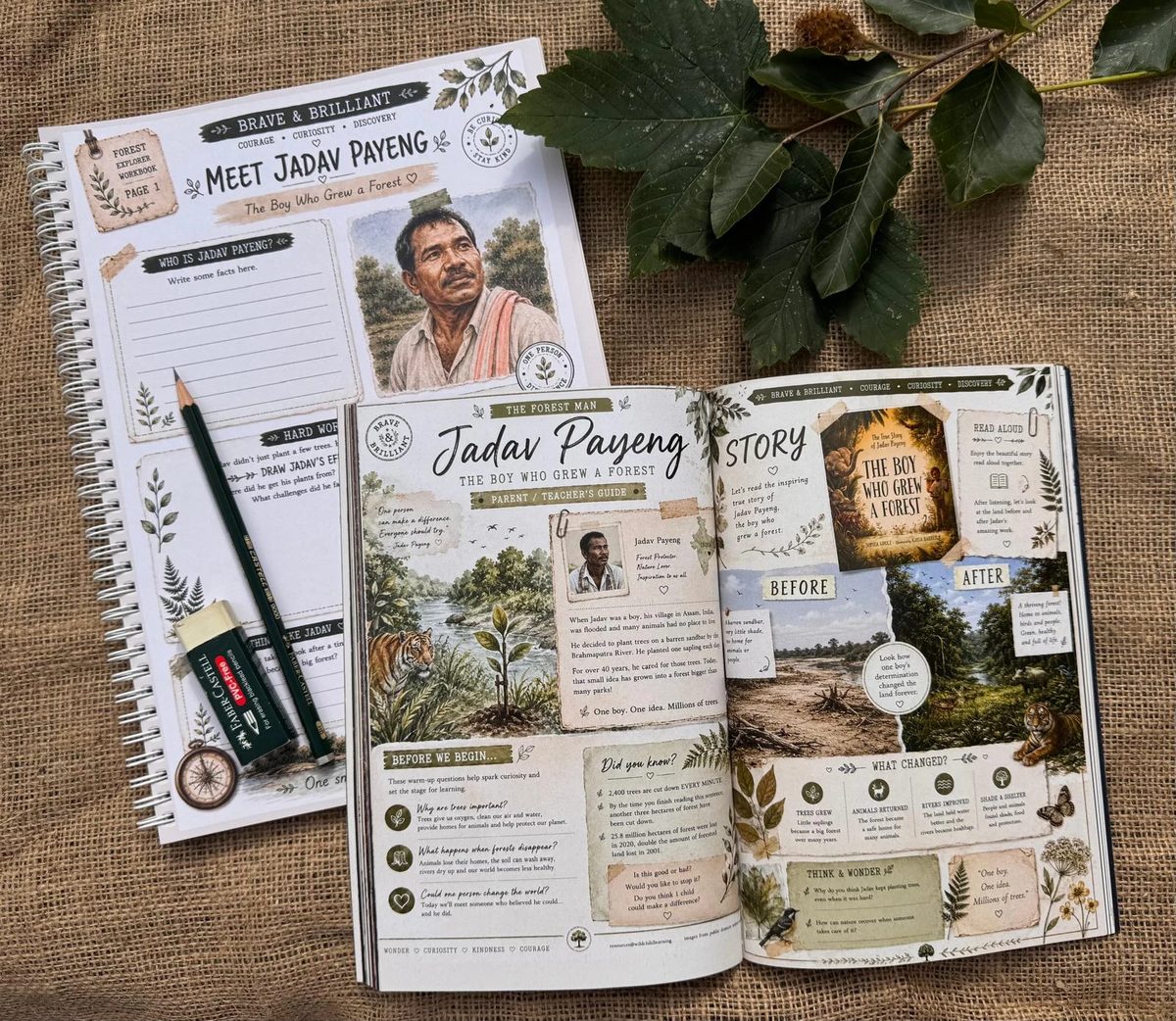
Have you been sat in bed, scrolling endless home ed accounts and researching all the pros and cons of teaching your family at home? How to do it? What to say? Is it legal? What will Sharron say?! (Everyone has a Sharron — the friend with plenty of opinions about your choices.) What will I actually teach them?
But, you know in your heart it’s what your family needs; even if it’s just for a season.
If so, you are in very good company. "What curriculum should I use?" is almost always the first question a new home-educating parent asks, and it is usually asked with a slightly racing heart. So before anything else, take a breath. There is no single right answer waiting to be found — there is simply the answer that fits your child, your family, and your season of life. This guide is here to help you find it.
What is a home education curriculum?
A curriculum is simply what you choose to teach and the resources you use to teach it. Nothing more mysterious than that.
It might be a complete boxed programme with lesson plans for every day of the year. It might be a shelf of beautiful books, a nature journal, and a maths workbook. It might be your child's own questions, followed wherever they lead. All of these are curricula — some are just written down more formally than others.
It helps to untangle three words that are often used interchangeably:
- Curriculum — what you teach (the content and the plan)
- Approach or philosophy — how and why you teach it (structured, literature-led, child-led...)
- Resources — the books, PDFs, kits and courses you use along the way
Most families find their approach first, and then choose resources that fit it — which is why the biggest section of this guide is a tour of the approaches themselves.
Do you have to follow the National Curriculum?
No — and this surprises many parents. The National Curriculum applies to state schools, not to families.
In England and Wales, the legal foundation is section 7 of the Education Act 1996, which asks parents to ensure their child receives an education that is:
"efficient, full-time... and suitable to the child's age, ability and aptitude, and to any special educational needs he may have." — Education Act 1996, s.7
Notice what it doesn't say. No subjects are listed. No hours are prescribed. No testing is required. The Department for Education's elective home education guidance confirms that home-educating parents are not required to follow the National Curriculum, provide a broad and balanced curriculum, or observe school hours.
The details differ slightly across the four nations:
| Nation | The essentials |
|---|---|
| England | No requirement to follow the National Curriculum. If deregistering from school, write to the head teacher. Local authorities may make informal enquiries about the education provided. |
| Wales | Same legal foundation as England (Education Act 1996), with Welsh Government guidance for home educators. |
| Scotland | Parents have a duty to educate "by other means" if not at school. If your child already attends a local authority school, you usually need the council's consent to withdraw them. |
| Northern Ireland | Wording mirrors England and Wales — education suitable to age, ability and aptitude, at school "or otherwise". |
(This is general information, not legal advice — always check the current guidance for your nation on gov.uk or your devolved government's website before deregistering.)
And if you're right at the very beginning of this journey — the letter, the law, the first tender month — our companion guide, How to Start Home Educating in the UK: A Complete, Calm Guide, walks through every step calmly and completely.
Many families still choose to keep loosely in step with the National Curriculum — perhaps because a child may return to school one day, or simply because it offers a reassuring map. That is a perfectly good choice. But it is a choice, and knowing that changes how the rest of this guide reads: every approach below is equally legal and you have the power to choose what’s best for you!
The main types of home education curriculum
Every approach below has helped real families flourish — and every one of them has quietly defeated other families. There is no hierarchy here, only fit. For each, you'll find what it is, what it asks of you, and who tends to love it.
Structured / school-at-home
Textbooks, workbooks, timetables — the familiar rhythm of school, recreated at the kitchen table, often aligned to the National Curriculum.
- Lovely because: clear progression, easy to track, reassuring if a child may return to school, and requires little planning once the books arrive.
- Worth knowing: it asks a lot of hours from the parent, and the children who left school because worksheets dimmed their spark may find the spark stays dim at home too.
- Often fits: families home educating temporarily, exam-focused teens, and parents who feel safest with a visible framework.
Online schools and courses
Live or recorded lessons delivered by qualified teachers — from full online schools to single-subject courses.
- Lovely because: the teaching is done for you, progression is external, and older children can work towards iGCSEs with expert support.
- Worth knowing: it is usually the most expensive route, involves significant screen time, and hands much of the joy of learning together to someone else.
- Often fits: secondary-age students, single-parent or working households, and subjects , ( such as GCSE’s, maths or science) where confidence runs thin.
Charlotte Mason / living books
A gentle, literature-rich philosophy built on "living books" (books written with warmth and narrative, rather than dry textbooks), narration, nature study, and short lessons.
- Lovely because: deeply beautiful, tried and tested for over a century, and wonderfully suited to curious children who love stories.
- Worth knowing: the full method can feel like a devotion; some families find its traditions (and its purists) more constraining than freeing.
- Often fits: book-loving families with primary-age children who want richness with structure.

Unit studies and project-based learning
One topic — castles, rivers, the human body — explored across every subject at once, often with children of different ages learning together.
- Lovely because: knowledge connects naturally, siblings share the journey, and enthusiasm carries the learning.
- Worth knowing: maths rarely fits inside a topic and usually needs its own thread; planning falls to the parent unless you buy ready-made units.
- Often fits: families with several children, hands-on learners, and parents who enjoy a little creative planning.
Unschooling / autonomous education
No set curriculum at all: the child's own interests lead entirely, and the parent's role is to notice, resource, and accompany.
- Lovely because: intrinsic motivation is the whole engine; children own their learning completely.
- Worth knowing: it requires deep trust and active facilitation (it is not "doing nothing"), and evidencing a "suitable education" to a local authority takes more thought.
- Often fits: families recovering from school-related anxiety, and parents at ease without milestones.
Wonder-led / interest-led learning
A gentle middle path — and, transparently, the approach we take at The Wonder Curriculum. Wonder-led learning begins with a child's natural questions (why is the sky blue? what is infinity?) and wraps rich, beautiful resources around them, so curiosity leads but the parent is never left planning alone.
- Lovely because: it keeps the freedom of child-led learning while giving parents something to hold — ready-made adventures that follow a question deeply rather than a syllabus broadly.
- Worth knowing: it doesn't map neatly onto National Curriculum levels, so families wanting formal benchmarks usually pair it with a structured maths or English spine.
- Often fits: curious children who ask why a dozen times a day, and parents who want learning to feel like discovery rather than delivery.

How to choose: six gentle questions
Rather than comparing feature lists, sit with these six questions — ideally with a cup of tea, and if possible peace and quiet! My quiet times were always late at night as my children were early risers. So find a time that works for you, take a pretty notebook and write these things down.
- How old is your child, and what season are they in? The early years need very little formal curriculum at all — reading aloud, playing, and noticing the world go remarkably far. The teenage years may need exam planning. Choose for the season you are in, not the one you fear.
- How does your child actually learn? Not how you wish they learned. Does the child in front of you devour books, or take things apart? Do worksheets settle them or deflate them?
- How much time and energy do you truly have? A beautiful curriculum that needs three hours of nightly preparation is not beautiful for long. Be kind to your real life.
- What is your budget? There are wonderful free resources and wonderful expensive ones, and the price rarely predicts the joy. (More on costs below.)
- Are exams on the horizon? If GCSEs or iGCSEs are likely, work backwards: external candidates typically need syllabus-aligned study from around age 14, which shapes curriculum choices for those subjects — though not for everything else.
- How much structure does your family need to feel calm? Some families breathe easier with a timetable; others feel it as a weight. Neither is wrong. Choose the level of structure that makes your home more peaceful, not less.
Write your answers down, and a shortlist tends to assemble itself. And remember: this is not a permanent decision. Almost every seasoned home educator will tell you their first curriculum was not their last.
What does a home education week actually look like?
Rather than a polished timetable, here is a real morning from our own home education diary — an ordinary one, which is rather the point.
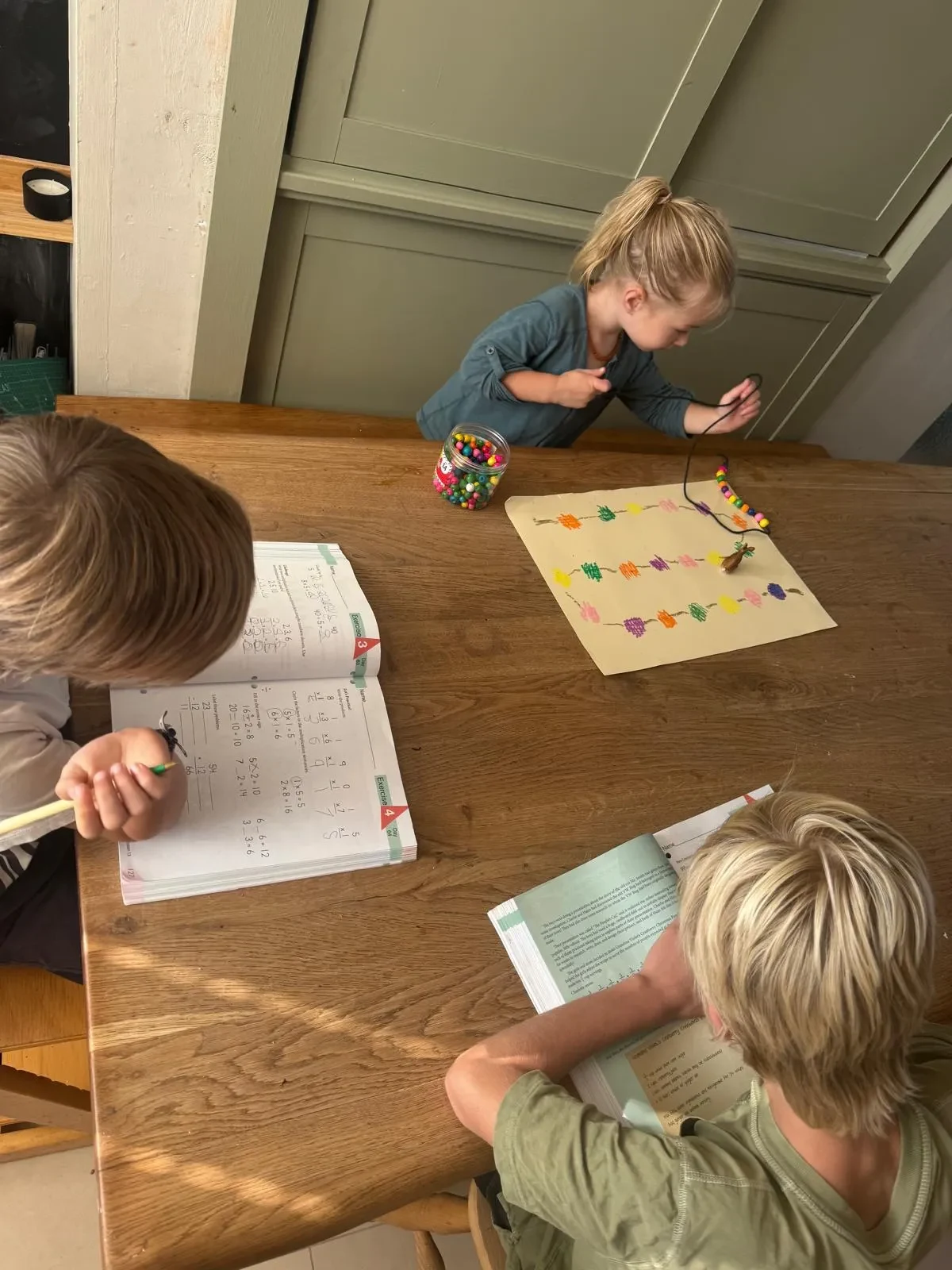
We started the morning with maths. The older ones settled at the kitchen table with their workbooks, while a little threading activity kept our youngest happily occupied (and, to my genuine surprise, it actually worked). Of course, everyone needed help at some point — first one, then another, then somehow everyone at once. Which meant we were quietly practising another important life skill alongside the sums: waiting patiently for your turn. A standard homeschool maths lesson, in other words.
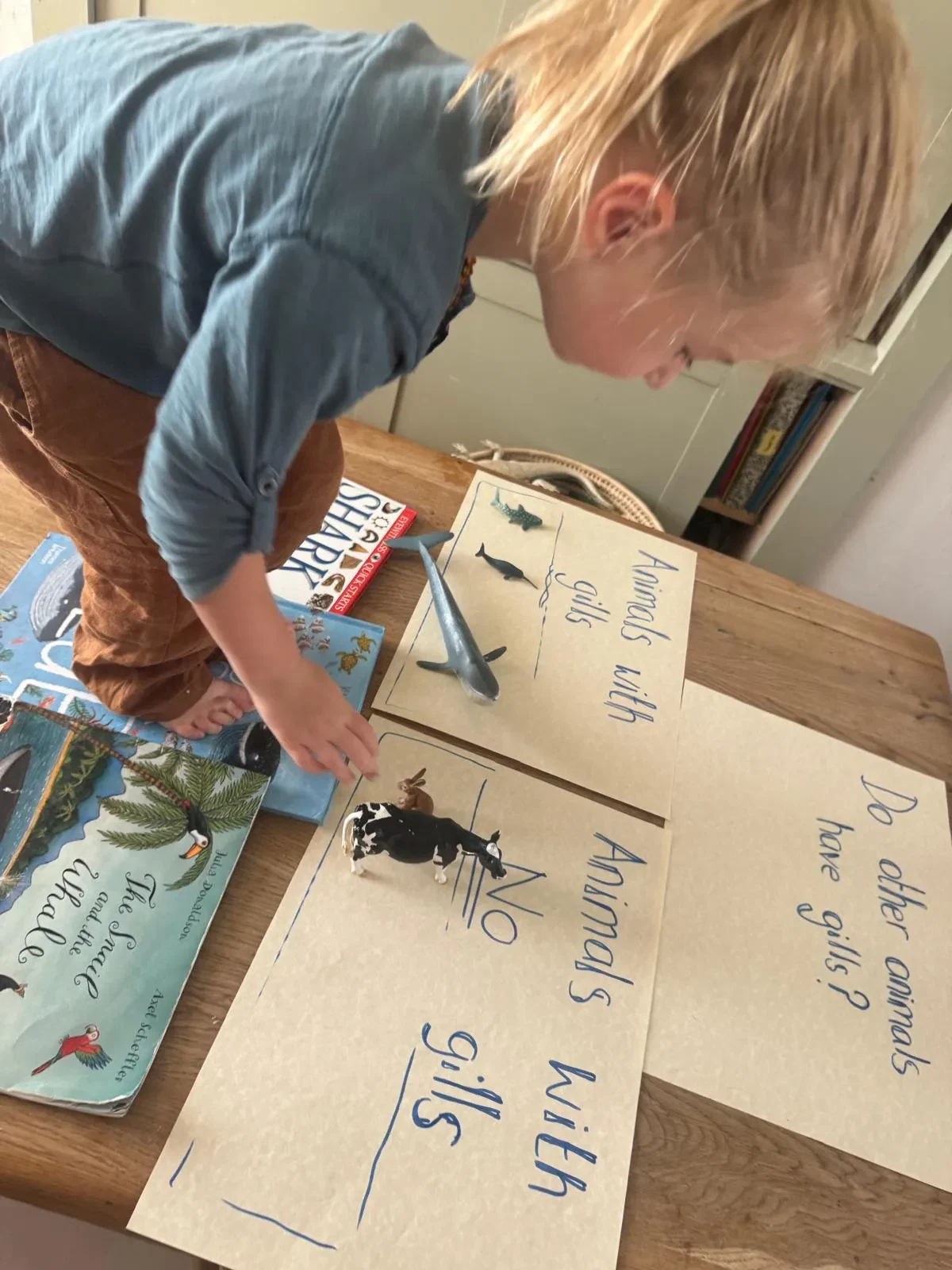
Our youngest is completely captivated by sea creatures at the moment, and the big question of the day was: "Do all animals have gills?" So we put down what we were doing and set about finding the answer together. This is one of my favourite things about home educating — being able to stop mid-plan and follow a question at the very moment the wondering happens, rather than filing it away for later.
We finished the morning with a little teamwork, when they all decided they wanted to make dinner together — which was either going to be a lovely bonding experience or complete chaos. (A bit of both, if I'm honest.)
Just another day of learning, questions, waiting our turn, and trying to fit everything in.
The honest answer is that no two weeks look alike — and that the gap between a Pinterest-perfect timetable and a real Tuesday is where most of the guilt lives. It shouldn't. An education can be efficient, full-time and suitable and still include pyjamas, puddles, and a maths lesson abandoned in favour of a hedgehog in the garden. Often, especially then.
How much does a home education curriculum cost in the UK?
Home education can cost almost nothing, or thousands of pounds a year. As a rough guide (2026 prices — always check current ones):
| Approach | Typical annual cost per child | Notes |
|---|---|---|
| Library-and-free-resources | £0–£100 | Libraries, museums, BBC Bitesize, free printables, local authority resource lists |
| Workbook / textbook spine | £50–£300 | Maths and English workbooks, second-hand textbooks |
| Literature-rich (living books) | £100–£400 | Much of it reusable for younger siblings; charity shops are gold |
| Complete boxed or PDF curricula | £100–£600 | Varies widely; digital lesson packs sit at the gentler end |
| Online school (full-time) | £2,000–£4,000+ | Plus exam entry fees of roughly £150–£300 per iGCSE as a private candidate |
Two quiet truths about cost. First, families almost always spend the most in their first year, buying things they later realise they didn't need. Buy less than you think you need, and add later. Second, remember that home education is self-funded — there is no government funding for curricula or exams, so it deserves a place in the family budget conversation early.

Common worries, gently answered
"I'm not qualified to teach."
You don't need to be. UK law requires no teaching qualification to home educate — and you have already taught this child to walk, to speak, and to ask questions. For the subjects that stretch beyond you (they will come, and that's fine), there are courses, tutors, and communities. You don't need to know everything; you need to know how to find things out together.
"What about socialisation?"
The question every home educator learns to smile at. Between home ed groups, sports, clubs, siblings, neighbours and the simple fact that home-educated children practise conversation with every age group rather than only their own year group, social life is rarely the problem families fear. It does, however, need intention — friendships won't be timetabled for you, so building community becomes part of the curriculum too.
"Can my child still sit GCSEs?"
Yes. Home-educated young people sit GCSEs and iGCSEs as private candidates at approved exam centres. Many families choose iGCSEs because the syllabuses suit external candidates (little or no coursework). It takes planning — finding a centre and budgeting for entry fees — but thousands of home-educated teenagers do it every year, and universities are long accustomed to home-educated applicants.
"What if I choose the wrong curriculum?"
Then you will be in the majority — and you will change it. Nothing about this decision is irreversible. A curriculum that isn't working can be adjusted, shelved for a season, or passed on to another family. The only real mistake is pushing on for months with something that is making everyone miserable because you paid for it. Sunk costs make poor teachers.
Frequently asked questions
What curriculum do most home educators use in the UK?
There is no single dominant curriculum — UK home education is gloriously varied. Most families blend approaches: a structured spine for maths and English, with literature, projects, or interest-led learning around it.
Is home education legal in the UK?
Yes, throughout the UK. In England, Wales and Northern Ireland you deregister by writing to the school; in Scotland you usually need local authority consent if your child attends a council school.
Do I need to follow school hours or terms?
No. "Full-time" in law does not mean school hours. Home education is famously efficient — one-to-one learning covers in a morning what a classroom covers in a day — and many families learn through the summer and holiday in June.
Can I mix different curriculum approaches?
Completely. Eclectic home education is arguably the most common approach of all, and nothing about mixing reduces the quality of the education — it usually improves the fit.
Do local authorities check what curriculum I use?
Local authorities in England have no formal duty to monitor home education routinely, but they may make informal enquiries. Keeping a light record — photos, a list of books and activities — makes such conversations easy. You are demonstrating a suitable education, not a particular curriculum.
Where The Wonder Curriculum fits
We should say this plainly: we make curriculum resources, and this guide will naturally have our fingerprints on it. So here is our honest place in the landscape above.
The Wonder Curriculum is for the wonder-led middle path — families who want learning to begin with a child's own questions, but don't want to plan every adventure from scratch. Our curriculum books and lesson PDFs each take one wonderful question (what is infinity? what is colour made of?) and follow it deeply, with stories, things to notice, and rabbit holes to fall down together.
It will suit you if you want learning that feels slower, richer, and more joyful — and if you are happy pairing it with a simple maths spine for the formal threads. It will not suit you if you need a complete National Curriculum-aligned programme with levels and tests; other approaches on this page will serve you better, and we would rather you found the right fit than bought the wrong one from us.
If this feels like the kind of learning you've been longing for, we'd love to welcome you in — you can explore Volume One of The Wonder Curriculum and see sample pages before deciding anything at all.
Come and wonder with us.