



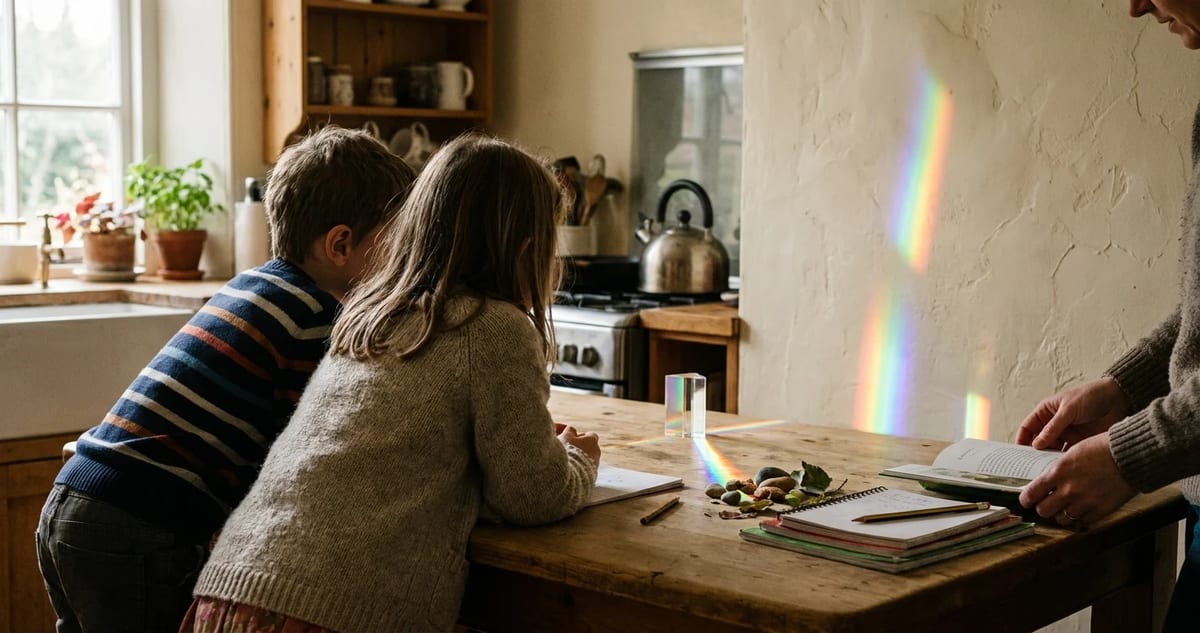
How many questions has your child asked you today?
If you have small people in your house, the answer is probably dozens. Why is the sky blue? What is infinity? Do all animals have gills? Where does the water go? Children arrive in the world running on curiosity the way the rest of us run on tea — and every one of those questions is a door held open, waiting to see whether anyone will walk through it with them.
Child-led learning is simply the decision to walk through the door.
This is the article where I want to show you the heart of how we learn in our home — not because it's the only way (it isn't — here's our honest tour of every approach), but because it's the one that changed everything for our family, and the one that eventually became The Wonder Curriculum.
What is child-led learning?
Child-led learning is an approach where children take the lead in what and how they learn — following their own interests, questions and pace — while the adult acts as a facilitator rather than an instructor.
Instead of starting with a syllabus and asking, how do I get my child interested in this?, child-led learning starts with the child and asks, what are they already interested in — and how do I feed it?
In practice, it rests on four quiet principles:
- Follow the interest. You watch what genuinely fascinates your child — not what you wish fascinated them — and you bring resources, books, materials and outings that deepen it.
- The adult is a guide, not a lecturer. Your job is to ask open-ended questions (what do you think would happen if...?), to wonder alongside, and to resist the urge to turn every moment into a lesson.
- Play and real life are the classroom. Baking is maths. Den-building is engineering. A rockpool is a marine biology department with better weather.
- Boundaries still exist. Child-led does not mean child-ruled. There is rhythm, there are routines, and there is a parent gently steering the ship — the child chooses the destinations, not whether anyone steers at all.
You will also hear this called interest-led learning or curiosity-led learning — the labels differ, the heart is the same. (We call our version wonder-led learning, and I'll explain exactly what we mean by that below.)
Why it works: what the research actually says
This isn't just a lovely idea — it's one of the better-evidenced instincts in education.
Decades of research on intrinsic motivation (the drive that comes from inside a learner, rather than from rewards or pressure) consistently finds that children learn more deeply, persist longer and think more creatively when they have a sense of autonomy over their learning. Psychology Today's summary of the research on child-led learning highlights enhanced performance and persistence, increased creativity and critical thinking, and stronger self-direction. The Education Endowment Foundation's early years toolkit reaches a similar conclusion about play-based approaches: environments that support children to explore and direct their own play carry meaningful benefits for language, literacy and mathematical understanding.
And honestly? The research matches what every parent has already seen with their own eyes. Think of the last thing your child taught themselves — the dinosaur names, the Minecraft mechanics, the entire life cycle of the frog they found. Nobody set that as homework. Interest did the heavy lifting. Child-led learning is simply the choice to put that engine at the centre of their education instead of leaving it idling at the edges.
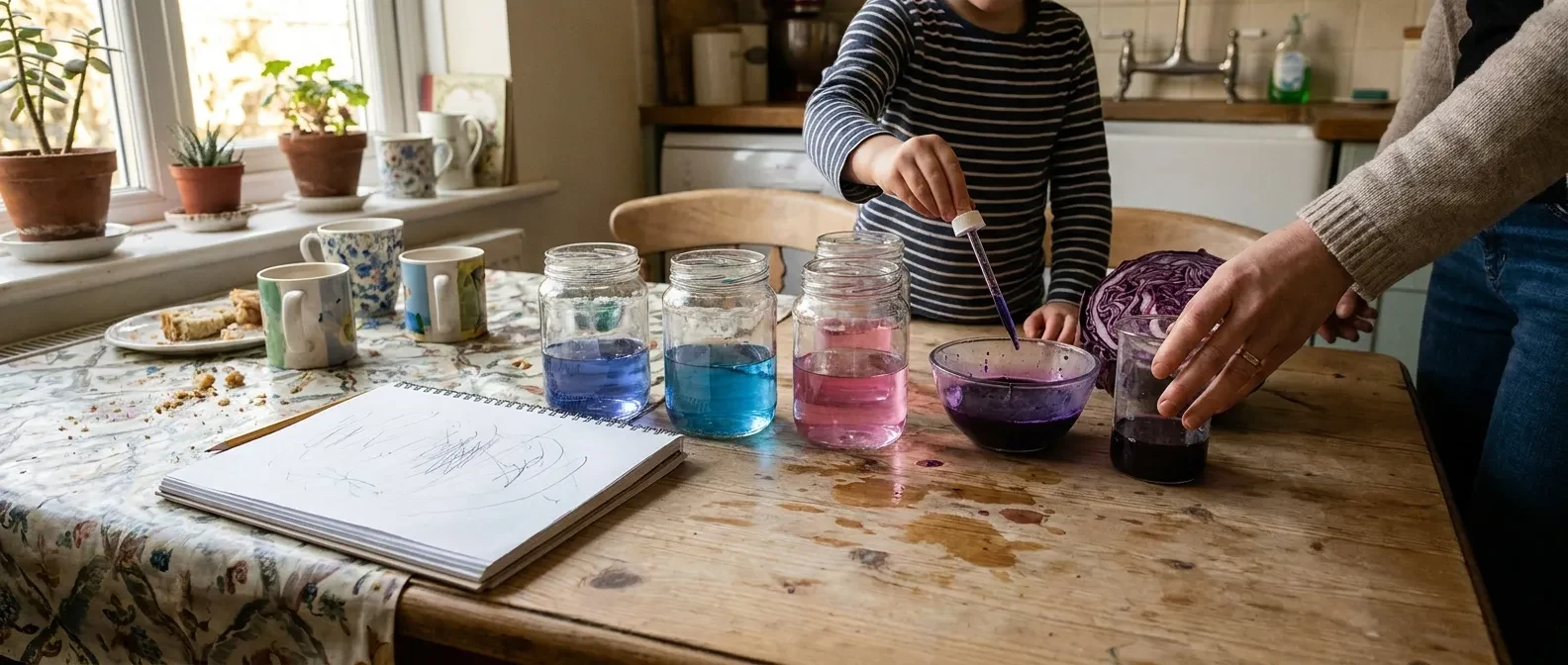
Child-led, adult-led, unschooling — and the wonder-led middle path
These words get tangled together, so here is the landscape in one honest table:
| Approach | Who sets the direction? | How much structure? | Often fits |
|---|---|---|---|
| Adult-led (structured) | The curriculum and the parent | High — timetables, workbooks, set progression | Families who feel calmest with a visible framework, exam years |
| Child-led / interest-led | The child's interests, with the parent facilitating | Flexible — rhythm rather than timetable | Curious children; families wanting connection over compliance |
| Unschooling (autonomous) | The child, entirely | None imposed — no set curriculum at all | Families with deep trust in self-direction, often after school-related anxiety |
| Wonder-led (our path) | The child's questions, with ready-made adventures to follow them | Gentle — resources provide shape, curiosity provides direction | Families who love child-led learning but don't want to plan it all from scratch |
Is this just unschooling?
No — and the difference matters, especially in the UK where unschooling (sometimes called autonomous education) has a strong and thoughtful community of its own.
Unschooling is the full philosophy: no curriculum, no imposed structure, complete trust that a child will learn what they need through living. It is legal in the UK and it genuinely works for some families — but it asks for deep conviction, and evidencing a "suitable education" to a local authority takes more careful thought.
Child-led learning is the broader spectrum, and most of us live somewhere in its friendly middle: our children's interests genuinely lead, and we keep a simple maths spine ticking along; their questions set the direction, and we bring beautiful resources to the table rather than waiting for everything to emerge on its own. If unschooling is jazz improvisation, wonder-led learning is folk music — there's a tune to hold onto, but everyone plays it their own way.
What child-led learning actually looks like at home
Let me make this concrete, because "follow the child's interests" can sound lovely and vague until you see it on an ordinary Tuesday.
The gills morning. Your youngest, mid-sea-creature obsession, might look up and ask, “Do all animals have gills?” Suddenly, what you had planned for the morning takes a back seat. Out come the books and drawings, and before you know it you’re comparing fish and dolphins and talking about how different creatures breathe. Nothing about it was on the plan. And yet, there’s biology happening everywhere.
The dinner that becomes a lesson. Perhaps the children decide they want to cook dinner. What happens next? Measuring, halving, sequencing, negotiating — and quite possibly a small masterclass in patience. In other words: maths, literacy and PSHE, disguised as chaos with aprons.
The walk that becomes a bird unit. One spotted feather leads to a borrowed bird book. The bird book leads to a feeder outside the window, a tally chart and drawings. Two weeks later, your child can identify more British birds than you can. You didn’t need to plan a bird unit. A feather did.
Notice what I'm not describing: children left alone to "get on with it." In every example there's an adult noticing, fetching the book, asking the next question, holding the rhythm of the day. That is the real work of child-led learning — it is attentive, not passive.
How to follow your child's curiosity: a gentle how-to
If you're drawn to this but unsure where to begin, here is what we've learned — often the hard way:
- Collect their questions. Keep a notebook, a jar, a note on your phone — anywhere to catch the why is the sky blue? moments as they fall. A week of collected questions is a better curriculum plan than most curriculum plans.
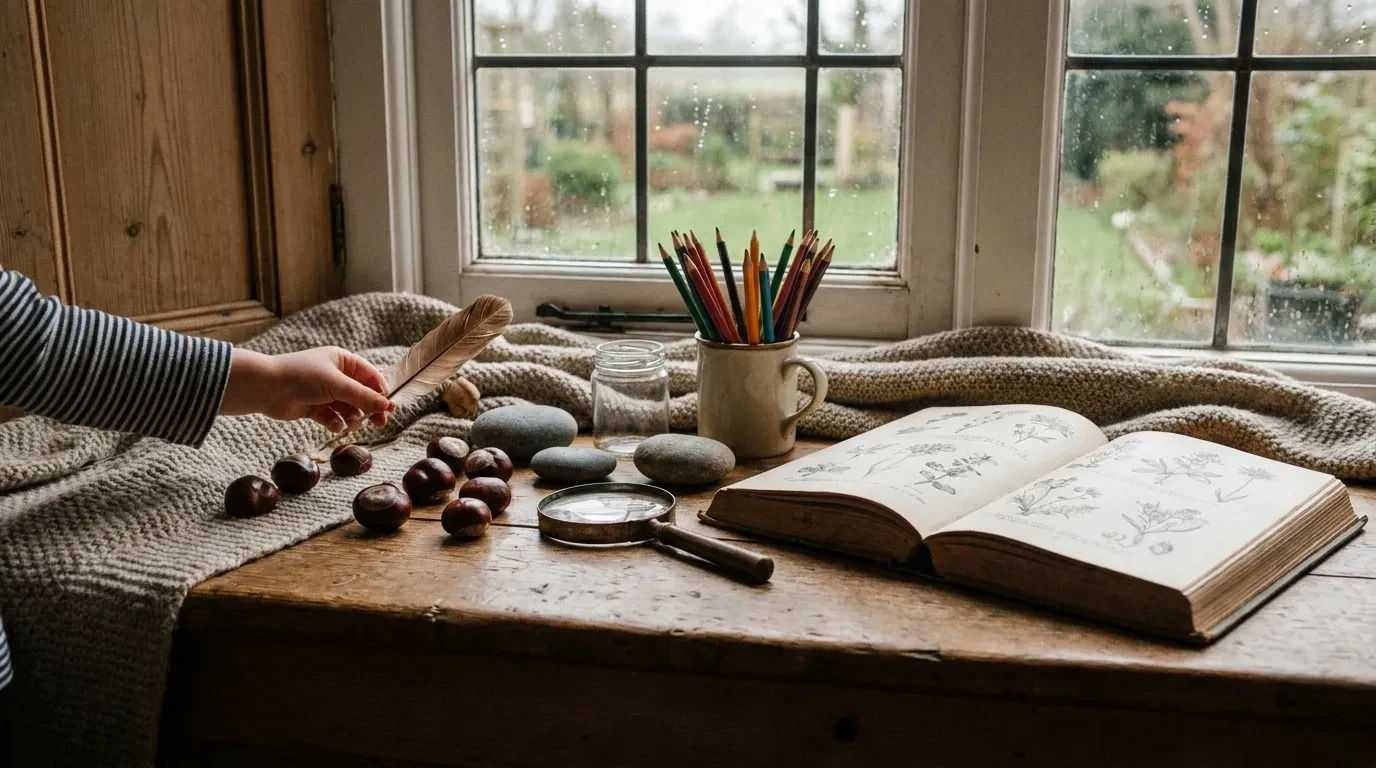
- Learn the art of strewing. "Strewing" is the home educator's word for leaving interesting things casually in a child's path — a library book on the sofa, a magnifying glass by the window, conkers on the table — with no announcement and no agenda. What they pick up tells you where to go next.
- Answer questions with questions. Not always (sometimes a child just needs to know), but often: what do you think? how could we find out? The goal isn't to withhold answers — it's to teach them that finding out is something they can do.
- Build a rich environment. Curiosity needs raw material. A library card, time outdoors, art supplies within reach, audiobooks, real tools, unhurried afternoons. Boredom, given good materials and enough time, reliably turns into something interesting.
- Follow one question deeply rather than ten shallowly. The magic isn't in covering topics — it's in the fourth day of the bird obsession, when the learning gets deep enough to stick.
- Keep a light record. A photo here, a line in a diary there. It preserves the memories, shows you (on wobbly days) how much is really happening — and quietly doubles as your evidence of a suitable education.
The honest bit: where child-led learning gets hard
Every article like this should have this section, and too few do. Child-led learning has real challenges, and pretending otherwise helps nobody.
"What if their interests leave gaps?" They will — every approach leaves gaps (schools included; ask any adult what they remember of Year 8 geography). The difference is that gaps in a child-led education sit next to unusually deep knowledge in the areas they loved. We handle the gaps that genuinely matter — reading, writing, core maths — with a simple spine, and let the rest be led.
Maths rarely emerges on its own. There, I said it. Baking and shop-play carry you a long way, but systematic maths usually needs a gentle, consistent thread. Most interest-led families (ours included) keep a short daily maths practice and lead everything else with curiosity. It is not a betrayal of the philosophy. It's a seatbelt.
Showing a local authority. In the UK you must provide an education suitable to your child's age, ability and aptitude — and if your local authority makes informal enquiries, a purely child-led education takes slightly more care to evidence. This is where the light record earns its keep: photos, book lists, a diary of questions chased. Suitable does not mean school-shaped, and the DfE's elective home education guidance confirms no National Curriculum requirement — our getting-started guide walks through exactly what the law asks.
It asks a lot of you. Noticing, resourcing, staying one library trip ahead — the mental load is real, and it's the honest reason we eventually made the resources we couldn't find. Nobody should have to invent every adventure from scratch.
"My child isn't interested in anything." They are — but a child fresh out of school often needs a season of rest (home educators call it deschooling) before curiosity resurfaces. Weeks, sometimes months. It comes back. It always comes back.
Why The Wonder Curriculum was born
And so we arrive at the part of the story that is ours.
We are a home-educating family, and we should be transparent: we make and sell the resources this section describes. But the resources exist because of everything written above — so here is the story, plainly told.
We fell in love with child-led learning the way most families do: by accident, at bedtime, mid-question. And then we hit the problem every wonder-following parent hits — the gap between the question and the resources. The question was what is infinity? The available options were a worksheet about numbers to 100, or three hours of me cobbling together something from library books and the internet after the children were asleep.
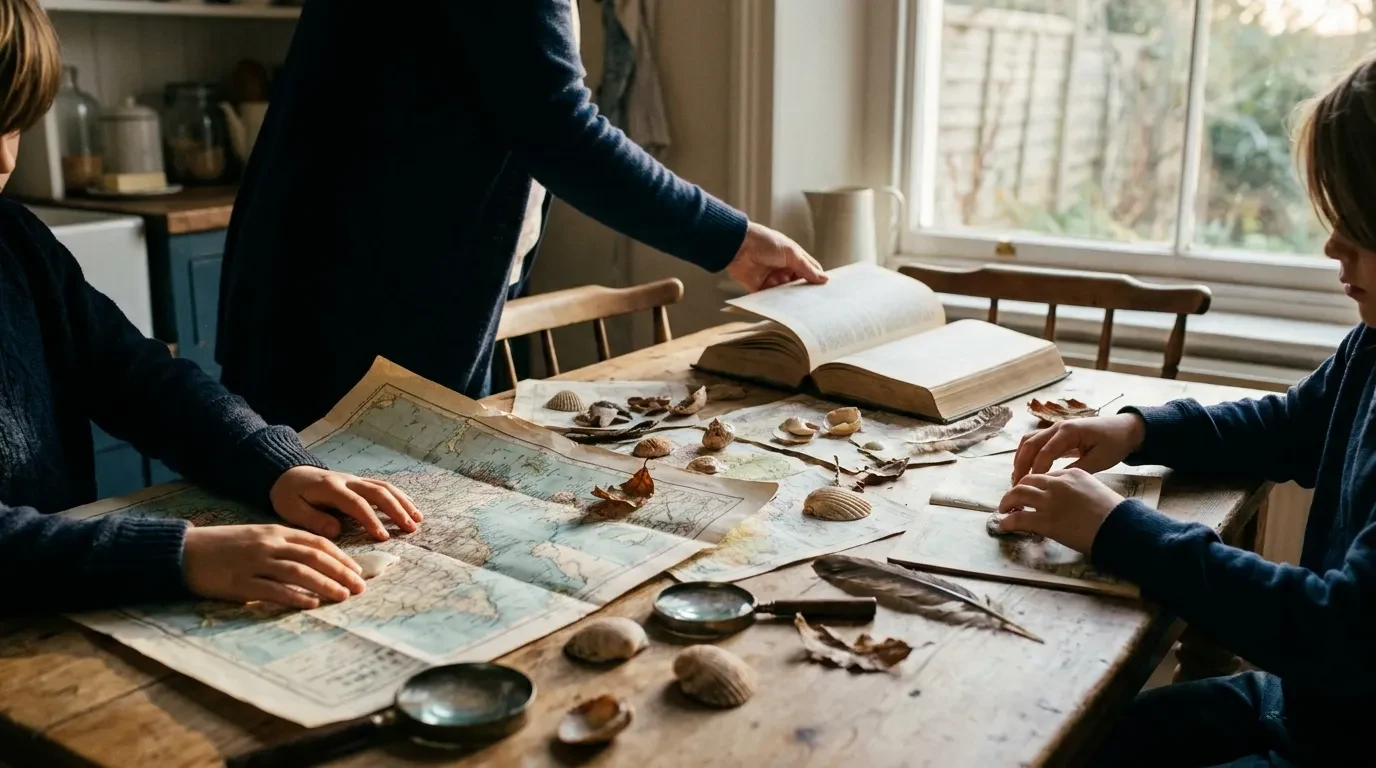
What we wanted didn't seem to exist: resources that started from the child's question — not from a syllabus — and followed it deeply, beautifully, across every subject it naturally touched, with the planning already done. So, slowly, around our own kitchen table, we made them. And The Wonder Curriculum grew out of the making.
Our values are stitched into every page:
- Wonder before worksheets. A child's question is the most powerful curriculum object in existence. We start there, every time.
- Slow, rich and joyful. We would rather follow one wonderful question for a fortnight than tick off forty shallow objectives. Depth beats coverage.
- Families learning together. Our adventures are written for real households — siblings of different ages around one table, learning alongside each other (and alongside you).
- Parents are guides, not experts. You don't need to know what infinity is. You need the adventure in your hands and the willingness to wonder out loud.
What it actually is: curriculum books and PDF adventures, each built around one glorious question — what is colour made of? what is infinity? — with stories, things to notice, experiments, and rabbit holes to fall down together. Wonder-led learning, with the planning done and the wonder left in.
And in the same honesty this whole article owes you: it will not suit everyone. If you want a complete National Curriculum-aligned programme with levels and testing, we are genuinely not it — our guide to every curriculum approach will help you find what is. But if you've read this far nodding — if your child's questions feel like the most alive thing in your home — then you can explore Volume One of The Wonder Curriculum and see sample pages before deciding anything at all.
Frequently asked questions
What is an example of a child-led activity?
Anything where the child's interest sets the direction: a snail found in the garden becoming a snail diary, a den build becoming an engineering project, baking becoming fractions. The adult's role is to supply materials and open-ended questions, not instructions.
What is the definition of child-led learning?
Child-led learning is an approach where children's own interests, questions and pace direct their learning, while adults facilitate — observing, resourcing and extending — rather than delivering a fixed, adult-imposed curriculum.
Is child-led learning the same as unschooling?
No. Unschooling is the fullest expression of it — no set curriculum at all. Most child-led families keep gentle structure (like a maths spine) while letting interests lead everything else. Wonder-led learning sits deliberately in that middle ground.
Does child-led learning work for older children?
Beautifully — the questions just get bigger. Many families stay interest-led until exam preparation begins around age 14, then use syllabus-aligned study for the handful of subjects that need it, keeping curiosity in charge of the rest.
Does child-led learning meet UK legal requirements?
It can, comfortably. The law asks for an education suitable to age, ability and aptitude — not the National Curriculum. Keep a light record of what your child explores and you'll have no trouble showing a suitable education. Full details in our complete getting-started guide.
Come and wonder with us
If a question is hanging in the air at your kitchen table right now — that question, the one you've been promising to look up — perhaps don't look it up alone tonight. Wonder is better shared.
That is the whole of what we believe, really. Start with the child. Follow the question. Keep the wonder.
Come and wonder with us.