




Part of our Wonder Series, where we explore the weird, wonderful science hiding inside everyday life.
Look up. Go on — if it's a clear day where you are, take a proper look. That blue stretching over your head, all the way to the edge of everything you can see — have you ever really wondered why it's blue, and not green, or grey, or no colour at all?
The sky looks blue because tiny molecules in Earth's atmosphere scatter blue light from the Sun more strongly than most other colours. The sky doesn't actually contain anything blue — there's no blue paint up there, no blue gas, nothing you could scoop up and hold. The blue you're seeing is a trick of light, happening constantly, right above your head, every single day of your life.
What Is Sunlight Actually Made Of?
Sunlight looks perfectly plain — just bright, ordinary white light. But that's a disguise. Sunlight is secretly every colour mixed together, all travelling in tiny waves at once. Each colour is really just a different size of wave: red light travels in long, lazy waves, while blue and violet light travel in short, quick, jittery ones.
You've already seen this trick undone, even if you didn't know it: a rainbow is simply sunlight getting split apart into all its hidden colours as it passes through raindrops.
Why Does the Sky Choose Blue?
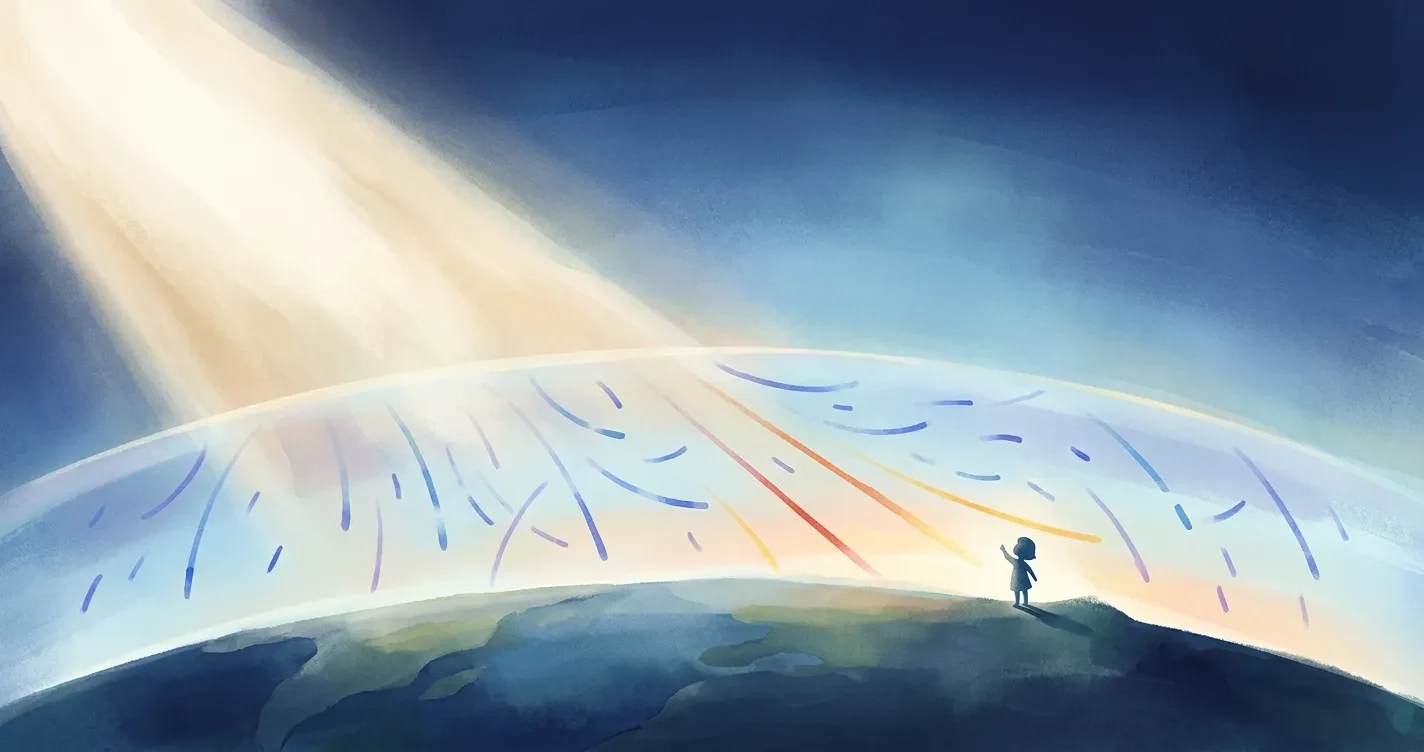
Here's where the magic happens. As sunlight travels down through Earth's atmosphere, it crashes into countless tiny gas molecules — mostly nitrogen and oxygen, the ordinary stuff that makes up the air you're breathing right now. These molecules are so small that they affect short, quick light waves far more than long, lazy ones.
This is called Rayleigh scattering, and both the Met Office and NASA explain it the same way: blue light, with its short, jittery wave, gets bounced around by these molecules far more than red light does — scattered off in every direction, again and again, all across the sky. Wherever you look up, some of that scattered blue light reaches your eye. That's not one blue patch overhead — it's the whole sky, glowing blue as countless tiny molecules scatter sunlight through the atmosphere.
So Why Isn't the Sky Violet?
Here's a genuinely brilliant question, and one that even catches scientists out in conversation: violet light has an even shorter, jitterier wave than blue — which means it actually gets scattered even more. By that logic, shouldn't the sky be violet, not blue?
Two things save blue. First, our eyes are simply much more sensitive to blue light than violet — so even though violet is being scattered like mad up there, we don't notice nearly as much of it. Second, the sun itself sends out less violet light to begin with, so there's simply less of it available to scatter in the first place. Blue wins the popularity contest for two completely different reasons, working together.
Why Do Sunsets Turn Red and Orange?
Same trick, different angle. When the sun is low near the horizon — morning or evening — its light has to travel through a much longer stretch of atmosphere to reach your eyes than it does at midday. By the time it gets to you, nearly all the blue light has already been scattered away, off in a thousand other directions, long before it arrived. What's left, mostly untouched, are the longer red and orange waves, arriving almost straight at you. That's the whole sky turning warm and fiery at sunset — not a different kind of light, just blue's turn to disappear.
Wonderfully Weird Sky Facts
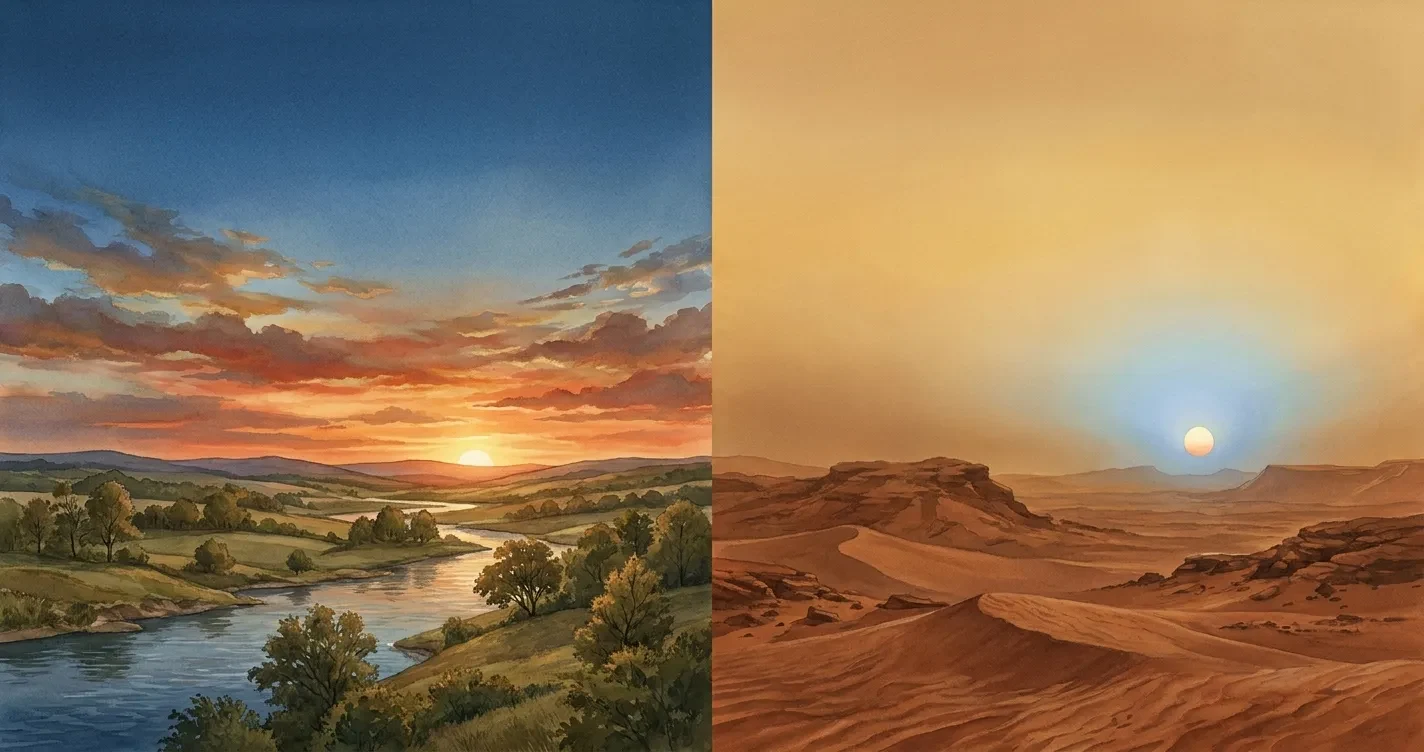
- 🔴 Mars can look almost like Earth's sky in reverse. During the day, fine rust-coloured dust gives much of the Martian sky a yellow-orange or butterscotch appearance. Near sunset, however, blue light remains concentrated close to the Sun, creating a cool blue glow. NASA's rovers have captured colour-calibrated images of this effect, including Spirit in 2005, Curiosity in 2015 and Perseverance in 2021.
- 🌅 Earth's sky might once have looked orange, not blue. Geological evidence suggests that an organic haze may have appeared at times during the Archean eon, as sunlight broke apart methane and helped form more complex hydrocarbons. Computer models developed by NASA and University of Washington researchers indicate that, when this haze was present, it could have made Earth look like a "pale orange dot" from space. Nobody can travel back to check for certain, but it is a fascinating, evidence-based possibility.
- 🌑 There's no glowing blue "sky" in space. Keep climbing upward, past the atmosphere, and the scattering trick runs out of enough gas molecules to create a coloured dome. That's why space looks black even in bright sunlight.
- 🌙 The Moon and Mercury have black skies, even in daylight. Both possess extraordinarily thin exospheres rather than substantial atmospheres, so there are far too few particles to scatter sunlight into a bright, coloured sky. NASA describes the Moon's exosphere as being mostly empty space, with molecules so sparse that they rarely collide.
Down the Rabbit Hole: Are All Blue Skies Blue for the Same Reason?
Now you know Earth's trick — but what about other blue things out in space? Neptune, way out at the edge of our solar system, looks strikingly blue too. Surely it's doing the exact same scattering trick as Earth?
Actually, no — and that's the wonderful surprise. NASA explains that Neptune's blue comes mostly from a completely different process: its atmosphere contains methane gas, which absorbs red light rather than scattering it away. With the red light swallowed up, mostly blue light is left to bounce back out to our eyes. Neptune's neighbour Uranus has methane too, but appears a paler blue-green, because an extra hazy layer in its atmosphere mutes the effect.
So Earth and Neptune can look like blue-sky cousins from a distance, using different tricks to get there — Earth scatters blue light through its air, while methane on Neptune absorbs red wavelengths and leaves more blue-green light to return. Atmospheric haze changes the exact shade too. Blue, it turns out, is a colour the universe seems to enjoy inventing in more than one way.
Try It Yourself: Make Your Own Sky in a Glass
You can make a simple model of sky colours at home using a classic light-scattering demonstration.
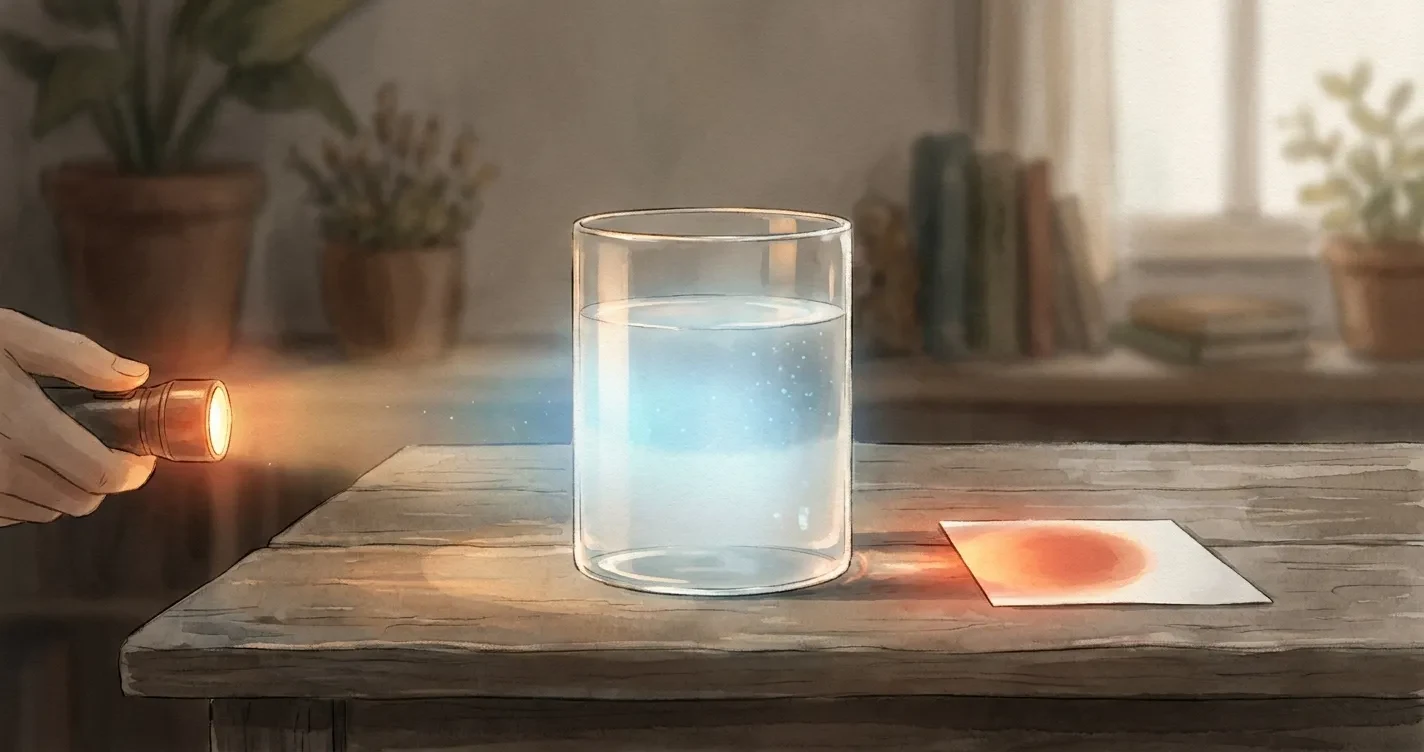
- Fill a clear, straight-sided glass with water, and take it somewhere you can dim the lights.
- Add a few drops of milk and stir gently, just until the water turns very slightly cloudy — not fully white.
- Shine a small torch through the glass from the side. Look at the water from another angle, keeping your eyes away from the direct beam. You may notice a subtle bluish glow within the glass.
- Hold a piece of white card behind the glass, opposite the torch. The light reaching the card may appear warmer, orange or reddish — especially if you add another drop or two of milk.
The tiny droplets in the milk scatter different wavelengths of light by different amounts. It isn't exactly the same process as Rayleigh scattering in Earth's atmosphere, because milk droplets are much larger than gas molecules, but it creates a useful miniature model of a blue sky and reddish sunset.
An Important Grown-Up Note
Keep the torch pointed through the glass and onto the card, and never shine it into anyone's eyes. An adult should help dim the room and position the equipment. And while we're talking about looking at bright things: never look directly at the real Sun, even for a moment, because it can permanently damage your eyes.
The Big Takeaway
The sky was never hiding a colour up there, waiting to be found. It's something far stranger and more wonderful than that: light meeting impossibly tiny, invisible molecules, scattering through the air and painting the whole sky blue through the laws of physics — then repainting it orange and red every evening, just as reliably.
So next time someone asks why the sky is blue, you'll know it isn't really a simple question at all. It's one of the most beautiful tricks the universe plays, right over your head, for free, every single day.
Sources and Further Reading
- NASA Space Place: Why Is the Sky Blue?
- Met Office: Why the Sky Is Blue and Sunsets Are Red
- NASA: Sunrises and Sunsets on Mars
- NASA: Why Uranus and Neptune Are Different Colours
- Royal Society of Chemistry: Tyndall Effect Demonstration
Curious about more strange science hiding in everyday life? Don't miss How Do We See Colour? to keep exploring how light becomes everything you see.