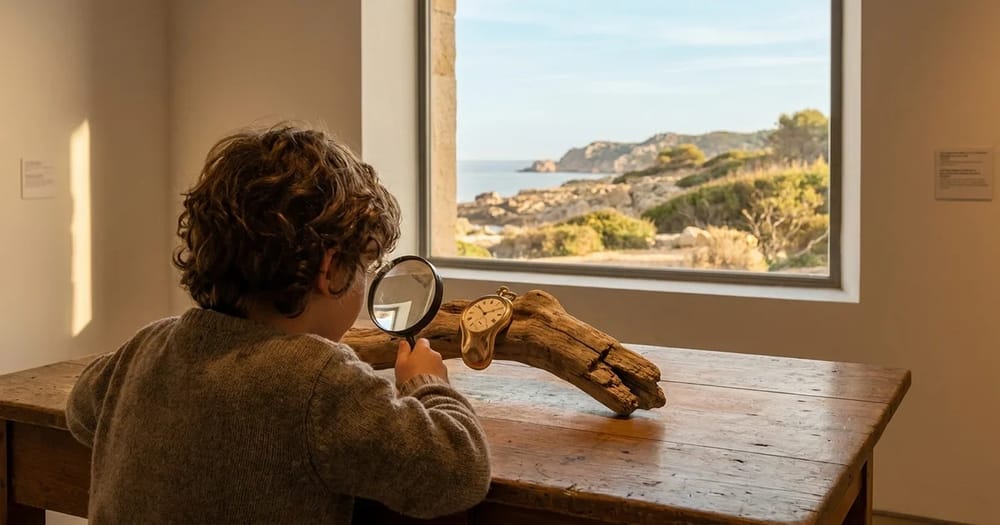
Imagine reaching for a clock and finding that it has gone soft.
Its metal case bends over the edge of a branch. Its face droops like warm wax. The hands are still there, but the clock can no longer do the sensible job a clock is supposed to do.
That is the surprise waiting inside The Persistence of Memory. Salvador Dalí painted recognisable objects with extraordinary care, then placed them in a world where the usual rules had quietly slipped away.
The result is unsettling, funny and strangely beautiful. It also leaves us with a question that has lasted for nearly a century: why did Dalí paint melting clocks?
What are you really looking at?
Dalí completed The Persistence of Memory in 1931. It is an oil painting on canvas, now in the collection of the Museum of Modern Art in New York.
At first, the scene appears almost still. There is a calm sea, sharp golden cliffs and a flat stretch of ground. Then your eyes meet the clocks. Several pocket watches have become limp. One hangs from a bare branch; another folds over the edge of a block; another lies across a pale, face-like creature in the centre.
A solid watch in the foreground is covered with ants. Far away, the coast remains bright and sharply painted, as if it belongs to the waking world. Nearer to us, everything feels stranger.
This mixture matters. Dalí did not paint a blurry dream. He used smooth paint and precise detail to make impossible things look touchable. MoMA describes the work as a meeting of hyper-realistic technique and a world in dissolution: hard things become soft, useful things stop working, and familiar objects behave as though they are alive.
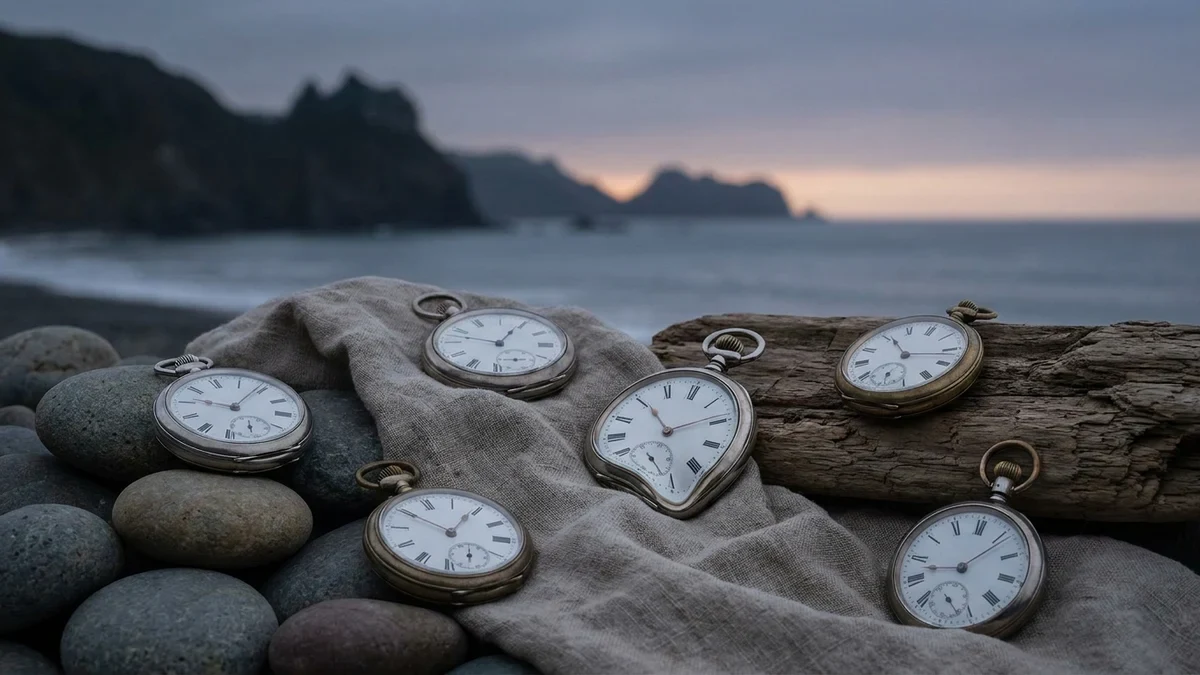
Why did Dalí make the clocks soft?
The most honest answer is that we know part of the story, but not all of it.
Dalí later connected the watches with soft Camembert cheese. He referred to them as the “Camembert of time”, and museum accounts describe cheese as a probable spark for the image. Picture a firm round of cheese slowly losing its shape in the warmth. Now imagine the same transformation happening to a pocket watch.
That jump—from cheese to time—is wonderfully Surrealist. It brings together two things that do not logically belong together, then paints the result with such care that your eyes almost believe it.
But the cheese story is not a complete answer. A painting is not a riddle with one hidden solution printed at the back. Dalí’s clocks may make you think about how time feels different when you are waiting, dreaming, remembering or having fun. That is a possible response, not a fact we can prove about every clock.
Perhaps that uncertainty is part of the reason the image has lasted. A normal clock tells everyone the same time. Dalí’s soft clocks ask whether time always feels the same.
Was the painting about Einstein’s theory of relativity?
You may read that Dalí was illustrating Albert Einstein’s theory of relativity. It is a tempting story: a famous scientist changes how people understand time, and a famous artist paints clocks that will not stay rigid.
However, the museum evidence does not establish Einstein’s theory as Dalí’s reason for creating the clocks. The better-documented clue is Dalí’s own cheese comparison.
That does not mean you are forbidden to connect the painting with science. Art can lead your thoughts in many directions. It simply means we should separate what Dalí is recorded as saying from what later viewers have guessed.
Good wondering leaves room for both evidence and imagination.
A dream painted with waking-world precision
The Persistence of Memory belongs to Surrealism, an international movement that explored dreams, the unconscious mind, chance and unexpected combinations.
Surrealist artists did not all make the same kind of work. Some used games and automatic drawing. Some combined objects that normally had nothing to do with one another. Some created images so realistic that the impossible part felt even more surprising.
Dalí became famous for that last approach. In this painting, the coastline looks solid, the shadows feel believable and the clocks have weight. Yet the scene cannot exist in ordinary life.
Look at the pale form beneath one of the watches. MoMA describes it as an approximation of Dalí’s own face in profile. It is not a neat portrait. It seems to be becoming—or unbecoming—something else. That uncertainty makes it feel like a shape you might recognise for one second in a dream and lose the moment you wake.
The real landscape behind the strange one
Not everything in the painting came from an imaginary place.
The golden cliffs in the distance recall the coast of Catalonia, Dalí’s home. This is one of the loveliest tensions in the picture: a landscape connected to real memory holds objects that have escaped reality.
Have you ever dreamed about somewhere you know well? Perhaps your kitchen was exactly right, except the cupboards opened into the sea. Or your street looked ordinary, except everyone moved backwards.
Dreams often begin with familiar pieces. Memory supplies the room, the path or the face. Imagination changes the rules.
That may help us look at the title in a new way. Even when everything nearby has become unstable, the distant landscape remains clear. We cannot prove that Dalí intended one fixed message, but we can notice the conversation between memory, place and changing time.
Wonderfully weird facts about The Persistence of Memory
- It is surprisingly small. The painting measures only 24.1 × 33 centimetres—about the size of a laptop screen. Its fame can make us imagine an enormous canvas, but the real work invites close looking.
- It was painted in 1931. The material is oil paint on canvas, and the Fundació Gala-Salvador Dalí records that it is signed and dated in the lower-left corner.
- The ants are not random decoration. MoMA explains that ants recur in Dalí’s work and represent decay, especially here as they gather on the solid gold watch.
- The coast is real. The distant cliffs refer to Catalonia, giving the dreamlike scene a firm link to Dalí’s own world.
- The famous “two-hour masterpiece” story is doubtful. A recent MoMA examination warns against repeating that tidy tale as fact.
- The clocks are pocket watches, not wall clocks. They are small personal objects made useless by their softness—one more reason the image feels both familiar and impossible.
Down the Rabbit Hole: What happened when Dalí returned to the painting?
More than twenty years later, Dalí revisited the same strange landscape.
The later work is called The Disintegration of the Persistence of Memory and dates from 1952–54. Instead of simply repeating his famous image, Dalí breaks the scene into floating blocks and separated pieces. It feels as though the first painting has been taken apart so we can peer between its parts.
Why would an artist return to an old idea?
Perhaps the most interesting answer is another question: if you remade a picture from years ago, what would you keep—and what would you change?
You might have new interests, new fears or new knowledge. Dalí’s second painting reminds us that an artwork does not always finish a thought. Sometimes it begins a conversation that the artist continues much later.
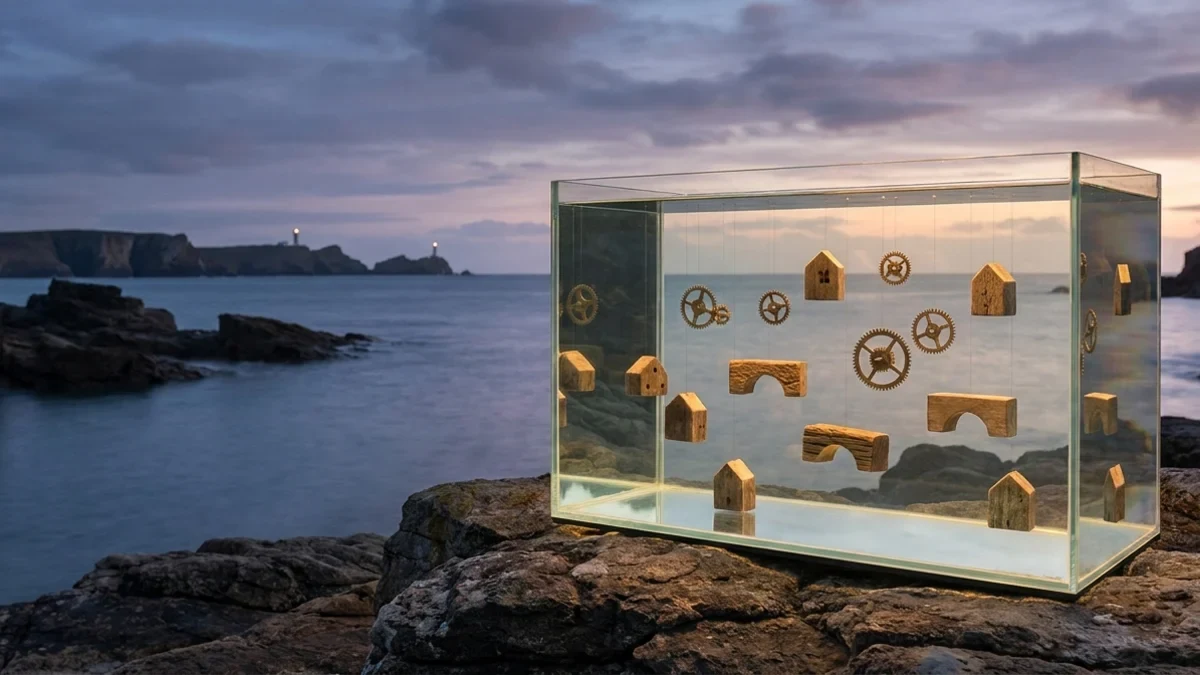
Try It Yourself: Make the hard soft and the soft hard
You do not need melting metal or a dramatic dream to think like a Surrealist. You only need two ordinary objects and one impossible change.
- Choose something hard: a key, spoon, stone, toy brick or clock.
- Choose something soft: a scarf, sponge, cloud, jelly or cushion.
- Draw the hard object behaving as if it were soft. Could a key curl around a tree? Could a spoon slump over a chair?
- Now reverse it. Draw the soft object behaving as if it were hard. Could a cloud hold up a house? Could a scarf become a staircase?
- Add a real place you know—a kitchen, garden or beach—and paint or colour it carefully.
- Give your picture a title that raises a question rather than explaining everything.
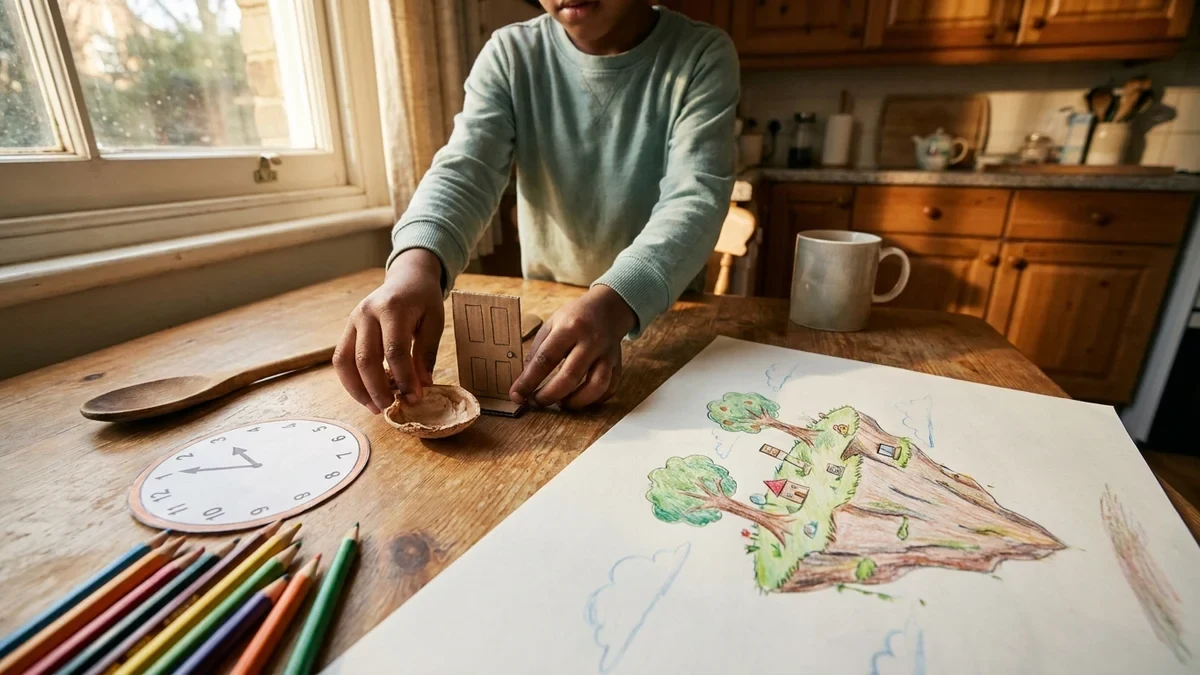
When you finish, look again. Which part seems most believable? Which part changes the rules? Does the picture feel funny, peaceful, eerie—or all three?
The Big Takeaway
Dalí’s melting clocks became famous because they do something simple and unforgettable: they turn a dependable object into a question.
We know that The Persistence of Memory was painted in 1931, that its distant cliffs connect to Catalonia, and that Dalí linked the soft watches with Camembert cheese. We also know that he used extraordinary precision to make this impossible world feel almost real.
What we do not have is one final sentence that unlocks every object. That is not a failure. It is an invitation.
The next time a minute crawls, a holiday flies past or a dream makes time behave strangely, perhaps you will remember those soft watches. Perhaps you will notice that clocks can measure time—but art can ask what time feels like.
Sources and Further Reading
- Museum of Modern Art: The Persistence of Memory collection record
- MoMA audio description: The Persistence of Memory
- MoMA curator audio: Surrealism and the “Camembert of time”
- MoMA Magazine: the story behind Dalí’s painting
- Fundació Gala-Salvador Dalí: catalogue record
- Tate Kids: explore Surrealism
- Encyclopaedia Britannica: description and history
Continue exploring with our free Who Was Salvador Dalí? resources, then look for the hidden shapes in Swans Reflecting Elephants or discover why Dalí made a Lobster Telephone.
Come and wonder with us.