


The Seven Continents
Review one common seven-continent model before asking how Türkiye can have land in both Europe and Asia.
Explore a country where Europe and Asia meet, with ancient cities, colourful markets, cave homes, coastlines, mountains and delicious food.
Türkiye stretches across both southeastern Europe and western Asia. Most of its land lies in Anatolia, while a smaller part lies in Europe, separated by the Bosphorus and other waterways.
It is home to busy modern cities, farming regions, mountains, forests and long coastlines. These resources invite your family to explore connections between geography, culture and history without treating one city or tradition as the whole country.

Begin with the continents, locate Türkiye and then look closely at Cappadocia’s extraordinary volcanic landscape.
Review one common seven-continent model before asking how Türkiye can have land in both Europe and Asia.
Find the country and explore introductory facts about its geography, cities, language and culture. The video uses the English name Turkey; Türkiye is now the country’s official English name.
See Cappadocia from above and notice the valleys and rock formations shaped from volcanic material over millions of years.

Use these books to explore Türkiye, travel, culture and geography together.
Demi retells a Nasrettin Hoca folktale in which a shabby coat, a grand coat and a feast reveal the foolishness of judging people by appearance.

Use these extras to explore language, culture, history and learning games.
Listen to the rhythm and sounds of Turkish while learning to count from one to one hundred.
Watch children taste several packaged snacks, then compare their reactions and wonder which foods are everyday, regional, homemade or celebratory.

An interactive quiz to revisit Türkiye’s geography, culture, language and history.
Follow your curiosity into volcanic geology, changing city names, tea, tiles and woven patterns.
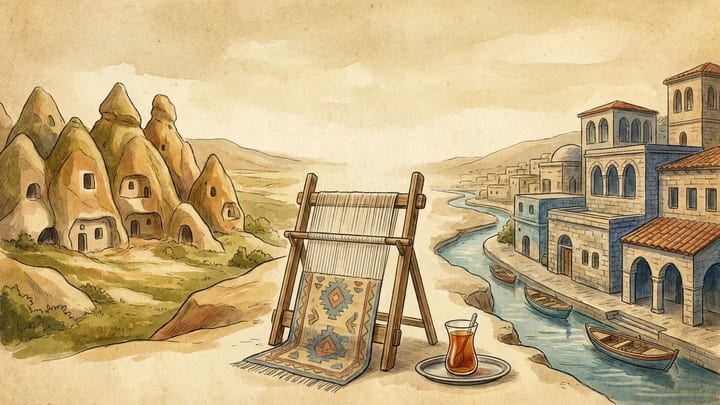
Investigate how Cappadocia’s soft rock formed, why Istanbul has had several names, how carpets are woven, why tea glasses have a narrow waist and how Iznik tiles are made.
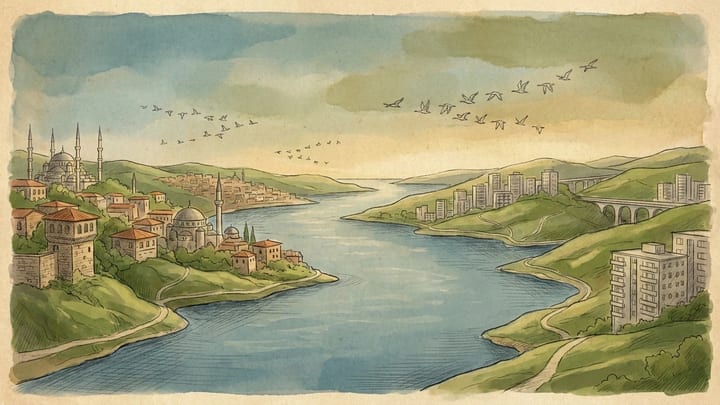
What changes—and what stays connected—when a city grows on two continents?
Subscribe for more wonder-filled resources, lesson ideas and gentle prompts to help your family explore geography, culture, history and the wider world together.
No spam. Unsubscribe anytime.