wonder episode mazing brain (00:00)
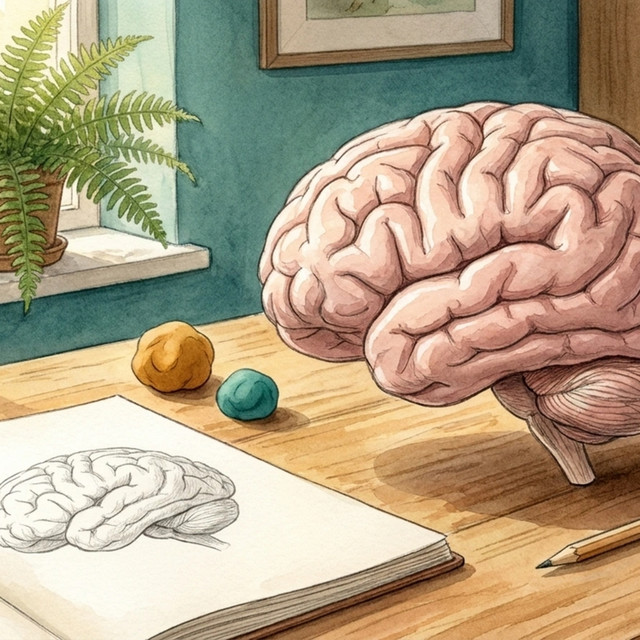
Wonder of your brain. Before we begin, I want you to think about this. Everything you have ever learned. Every person you recognize. The sound of someone's laugh. The taste of your favorite food. That song you somehow remember every word of, even though it's really, really annoying. Your brain makes all of that possible, and yet you've probably never given much thought to how.
wonder episode mazing brain (00:29)
We spend so much time thinking about the world around us that we rarely stop to wonder about the thing doing the thinking. So today that's where we're going. Welcome to this week's wonder episode. We're exploring something familiar enough to help you find your way around your own home, but so mysterious that scientists are still working out how it works. Your amazing brain. So
wonder episode mazing brain (00:57)
Let's begin because this small organ weighs roughly 2% of your actual body weight. About 1200 to 1400 grams if you are an adult. Which, if you want to visualize that, is about a bag and a half of sugar. So that is the size of your brain. It's not very big, but it's pretty incredible. And
wonder episode mazing brain (01:26)
This organ that helps you feel pain cannot feel pain itself. What rewind? Let's begin with this because I think it is quite extraordinary. We know that if you stub your toe, what happens is messages travel through your nervous system up into your brain, and then your brain translates that as pain and you go, ow, that really hurt. And it all
wonder episode mazing brain (01:56)
In a fraction of a second. So your brain helps you to understand pain and to experience pain. Thank you very much, brain. But did you know that the brain itself has no pain receptors? That doesn't mean you can never get a headache that your scalp can't hurt, or the tissues surrounding your brain never get hurt or pain have any pain, because you can get headaches and sensitivities, but the brain
wonder episode mazing brain (02:24)
Brain itself? Nope. No pain receptors. This is one reason that surgeons can sometimes operate on a person's brain while that person is still awake. Can you imagine that? So the medical team makes sure that the sensitive tissues are numbed, the patient is carefully supported, and they can actually be removing or operating on the brain itself.
wonder episode mazing brain (02:53)
And while doing it, they're asking the patient what their name is, to check that they're okay. They might say, okay, move your hand, move your other hand, what's this picture we're showing you? Why? Why do you think they're doing that? Well, the surgeon is working near the parts of the brain that support these abilities. So they're checking what the person can do to make sure that the team is protecting them and that the surgeon is not.
wonder episode mazing brain (03:20)
Cutting into an area that they don't want to be cutting into. But it doesn't cause the person any pain because there is no pain receptors inside our brain. Isn't that actually incredible? Imagine answering a question while a surgeon is working on the very organ that's helping you to understand the question. It just blows your mind.
wonder episode mazing brain (03:45)
So we can study the brain from outside, and we can sometimes ask its owner to tell us what's happening from the inside. But there's still so much to learn about this incredible part of our body. So let's go to something you might think you know. How much of your brain do you use? Some people might say 5%, some people say only 10%.
wonder episode mazing brain (04:14)
And I've heard it myself. And it sounds good. If we only could use the other ninety percent, then maybe I could speak twelve languages, or I might just remember where I left my keys instead of losing them all the time. But do you know that the 10% claim is a myth? We use far more than that. Different networks become more or less active depending on what we're doing. We might be listening to music, catching a ball, remembering an anniversary,
wonder episode mazing brain (04:44)
even just falling asleep and they all involve different patterns of activity. That doesn't mean that every neuron fires at once. A working brain needs carefully organized activity. I like to think of it like an orchestra. Now you wouldn't improve the music of an orchestra by asking every instrument to play its loudest note throughout the entire performance. It would be chaos, wouldn't it? But timing matters
wonder episode mazing brain (05:14)
Connections matter and working together matters. And the scale of that cooperation is really, really important. And in the brain, it's almost difficult for us as humans to take it in. Your brain contains tens of billions of neurons. A neuron is a nerve cell that receives and sends information. So you've got so many in your head.
wonder episode mazing brain (05:44)
One widely used scientific estimate puts the number at around eighty six billion. But that could be conservative, it could be up to a hundred billion, but let's stick at eighty six billion for now. The exact number does vary between people. But for now we're gonna stick at that. Let's imagine that we count one number per second. So we count from one to eighty six billion. Have you any idea how long that would take?
wonder episode mazing brain (06:14)
Do you think it take eight months, eight years, eight years, eight hundred years? Actually, it would take more than two thousand seven hundred years. And that's just counting the neurons before we even begin considering the connections between them. And all this activity is happening right now while you are listening to this podcast. So
wonder episode mazing brain (06:45)
How much can a brain actually store? This might be where people are getting the 5% and the 10% figure. Have you ever had a message appear on your phone that says storage full? No more photographs, no more videos, and you have to start deleting things or pay for extra storage. Nobody wants to do that. Does something similar happen in our brains? Could you learn so much that there's just simply no room left?
wonder episode mazing brain (07:14)
Researchers have tried to estimate the brain's storage capacity and the numbers are extraordinary. In twenty sixteen, science reported on research suggesting that a human brain's potential memory capacity could be around okay, I'd never heard of this word before, I hope I'm pronouncing it right. A petabyte. Now a petabyte is about one million gigabytes.
wonder episode mazing brain (07:42)
So imagine a thousand computers, each with a thousand gigabytes of storage, that gives you a sense of the amount of information we're talking about. It's incredible. The research focused on synapses. So these are the junctions that connect the neurons. So if you imagine these nerve cells, the neurons are passing on information. The connection is called the synapse between the two neurons.
wonder episode mazing brain (08:11)
This is where they send the information across. So by studying tiny differences in synapses in a rat's brain, researchers estimated that these connections could hold considerably more information than previously thought. That helped them build an estimate of what a whole human brain might hold. Now there's an important distinction here. This is an estimate based on how connections might store storage.
wonder episode mazing brain (08:38)
We haven't measured a person's memories and discovered an exact storage limit. And a brain does not have neat computer files, so you can't click on a folder last Tuesday, replay it all perfectly, or go back first day at nursery, first day on holiday in twenty sixteen. It doesn't work like that at all. But this science article even compared this estimate with the internet.
wonder episode mazing brain (09:07)
And it was a striking comparison from a p report from twenty sixteen, rather than just a literal claim that you could kind of make up off the spot. It compared everything to the size of the internet. Everything that we could possibly remember in our brain is infinite, like the internet. Isn't that actually incredible? The scale is remarkable.
wonder episode mazing brain (09:36)
Think about the things that you carry around all the day and it's in your brain and you don't think about it at all. For example, the layout of a home you no longer live in. My daughter can describe in detail her first house. And she only lived there till she was three. And she remembers everything. She can take you through it. She knows where her bed was, she knows what she saw out the window, she knows which side the bathroom is in. And it's there. Rent free in her brain.
wonder episode mazing brain (10:06)
The words of a song, how to balance on a bicycle, the moments that matter as well as the ones that really don't. So much of life can be held in something that is small enough to fit inside a skull. Yet somehow, with all that going on, we can still forget why we open the fridge. Which brings us to another question. If our brains are so remarkable, why can they be so easily distracting?
wonder episode mazing brain (10:35)
Why can you read a paragraph, reach the bottom and realise you haven't taken in any of it? Why can you run upstairs to get something, stand in the bedroom and think I have no idea why I came here? Let's try something and it might make a little bit more sense. Let's say the numbers from one to ten.
wonder episode mazing brain (11:01)
Easy. You did it perfectly. Now say the letters from A to J. Go for it.
wonder episode mazing brain (11:14)
Brilliant. Well done. Fairly familiar sequences, but I am going to challenge you now. Alternate between them. So one A, two B, three C, four D. Keep going. Can you do it?
wonder episode mazing brain (11:35)
Did you slow down? Have you had to stop and find your place? Are you counting on your fingers? It's actually a lot harder to do, but you can count to ten without thinking. You can say the A B C no problem. But switch in between two sets of instructions this gives us a small taste of what can happen when we try to do several things that need our concentration or attention.
wonder episode mazing brain (12:03)
Course there are some things we can do together. We can walk and talk, we can breathe while reading, but when two activities both demand concentration, we often switch between them rather than give each our full attention simultaneously.
wonder episode mazing brain (12:19)
Switching actually has a cost. It can take extra time and increase mistakes. Sorry to all you parents out there like myself that like to try and multitask. Think about it like this: if you are trying to understand something difficult while checking messages and listening to a conversation, your brain has quite a job on and it's going to make mistakes.
wonder episode mazing brain (12:47)
So multitasking is not something our brains are very good at. And that little experiment explained why. So here's a question. Here's a question for all of us, whether you are five or fifteen or fifty. When did you last give something your whole attention? So all the brain power.
wonder episode mazing brain (13:13)
Person? When someone was talking to you, did you give them your full attention? You put your phone down, you put your book down, you stopped playing with your toys? Or a piece of music? You just sat with your eyes closed, listening to every note? Or a page in a book, concentrated fully on what you were reading? Or maybe you looked out the window at something growing in the garden or a bird or a butterfly? I wonder.
wonder episode mazing brain (13:42)
What we might notice if we stayed with these things a little longer.
wonder episode mazing brain (13:51)
And then there's what happens when we sleep. From the outside, a sleeping person might look as though very little is happening. But inside the brain activity continues and sleep is really important for learning and memory. And during some of that sleep, we dream. You can be lying perfectly still in your own bed while apparently searching for a classroom you haven't visited for twenty years or flying, completely possible in your dream.
wonder episode mazing brain (14:20)
Or having a perfectly ordinary conversation with someone who, on reflection, when you wake up, was a talking horse. But at the time, you may accept all of it as completely normal. And then you wake up and think, what on earth was that about? Dreams are often especially vivid during a stage of sleep called R E which stands for rapid eye movement. But we can dream in other stages too. So that's quite amazing, isn't it? Your brain does something.
wonder episode mazing brain (14:49)
even while you are asleep. But here's something I love. Scientists still haven't settled exactly why we dream. They don't know for definite. There's ideas about links with memory and emotions, but researchers are continuing to investigate them. We can measure brain activity, we can study sleep and patterns, and we can even ask people to describe what they experienced. Yet something so familiar
wonder episode mazing brain (15:18)
Still holds unanswered questions. So have you ever wanted to be an explorer and thought I have to travel to the edge of the earth or I even have to go to the bottom of the ocean? You don't. In fact, maybe you can explore something that is at the very tip of our fingers sleep. Isn't that incredible?
wonder episode mazing brain (15:47)
Falling asleep can help us to travel to new places, and there's still a lot for us to explore and learn. And your brain, it isn't finished. It is still changing, which is quite incredible. So let's think of something that you once had to concentrate very hard to do reading, riding a bicycle, playing a chord, or for you grown ups perhaps learning to drive. At first there was so much to remember.
wonder episode mazing brain (16:15)
Where to look, what to move, what came next. But with practice, some of those actions became more familiar. Learning can change the connections within the brain. Scientists call its ability to change neuroplasticity. Do you want to say that word with me? Neuroplasticity. And if you've got the weekly wonder PDF, you're going to do an experiment that tells you all about this.
wonder episode mazing brain (16:43)
So it's a really useful word for us to know because it reminds us that the brain is a living tissue and it can change. It responds to different experiences. And I think for your experiment you need play-doh and a toy car. So I hope you enjoy playing with them. But that's the cool thing about the brain. It isn't a finished machine. In fact, its ability to change continues all throughout your life.
wonder episode mazing brain (17:11)
That doesn't mean that every skill comes easily or that if you practice it will never be difficult. People have different needs and the right support matters. But there is something hopeful in knowing that something that you find difficult today doesn't tell the whole story of how you might feel about this thing in the future. And it applies to us grown ups too. We can be so comfortable at saying, I'm just no good at that.
wonder episode mazing brain (17:38)
I'm not a maths person, I can't draw. But maybe a more interesting question would be, hmm, I'm not really very good at that yet. What might help me to learn? Maybe I need a different explanation. Maybe I need a video tutorial. Maybe I need it broken down into smaller steps. Or maybe I just need time to practice without being watched.
wonder episode mazing brain (18:07)
Or someone willing to learn alongside us might help. And here is a lovely possibility for families. The grown-up doesn't always have to be the person who already knows. You can both be beginners. You can both be curious. And you can both say, I don't understand that yet. Let's find out. And that's one of the best things about home education and raising children.
wonder episode mazing brain (18:36)
If you can admit to your child that you don't know everything, but you are prepared to knuckle down and learn alongside them, you are teaching them so much more than knowledge. You're teaching them how to get knowledge, the process of learning. And that's a really, really special thing. So here is your invitation for this week.
wonder episode mazing brain (19:00)
You may or may not have downloaded this week's Wonder PDF, which is all about the brain. But choose one of these questions to investigate together. How do we recognize a familiar voice? Or why does a smell sometimes bring back a memory? This is fascinating. What happens to our brain if we learn a new language? Choose the question that makes you want to keep talking. Make a guess, look for evidence, and
wonder episode mazing brain (19:29)
See whether you can change your mind because that too is a remarkable thing that the brain can do. It can hold an idea, meet something unexpected, and reconsider. The organ helping you listen to this episode is also helping you question it, connect it with your own experiences, and decide what you want to discover next. I think that that is worth wondering about. So until next time, keep noticing, keep asking, and
wonder episode mazing brain (19:59)
and keep wondering.