The first morning arrives. There may be a stack of new books on the table, a timetable you spent an evening making, and a child who wants to stay in pyjamas and read the same comic again.
Perhaps you thought you would feel certain by now. Instead, at half past nine, you find yourself wondering whether everyone else is learning more, doing more, getting it right.
A change this big takes some getting used to. You and your child have both been shaped by ideas about what a school day looks like. You do not have to replace those ideas all at once, or make your home look like a classroom to make this a meaningful beginning.
This guide explores what deschooling means, what a gentler first month might look like, and how to make room for both your child’s needs and your responsibilities as a home educator. If you haven’t yet taken the practical first steps, our calm guide to starting home education in the UK covers those.
What is deschooling?
Deschooling is the adjustment families may go through when a child leaves school and begins learning at home. It can mean giving yourselves time to settle into a different rhythm, noticing how your child responds, and questioning the assumption that learning must happen at a desk, to a bell or in a particular order.
It is not a formal programme. There is no certificate, official length or single set of activities. Some families find the word useful; others do not use it at all. Not every child has had a difficult school experience, and not every family will need the same kind of transition.
The word has a longer history. Ivan Illich’s 1971 book Deschooling Society questioned the role of institutions in education. The home-education use of the word is narrower: it usually describes a family’s adjustment after leaving school, rather than Illich’s wider argument about society.
Deschooling and unschooling: what is the difference?
Deschooling usually describes a transition. Unschooling is an ongoing approach to home education in which learning is led substantially by a child’s interests and experiences. A family may spend time adjusting and later choose a structured curriculum, an unschooling approach or a mixture. One does not require the other.
Nor is deschooling simply another word for home education. Learning at home is the wider arrangement; deschooling is one way of describing the change into it.
Why might the first month be slower?
Leaving school changes more than where a child spends the morning. The journey, familiar adults, classmates, lunch breaks and expectations may all change at once. Even when the decision feels right, that is a lot to take in. Teresa describes the first weeks as a decompression: when you come up from a deep dive, you don’t shoot straight to the surface. You rise slowly and let things settle.
A slower start can give you room to reconnect and notice. When is your child most comfortable talking? What do they choose when there is time to choose? Do they welcome suggestions, or do they need you to sit alongside them for a while without asking for an outcome?
For a child whose experience of school was difficult, familiar books, extra rest or quiet time may feel especially important. For another child, the best beginning might include a reading plan, a familiar routine or plenty of activity. If your child is persistently distressed, struggling with sleep or everyday life, or you are worried about their safety, speak to your GP or another appropriate professional, and seek urgent help if safety is immediate.
Clinical psychologist Dr Naomi Fisher has written about how her own view of children leaving school changed. Early in her career she worked with young people who had stopped attending, and saw it as anxiety-driven school refusal to be resolved by a return to school. Over time she came to recognise that, for some children, school had become a place where they felt unable to learn or be themselves (The Psychologist, British Psychological Society). Whatever your child’s story, the first weeks are a chance to find out what helps them learn well.
A gentle first month is not an instruction to leave your child alone with an empty day. It is an invitation to begin attentively, rather than trying to do everything before you know what either of you needs.
How long does deschooling take?
There is no official length. Home educators often pass on a rule of thumb: roughly one month for every year your child spent in school. So a child who has done two years might settle in a couple of months, while a child who has done seven or eight may need much longer. Teresa calls it folk wisdom rather than a law: “this rule of thumb isn’t a deadline, it’s just permission.” A child might settle sooner, need longer, or feel comfortable with one part of home education while finding another difficult.
Think of the first month as a useful place to pause and notice, not as a finish line. Ask yourselves what is helping, what feels too much and what your child would like to try next, and keep reviewing as you go.
Teresa and Emily call it the three-week wobble. The honeymoon fades, someone asks “so how’s the homeschooling going?” at exactly the wrong moment, and the doubt arrives on cue. Teresa compares it to the day-three baby blues a midwife warns you about: when a wobble is expected, it loses much of its power. It may come in week three, much later, or not at all. A hard Tuesday does not tell you everything about the decision you have made.
How to start deschooling: a gentle first-month guide
The following is an example, not a four-week programme you have to complete. You can revisit any step, take longer, or bring in more structure sooner if that helps your child.
1. Begin with a conversation
Ask what your child is looking forward to and what they are worried about. If talking feels difficult, offer choices: “Would you rather have a quiet morning or go to the library?” A younger child might answer through play; an older child might want time to think before talking.
Share the practical things that will still happen: meals, sleep, opportunities to learn and time with people they care about. A little predictability can be reassuring without reproducing a school timetable.
2. Notice before filling the calendar
For a few days, look for patterns rather than trying to judge them. What holds their attention? When do they have energy? Are certain noises, writing tasks or social situations difficult? What support makes an activity more accessible?
If your child likes a plan, make one together. If a packed plan leads to frustration, try offering one or two possibilities instead. Observation is useful when it leads to a thoughtful response, not when it becomes another test to pass.
3. Offer a few gentle anchors
A rhythm might include breakfast, a story or conversation, an opportunity to go outside, and a shared meal. Another family might prefer a morning checklist, a regular online lesson or quiet time after lunch. Anchors are there to help, not to become rules that make everyone feel they have failed.
A sample day could look like this:
- Morning: breakfast and a chapter read aloud, or a comic chosen at the library.
- Late morning: plan a simple lunch together, read the recipe and measure ingredients. Let your child help in a way that suits them.
- Afternoon: a walk, a visit to a friend or time building, drawing or following an interest at home.
- Later: make a note of a question that came up and decide together whether to return to it tomorrow.
That is one illustration, not a template. Adjust it for your child’s age, abilities and any special educational needs.
4. Follow an interest a little further
If your child wonders why the moon is visible in the daytime, you might borrow a book, look at the sky together and return to the question when it comes up again. If they love games, you could ask them to explain the rules, map a world or work out a strategy. A question may lead somewhere unexpected; it is also fine if it ends after five minutes.
The point is not to turn every interest into a lesson. Sometimes the pleasure of doing something together is enough for that moment. At other times, you can offer a book, question or resource that helps an interest grow.
This is the heart of what we call wonder-led learning: starting from a real question your child cares about and following it as far as it wants to go. A question as simple as why is the sky blue? can turn an ordinary walk into an afternoon of looking, asking and trying things out.
5. Look back and make a small plan
At the end of the week, ask: What did we enjoy? What was difficult? What did we notice about reading, numbers, conversations or questions? What might we offer next?
You may decide to introduce a regular maths activity, revisit a favourite book, find a group or speak to someone about support. A plan can be simple and flexible; it can change when you learn more about what your child needs.

Deschooling activities and examples
You do not need to do all of these. Choose what interests your child, adjust for their needs and leave room for their own ideas.
- Read aloud. Teresa calls reading aloud the quiet hero of deschooling. It asks nothing of the child, with no output and no performance, and it rebuilds the feeling that stories and time together are a pleasure, not a task. Some of her favourite memories are of her children piled on top of her “like a bunch of puppies” with a book.
- Visit the library. Browse comics, information books, audiobooks or stories without needing to finish everything you borrow. Ask the librarian about local activities.
- Cook something familiar. Read a recipe together, measure ingredients, compare quantities and notice what changes as food cooks. For a child who dislikes measurements, start with stirring or choosing the meal.
- Make or mend. Build a cardboard town, repair a toy or draw a map of an imagined place. Offer tools or help without taking over the project.
- Explore nearby. A park, a bus journey or a short visit to a museum can lead to questions about plants, maps, people or history. Accessibility and energy matter more than the distance travelled.
- Play a game. Board games, cards and digital games can offer opportunities for strategy, reading, conversation or problem-solving. Enjoyment does not have to be disguised as work.
- Find a connection. A familiar friend, home-education group, sports club or online community may be a welcome part of the week. Some children prefer one person at a time; others miss a bigger group.
Screens can be a source of comfort, connection and learning as well as a source of family disagreement. Rather than assuming all screen time is either good or bad, talk about what your child is doing, how they feel afterwards and what balance works alongside sleep, relationships, movement and other opportunities.
Deschooling yourself: the parent’s part
The school clock can stay in a parent’s head long after a child has left the classroom. The same child playing on a Saturday might feel perfectly ordinary; on a Tuesday morning, you may suddenly worry that they should be sitting at a desk.
That feeling deserves kindness, but it is not by itself a measurement of your child’s education. When the worry arrives, try asking a more useful question: What have we offered, noticed and learned this week, and what could we try next?
What deschooling looked like for us
Teresa first met deschooling from the outside. Her mum home educated Teresa’s much younger sister, and Teresa, by then an adult, remembers looking at her sister’s day and asking why she wasn’t doing school at two o’clock, or why she hadn’t started by ten. “I did not get it at all,” she says now. Even after years of home educating her own children, she describes those school-shaped expectations as something she has “battled with up to this very day”.
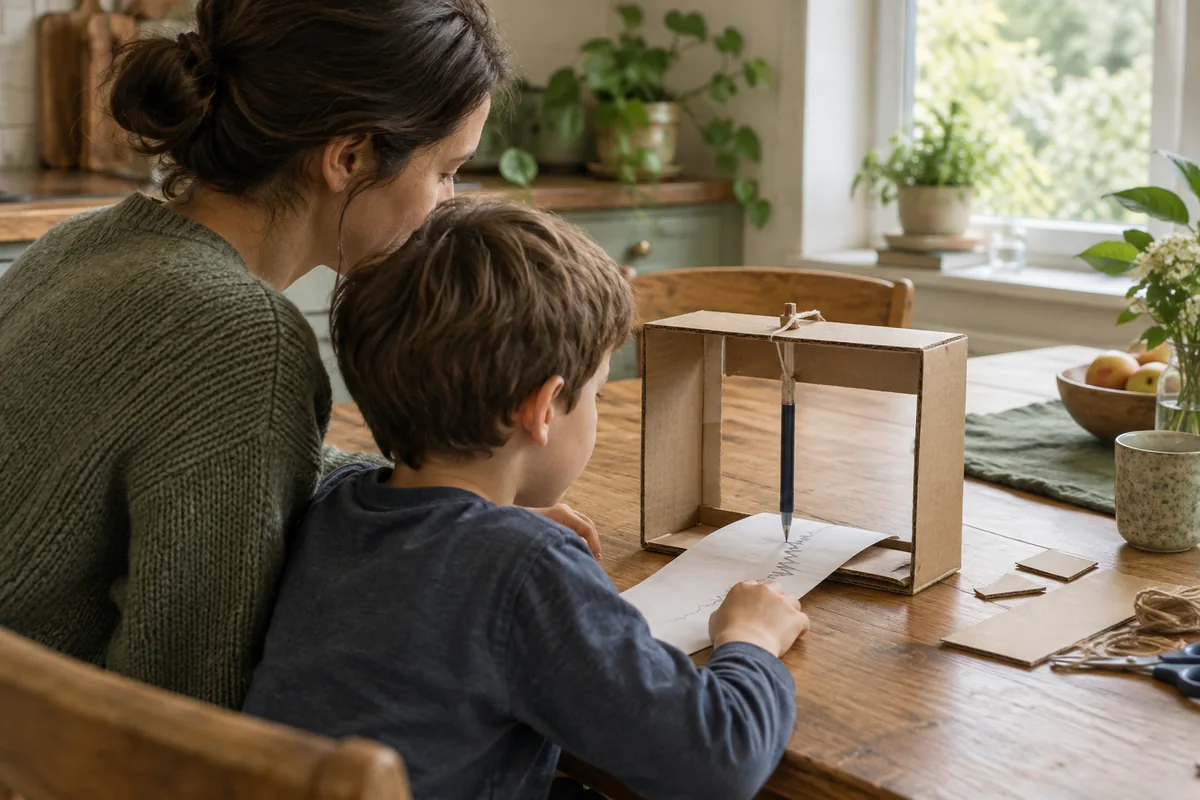
The clearest moment came one Sunday afternoon. Her eldest was asking all about earthquakes, so the two of them started building a simple seismograph from an old cereal box and a pen. Partway through, Teresa caught herself thinking: why am I doing school on a Sunday? On a Wednesday, the same afternoon would have felt like perfect child-led learning. “The timetable was in my head,” she says.
Emily, who co-hosts our podcast and home educates her girls, has watched boredom change over time. At the start it can feel like an emergency you are responsible for fixing. Now her girls are rarely bored, and some of their best creations, from cardboard cameras to boats, have come out of quiet afternoons with nothing planned.
A child’s questions do not always arrive on a timetable. That does not mean parents must be available every moment; rest and boundaries matter to grown-ups, too.
Try a one-line notebook
For one week, write down one thing your child did, asked, noticed or made each day. You might note the recipe they helped read, a question about the weather, a game they explained, or a book you enjoyed together.
At the end of the week, read it back. The notebook can help you see patterns and think about what to offer next. It isn’t a test or a required format, just a record that is useful to you. Teresa says she has never met a parent who read those pages back and found nothing.
Where this can get hard
A slower beginning can be worthwhile and still be difficult to arrange. A parent may be working, supporting more than one child, worrying about money or trying to find their own breathing space. A child may miss friends, need reliable structure, or feel angry that the familiar shape of their days has changed.
You do not have to make every day beautiful. It may help to ask another trusted adult to share a walk, meal or learning activity; arrange a regular call with a friend; or keep one predictable part of the day while experimenting with the rest. If a group is too much for now, a short visit with one familiar person can be a gentler beginning.
Boredom can be uncomfortable, too. Emily’s favourite reply is a question back: “Oh, that’s interesting. What are you going to do?” It hands the next move to your child without leaving them stranded. Sometimes a little space leads to an idea; sometimes a child needs help getting started, company, accessible materials or a clearer choice. You might ask, “Would you like some ideas, or would you like me to sit with you?” There is no need to leave a struggling child alone with boredom to prove a point.
For older children, exams or future plans can bring particular pressure. Listen to their priorities and look into exam options and deadlines together early, as some routes take planning. A child with SEND may need established support, predictable routines or professional advice alongside a flexible approach. Deschooling should not become a reason to withdraw support they rely on.
Deschooling and your responsibilities in the UK
Deschooling is a family word, not a legal one: your duty to make sure your child receives a suitable education carries on from day one. That doesn’t mean the first month has to look like school. It means being able to describe what you are offering and how you are developing it. The rules differ across the four UK nations.
England
GOV.UK’s home-education guidance says parents must make sure their child receives a full-time education once they reach compulsory school age (from the term after their fifth birthday), and that the council can make informal enquiries about whether that education is suitable. You don’t have to follow the National Curriculum; we explain more in Do you have to follow the National Curriculum when home educating?
The Children’s Wellbeing and Schools Act 2026 became law on 29 April 2026. As its home-education measures come into force, councils will keep a “Children Not in School” register that parents will need to provide information for, and some children (for example, those subject to child-protection enquiries) will need council consent before they can be taken off a school roll. These parts depend on regulations and statutory guidance that are still being consulted on, so check GOV.UK for what applies when you start.
If the council contacts you, explain the education you are actually providing: your child’s needs, your approach, the resources and opportunities you are using, and how you plan to review and develop them. Your one-line notebook can help you remember real examples. The word “deschooling” on its own won’t explain your provision, so describe what your days actually hold, and seek informed local advice if you are unsure.
If your child is still registered at a school, or attends a special school, check the withdrawal rules before the transition formally begins. The Department for Education’s elective home education guidance for councils is a useful starting point.
Wales
Wales shares much of its home-education law with England but has its own elective home education statutory guidance. The Welsh Government has also explained which parts of the 2026 Act apply in Wales.
Scotland
If your child attends a state school in Scotland, you will usually need the council’s consent to withdraw them. The Scottish Government’s home education guidance sets out the process and what councils look for.
Northern Ireland
Home education is a legal option in Northern Ireland. The Education Authority’s elective home education page explains deregistration and what to expect.
How do you know when to add more structure?
There is no bell to announce that deschooling is finished, but there are signs, and you will usually see them in your child first.
- The real questions come back. They ask freely and out of curiosity, not the wary “is this a test?” kind.
- Projects appear that nobody assigned. A den, a comic, a sudden obsession with volcanoes or aeroplanes.
- Things settle. Sleep evens out, prickliness softens, and they start telling you what they have noticed.
- They ask for more shape. Some children want a predictable plan, a regular subject or a project to work towards.
Then you will see it in yourself. The ten o’clock panic quietens. You stop translating every activity into school subjects to justify it. And one day you catch yourself planning something, perhaps a book to read together, a place to visit or a curriculum to try, not because you are scared but because you are excited. As Teresa puts it on the podcast, deschooling ends when you start building from curiosity instead of fear.
It can also go the other way: you may notice that an activity consistently causes distress, or that the lack of routine is leaving everyone unsettled. That is useful information too.
When you are ready, add one thing at a time: a regular library visit, a short maths session at a comfortable time of day, or a book chosen together. Agree when you will check in, and change it if it doesn’t fit. If you are weighing up resources, our guide to choosing a home education curriculum may help. Emily describes whatever you build next, whether structured, wonder-led or a bit of everything, as being “built on rested ground”. Structure and gentleness can sit quite happily side by side.
If you have been home educating for a year or two and realise you have been running on worry, Teresa’s advice is to pause and deschool now: give yourself permission to breathe and rebuild from curiosity. It is never too late to slow down.
Frequently asked questions
Is deschooling legal in the UK?
Yes. Home education is legal in all four UK nations, and deschooling is simply one way of beginning it. Your duty to provide a suitable education applies from the start, and the steps for leaving school differ by nation. In Scotland, for example, you usually need the council’s consent to withdraw a child from a state school.
What happens if my child doesn’t go to school?
If your child is of compulsory school age and not in school, you are responsible for making sure they receive a suitable education at home. In England, the council can make informal enquiries and, if it isn’t satisfied that a suitable education is being provided, can ultimately issue a school attendance order. A simple record of what you do, like the one-line notebook, makes your approach easier to explain.
Can we use a curriculum during deschooling?
Yes. Some children find familiar materials or a clear plan reassuring. Others prefer to introduce resources gradually. There is no need to reject a helpful resource simply because your family is adjusting. Our guide to choosing a home education curriculum walks through the options.
What if my child only wants to play or use screens?
Start by understanding what they are enjoying or finding comforting, then talk together about a balance that works alongside sleep, movement and time with people. Play and screens can both involve real learning. If you are worried about your child’s wellbeing, speak to your GP or another professional.
What is the difference between deschooling and homeschooling?
Homeschooling, or home education, is the whole arrangement of learning outside school. Deschooling is the settling-in season at the start of it, when the family adjusts before deciding what home education will look like for them.
Where The Wonder Curriculum fits
We create home-education resources, so we have a natural interest in families exploring them. You do not need to buy a curriculum to begin adjusting or to use the ideas in this article. If, in time, a gentle, curiosity-led resource feels useful, our Wonder Lessons may be one option to explore. You can also hear Teresa and Emily talk through everything in this guide on Come and Wonder, our podcast. If your child needs a different approach or more formal specialist support, another choice may fit better.
Sources and further reading
- Educating your child at home — GOV.UK
- Elective home education guidance — Department for Education
- Deschooling: how to deschool your child and you — BBC Bitesize
- Deschooling — Educational Freedom
- Children’s Wellbeing and Schools Act 2026 — legislation.gov.uk
- Elective home education statutory guidance — Welsh Government
- Home education guidance — Scottish Government
- Elective home education — Education Authority Northern Ireland
- School’s out — Dr Naomi Fisher, The Psychologist (BPS)
Legal information checked 17 November 2026. Check the latest guidance for your UK nation and your individual circumstances.