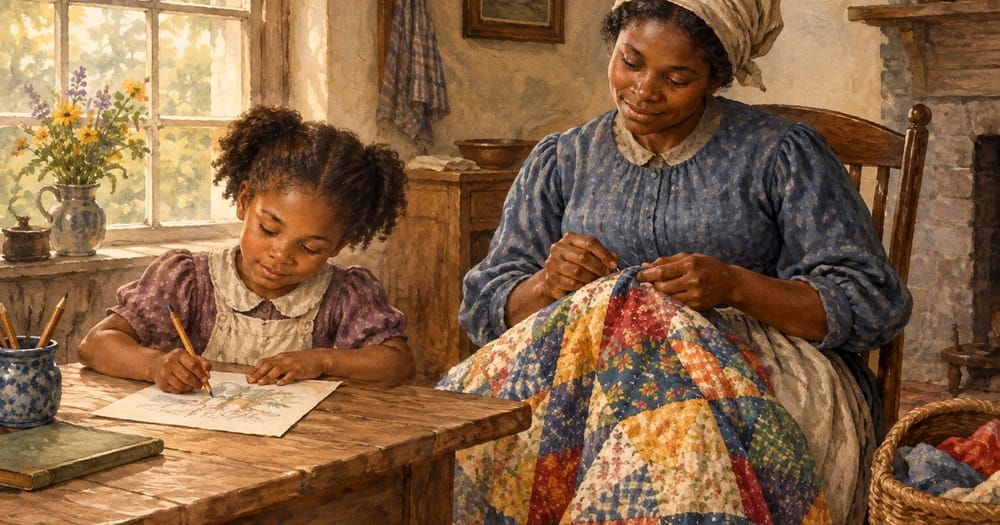
Imagine describing someone you know in just one word. You might call them a reader, a neighbour or a friend. Each word tells you something—but would it tell you everything?
Of course not. People have stories, relationships, thoughts and talents that cannot fit inside one small description. That is worth remembering when we talk about people in history, too.
What does “enslaved person” mean?
An enslaved person is someone who has been held in slavery by other people. In the United States during Frederick Douglass’s lifetime, slavery was a system in which people were treated as property. Enslaved people were forced to work, denied basic freedoms and could be bought and sold. Families could be separated. This was a terrible injustice.
Slavery existed in other places and times too, and its history is not the same everywhere. Here, we are looking especially at the American history connected to Frederick Douglass.
The word enslaved describes a condition imposed on someone. It does not tell us everything about the person living through it. That person might also have been a parent, a child, a skilled craftsperson, a friend, a storyteller or someone with ideas and beliefs of their own.
Why do some people prefer “enslaved person” to “slave”?
For a long time, many books described a person who was enslaved simply as a “slave”. You will still come across that word in historical sources and modern writing.
Today, some historians, museums and teachers choose “enslaved person” in their own explanations. They want to make clear that enslavement was not someone’s natural identity. It was something other people forced upon them.
The Frederick Douglass National Historic Site, for example, uses this language because it helps keep the individual’s humanity in view. It also reminds us that systems of enslavement were created by people—and could be challenged by people.
There is no single word that can tell a whole life story, though. And not every historian makes the same choice in every context. Instead of treating a phrase as a magic rule, we can ask why a writer has chosen it and what their words help us see.
Who did the enslaving?
You may also hear the word enslaver. It describes a person who held another person in slavery.
That word gives us another question to ask. If someone was enslaved, who had the power to do that? Who benefited from their forced work? Which laws and choices allowed the injustice to continue?
Those questions matter because slavery did not simply happen on its own. People created, defended and profited from the system. Other people resisted it and worked to bring it to an end.
Frederick Douglass was more than one label
Frederick Douglass was born into slavery in Maryland. As a child, he wanted to learn to read and write, even though people tried to stop him. In his own account, he described sharing bread with hungry boys he met in the street, who helped him learn his letters in return. You can read more about how Frederick Douglass learned to read, or follow his story in our Bread for Words lesson.
As a young man, he escaped with help from Anna Murray. Later, he wrote about his life, spoke against slavery and published a newspaper called The North Star. He also campaigned for women’s rights.
Calling Douglass an enslaved person helps us name an important truth about what happened to him. Calling him a writer, a speaker or a campaigner tells us something else. Neither list replaces his own story, but together these details help us see more of his life.
We should not leave out enslavement to make the story more comfortable. Nor should we let it be the only thing we learn about him.
What if an old book uses a different word?
A historical source might use language that a writer today would choose differently. Frederick Douglass used the word “slave” in his own account, and he also wrote about his “enslavers”. His words belong to his story and the time in which he wrote.
We do not need to pretend older words never existed. A quotation or a document can help us understand how someone described their own experience, or how others saw the world. But it helps to read carefully: who wrote it, when, and what could they see—or leave out?
Some historical sources contain upsetting descriptions or language. A grown-up can preview them, choose what to share and talk through any questions with you.
Three questions to keep nearby
When you read about a person in history, try asking:
- What does this description tell me—and what does it leave out?
- Does it help me understand who held power and what happened?
- Am I reading the person’s own words, or someone else’s description of them?
You will not always have every answer. Sometimes a good question is a place to begin looking.
Down the rabbit hole: Whose words survive?
Douglass left books and speeches that let us hear something of his own voice. But not everyone had the same opportunity to write, publish or have their words preserved.
Historians also look at letters, photographs and records made by other people. Each source can offer a clue, but each has limits. A record made by someone with power may tell us more about what they wanted to record than about the whole life of the person named in it.
If you found an old photograph with no names on the back, what would you want to know? Where might you look for another clue?
Try it yourself: A person is more than one word
With their permission, write the name of someone you know in the middle of a sheet of paper. Around it, add three things they enjoy, do or care about.
Show them what you have written. Is there something they would change or add? What did you discover by listening to their answer?
This activity is about noticing the many parts of a person’s life. It is not a simulation of enslavement.
Is it wrong to say “slave”?
Not always. The word appears in historical documents, in quotations and in Douglass’s own writing, and you will still meet it in books today. Many historians, museums and teachers choose “enslaved person” when they describe people in their own words, because it puts the person first. What matters most is noticing why a word was chosen and what it helps us understand.
The big takeaway
Words can help us slow down and look more carefully. Saying “enslaved person” is one way to name an injustice while remembering the human being who lived through it.
The next step is to keep listening, asking and learning about that person’s life—not just the label beside their name.
Sources and further reading
- Language of Enslavement — Frederick Douglass National Historic Site — explains the site’s language choices; for grown-ups, with descriptions of severe violence.
- Frederick Douglass — National Park Service — an overview of his life and work.
- Douglass’s own account — chapter VII — a primary source for grown-ups; contains distressing content and historical language.
- Historians discuss the language of slavery — Royal Historical Society — a scholarly discussion for grown-ups.
Curious about the rest of his life? Read our companion article, Who Was Frederick Douglass?