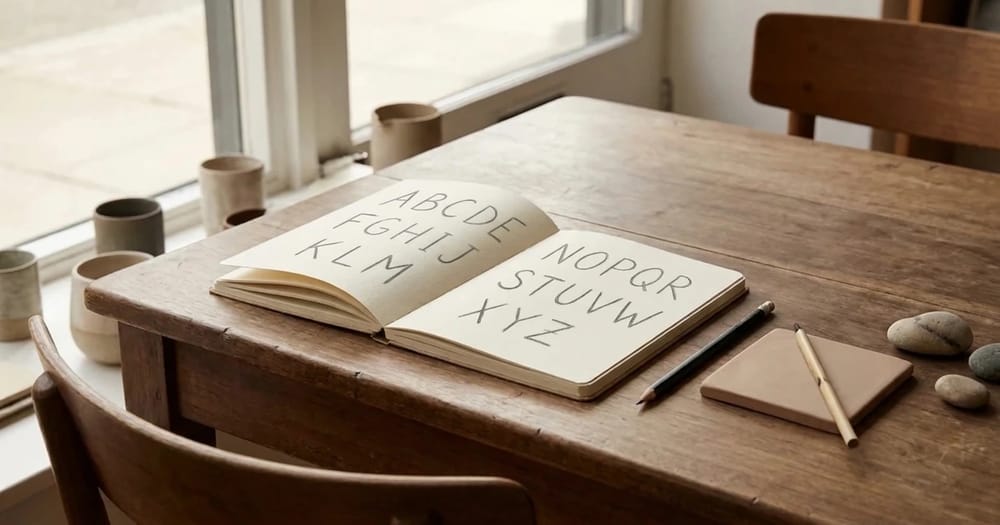
Write a capital A on a piece of paper.
Two sloping lines. One little bridge across the middle. Nothing especially mysterious.
Now turn the paper upside down. Can you imagine a face with two horns?
That familiar letter has a rather unexpected ancestor: a picture of an ox’s head. Your pencil has just drawn a tiny clue to a story thousands of years long.
So who looked at those pictures and thought, What if we could write with just a small collection of sound signs?
Let’s follow the letters backwards.
People could write before they had an alphabet
Writing and alphabets are not quite the same thing.
An alphabet uses a small collection of signs to represent the basic sounds of a language. We combine those signs to write words. Other writing systems can organise language differently, using signs for whole words or larger chunks of sound.
Long before our alphabet took shape, people were already writing with Egyptian hieroglyphs and Mesopotamian cuneiform. Cuneiform signs were often pressed into clay with a reed; their marks look like little wedges.
Egyptian hieroglyphs can look like a collection of tiny pictures, but they were not simply drawings of things. They could represent sounds as well as words. A bird-shaped sign did not always mean “bird”. Its job depended on how it was being used.
The important change behind early alphabetic writing was therefore not the discovery that a mark could represent a sound. Earlier writers already knew that. It was organising writing around a much smaller set of signs for individual sounds.
And an alphabet is not the only good way to write. Chinese writing, for example, has its own long and successful history. Different writing systems are different solutions to the wonderful problem of putting language somewhere outside our heads.
Where did the alphabet come from?
Some of the most important clues come from Egypt and the Sinai Peninsula, the piece of land between Egypt and the eastern Mediterranean.
At a place called Serabit el-Khadim, near ancient turquoise mines, archaeologists found unusual signs alongside Egyptian writing. Other early alphabetic inscriptions were found at Wadi el-Hol, in Egypt.
The unusual signs resembled Egyptian pictures, but they were not ordinary Egyptian writing. Scholars connected them with people who spoke Semitic languages: a family of languages that includes Hebrew and Arabic today.
A leading explanation is that ancient Semitic-speaking people borrowed familiar Egyptian signs and gave them sound values based on words in their own language. Exactly who did this, where it first happened and when are still debated. The popular idea that a particular group of miners invented everything is a theory, not a fact we can pin down with someone’s name and birthday.
There is another intriguing clue, too. Small clay cylinders found in a tomb in Syria may contain alphabetic writing from around 2400 BCE. That means roughly 4,400 years ago. If the signs are alphabetic, they could push the story further back than the Egyptian and Sinai evidence usually discussed.
Researchers are still working out what the marks mean and how they fit into the story. We should not quietly turn “may be” into “definitely is”.
Sometimes the most interesting answer begins with: We have some good clues, but we are still looking.
How did an ox become the letter A?
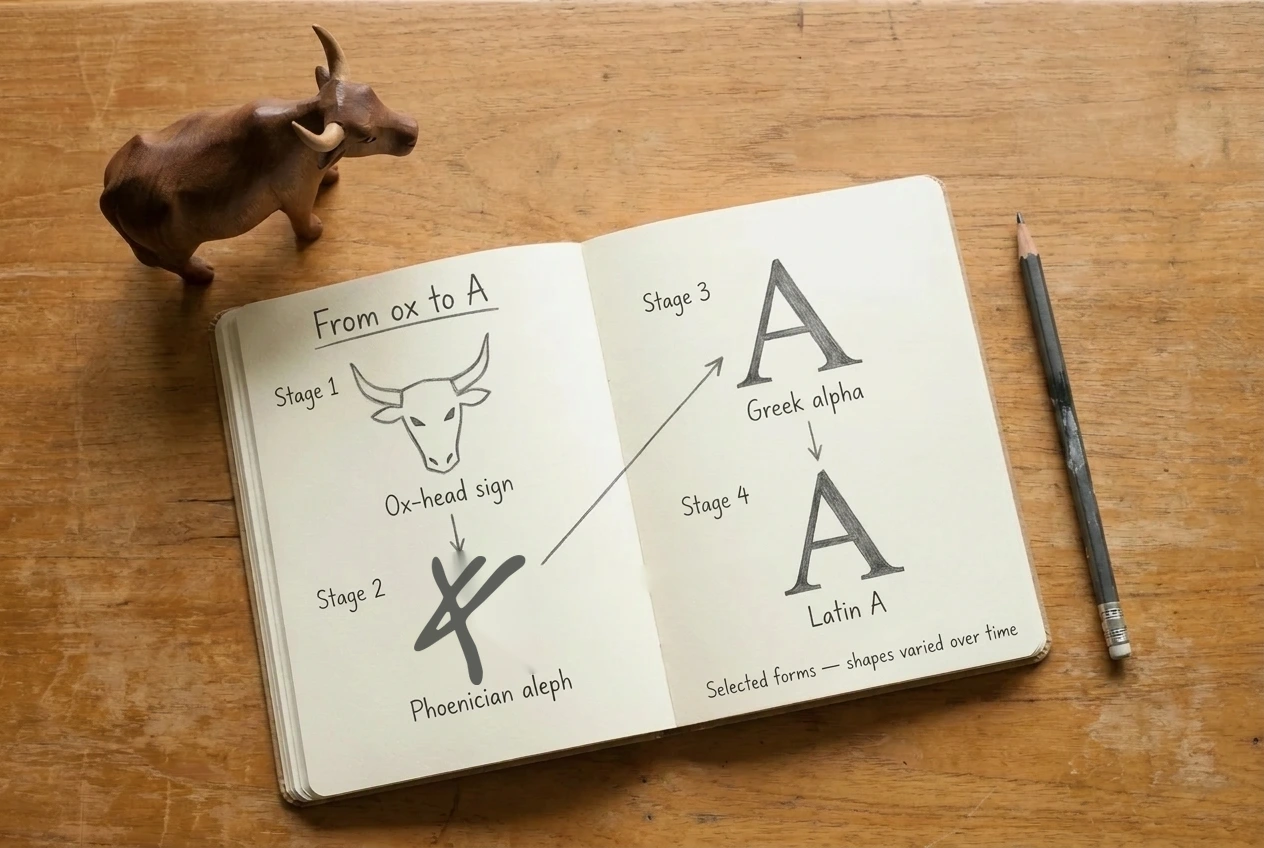
Imagine making a writing system from pictures of things around you.
You could draw a fish, then decide that your drawing stands for the first sound in fish: “f”. Now you can use that sign whenever you need that sound, even in a word with no fish in it.
That is an example of a principle called acrophony: using the first sound of a thing’s name.
Early alphabet makers used a similar idea, but with words in their own language, not English. A picture of an ox’s head represented the first consonant of the ancient word behind the letter name aleph. That sign eventually became the ancestor of our A.
Here is the important twist: it did not originally represent the “a” sound in apple. Its sound changed as different people adapted the sign.
Another sign was based on a house. Its ancient name, bet, is connected with a word for “house”, and its first sound was “b”. That sign belongs to the family history of our B.
Over many changes, the pictures became less picture-like. Their shapes turned, straightened and grew more abstract.
Turning your A upside down helps you imagine its ancestry. It is not a complete history lesson in one movement, though: real letters changed through many forms, not one neat flip.
What did the Phoenicians and Greeks change?
You may have heard that the Phoenicians invented the alphabet.
They were enormously important to its history, but they inherited earlier alphabetic traditions rather than starting from nothing.
The Phoenicians lived along the eastern Mediterranean coast. Their traders helped spread their writing around the Mediterranean. Their system had 22 letters, representing consonants, and was written from right to left.
Consonants include sounds such as “b”, “m” and “t”. Vowel sounds are the ones we write with letters such as A, E, I, O and U.
Try reading “ct”. Did you think of cat, cot or cut? With a whole sentence around it, you might have a better clue. That is only a little English experiment, not a full explanation of how Phoenician worked, but it helps you notice what vowel letters contribute.
When the Greeks adapted the Phoenician system, they used some signs for vowel sounds. The ancestor of A became the Greek vowel letter alpha.
People were not merely passing on an unchanged parcel. They were altering the contents to suit the languages they spoke.
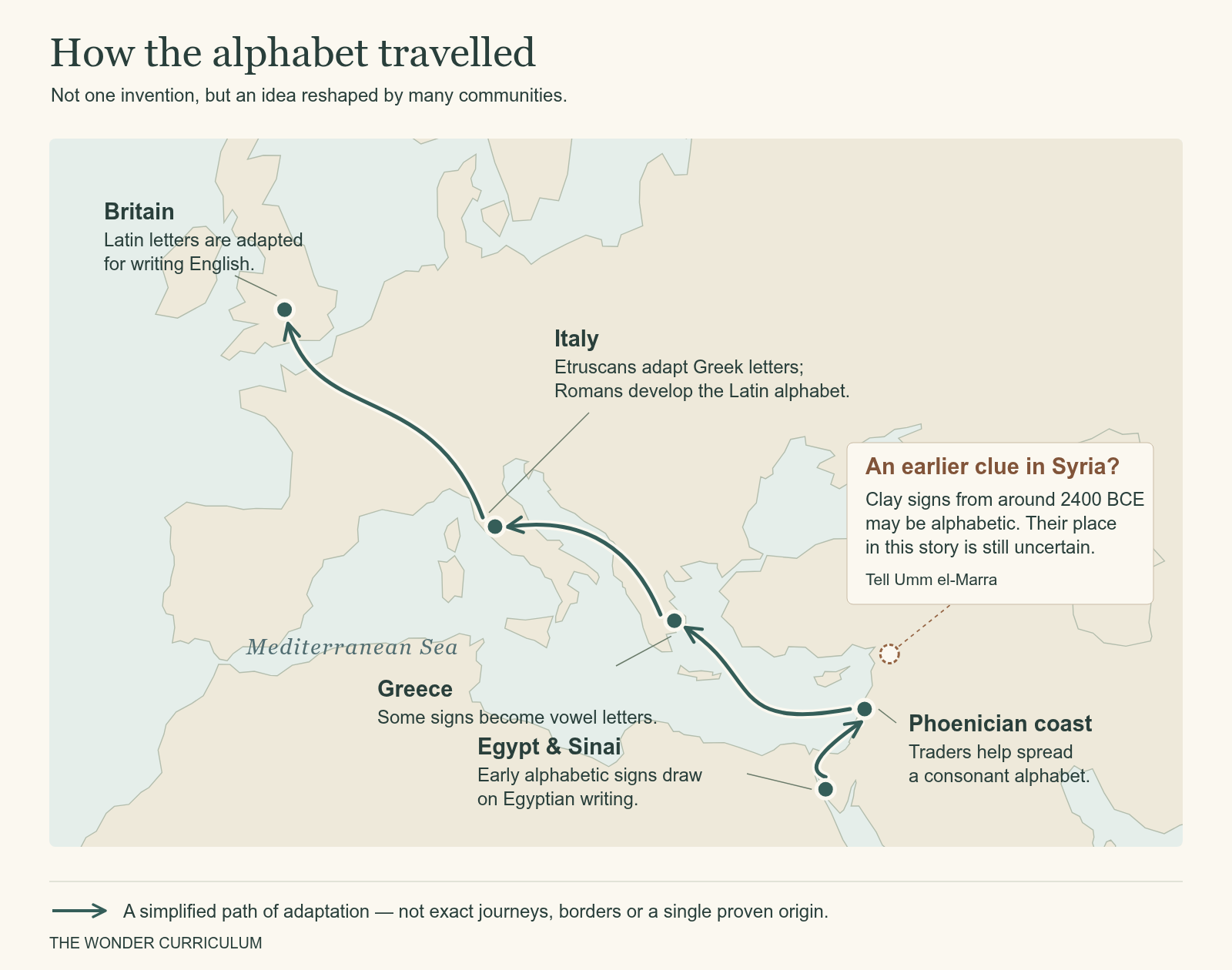
How did those letters reach English?
The story carried on through other communities, including the Etruscans in ancient Italy and then the Romans.
The Romans adapted an alphabet for writing Latin. This Latin alphabet is the ancestor of the letters used for English today.
But the Romans did not hand over a finished set of English ABCs.
As people used Latin letters for English, the collection changed. Medieval English also used some signs you would not find in today’s usual alphabet, including þ, called thorn, for a “th” sound. Letters were added, adapted or dropped over time.
Even W has a clue tucked into its name. Say it slowly: double-u. The letter developed from a doubled u form, although a capital W now looks more like two Vs joined together.
The alphabet you learn today is therefore not one person’s invention, completed in a single afternoon. It is something many generations have inherited and changed.
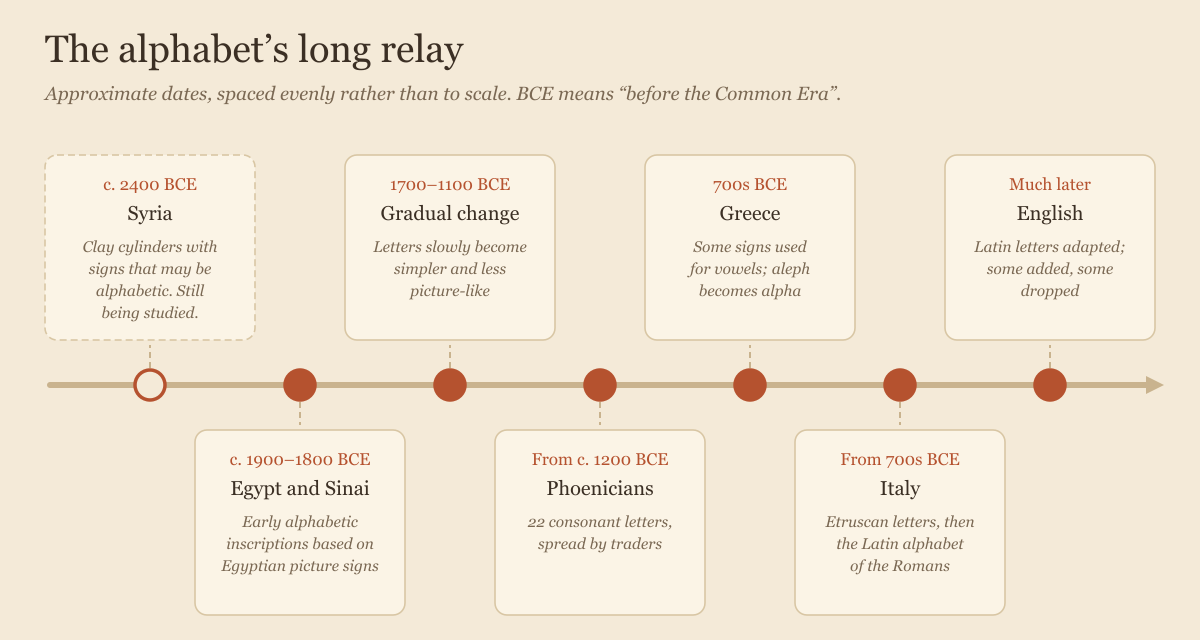
Here is the whole relay at a glance.
Wonderfully weird things hiding in your ABCs
- “Alphabet” has its own ABC beginning. Remember aleph, the ox, and bet, the house? Those early letter names became alpha and beta in Greek. Put the Greek names together — alpha + beta — and you can hear where our word alphabet comes from. Even its name carries a little piece of the letters’ journey.
- M has a watery past. The ancient sign behind M was connected with a word for water. Those zigzags have a much longer story than a quick pencil stroke suggests.
- R has a head in its family tree. A human-head picture was used for the first sound of an ancient Semitic word for “head”, helping explain the ancestry of R.
- Letters have not always travelled across a page in your usual direction. Phoenician writing ran from right to left. Left-to-right reading is familiar to English readers, but it is not a rule that all writing follows.
Down the Rabbit Hole: why is the alphabet in that order?
If people changed the letters, could they change their order too?
Yes. In fact, ancient evidence shows that more than one alphabetic order existed.
Much of our familiar sequence was inherited from older alphabets. But a clay tablet from Beth Shemesh preserves a different order, beginning with signs scholars describe as h-l-ḥ-m, rather than the ancestral sequence behind our ABCD.
A written-out alphabet like this is called an abecedary. It is rather like an ancient alphabet list for learning or reference.
That gives us a lovely distinction. We can trace the history of an order without knowing exactly why the earliest people chose it. The original reason for the arrangement remains uncertain; we should not invent a tidy story to fill the gap.
Imagine learning your letters in a different order. Your alphabet song would need some rearranging, but the words you could write would not disappear.
Try It Yourself: invent a tiny sound alphabet
You do not need to invent a whole writing system. A few sounds are enough to explore the idea.
You will need paper, a pencil and someone willing to exchange a small message.
- Choose a word such as “map”. Say it slowly and listen for its three sounds: “m”, the short vowel sound in map, and “p”. You are listening to the spoken word, not just naming its letters.
- Give each sound a sign. Perhaps a curl, a forked line and a small square. These are your own inventions, not copies of ancient writing.
- Make a key together. Draw each sign and agree on the sound it represents. Keep the key where your reader can see it.
- Write and decode. Use your signs for map, then rearrange them to try Pam. Can your partner work it out without you saying the word?
- Add one sound when you need it. To write mat, invent a sign for “t”. Change one sign and see how the word changes.
Now swap jobs. Let your partner write something for you.
What made a sign easy to recognise? Did two signs look too similar? Did you need to agree which direction to read?
You have not recreated the first alphabet. You have explored some of the choices a writing system needs: signs, sounds and a shared understanding of how to use them.
The Big Takeaway
Look at your A again.
It is still two sloping lines and a little bridge. But now there is an ox behind it, and a trail leading through different languages, places and generations.
We cannot name the first alphabet makers. We can notice how much we have inherited from them, and from the many people who changed their idea.
The next time you write your name, pause over one letter. Something you do almost without thinking has a history people are still piecing together.
What else might be hiding in plain sight?
Sources and Further Reading
- The Metropolitan Museum of Art: Alphabet Origins — From Kipling to Sinai — the picture origins of A, B, M and R.
- Encyclopaedia Britannica: Alphabet — how alphabets work and how Greek vowel letters changed the story.
- Penn Museum: The Alphabet — early evidence, debated origins and alternative letter orders.
- Johns Hopkins University: Ancient alphabetic writing in Syria — the clay cylinders that may push the story further back.
- Encyclopaedia Britannica: Phoenician alphabet — the Phoenicians’ letters and writing direction.
- HistoryExtra: When did the English alphabet first exist? — how the letters used for English changed.
- Encyclopaedia Britannica: Etruscan alphabet — the link between Greek and Latin letters.